
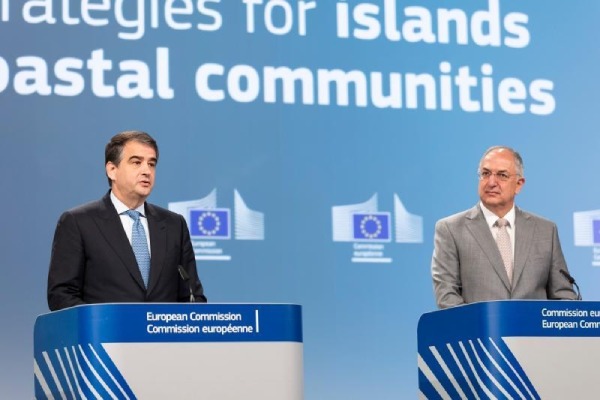
The European Commission on Wednesday unveiled its first dedicated strategies for islands and coastal regions, bringing together existing and future policy measures aimed at addressing the unique challenges faced by these areas across the European Union.
The strategies were presented in Brussels by Fisheries and Oceans Commissioner Costas Kadis and Executive Vice-President Raffaele Fitto following a meeting of the College of Commissioners.
Both strategies will be formally launched on June 26 in Paphos in cooperation with Cyprus’ presidency of the Council of the European Union.
Presenting the strategy for coastal regions, Kadis said coastal areas range from small fishing villages to major port cities, making tailored local solutions essential.
“These communities are characterised by great diversity, which requires localised responses rather than a one-size-fits-all approach,” he said.
The strategy, announced under the framework of the European Ocean Pact, covers approximately 95 million people living along 70,000 kilometres of coastline across 22 coastal EU member states.
According to the commissioner, coastal regions generate around €265 billion in gross value added annually, while facing growing pressures from climate change, pollution, tourism imbalances and demographic decline.
“They are vital for maritime trade, tourism, fisheries, renewable energy, cultural heritage and security, as many of them form the EU’s maritime borders,” he said.
The strategy is built around three pillars – prosperity, resilience and sustainability – supported by 13 flagship actions.
Under the prosperity pillar, measures include diversifying the sustainable blue economy, promoting dual-use fishing vessels that can also be used for fishing tourism, developing certification methodologies for blue carbon credits and supporting innovations in the blue bioeconomy, such as algae-based fertilisers.
The resilience pillar focuses on advanced digital capabilities for monitoring, simulations and scenario planning. It also promotes greater involvement of coastal stakeholders, including fishermen, port authorities and local maritime operators, in maritime surveillance through voluntary reporting of suspicious activities at sea.
Addressing the sustainability pillar, Kadis acknowledged that the impact of “asymmetrical” tourism on coastal and island communities remains a complex challenge.
“If we had already done enough, we would not need a strategy or additional measures to address and balance tourism pressures,” he said, adding that specific actions are included to tackle the issue.
Asked how Cyprus would benefit from the strategy, Kadis said all measures could be utilised by the island.
He highlighted the proposal allowing fishing vessels to be used for tourism activities as an example originating partly from Cyprus.
“This is an idea we received from Cyprus, from the Greek islands and from other parts of Europe,” he said.
He noted that existing regulations often make it difficult or impossible for fishermen to use their vessels for tourism purposes, depriving them of an important supplementary source of income.
The commissioner also pointed to opportunities for Cyprus in innovation, digitalisation and offshore renewable energy, sectors in which the island has already developed significant expertise.
Fitto presented the first-ever EU strategy specifically targeting islands, covering all islands across 16 member states with a combined population of around 17 million people.
This includes the three island member states – Cyprus, Ireland and Malta – which together account for 6.6 million inhabitants.
The strategy is structured around four pillars: economic development, connectivity, competitiveness and innovation; energy security, environmental protection and climate resilience; communities, demographics and quality of life; and security and crisis preparedness. Governance will serve as a cross-cutting element throughout the framework.
For Cyprus specifically, the strategy recognises that although the country’s GDP per capita is broadly in line with the EU average, stakeholders highlighted structural economic constraints linked to insularity and the limited size of the domestic market.
The island is also explicitly classified as a “remote area” under the General Block Exemption Regulation (GBER), allowing it to benefit from state aid measures supporting air and maritime transport services and higher aid intensity rates for airports and ports.
“This is the first time we are presenting a strategy dedicated to islands, and it represents a clear commitment from the European Commission,” Fitto said.
He added that extensive consultations had taken place with stakeholders and local authorities, and that he had personally visited numerous island regions where the issue was of critical importance.
Fitto said that €12.5 billion has been allocated to islands during the current 2021-2027 programming period.
He added that resources mobilised through the mid-term review of cohesion policy have already been directed towards competitiveness, housing, energy and water infrastructure.
Looking ahead to the next multiannual financial framework, he said the strategy would serve as a key tool for member states within the new budget structure, integrating cohesion, agriculture and fisheries policies into national and regional partnership plans.
“The approach is comprehensive,” he said, noting that the Commission is coordinating work across multiple portfolios to ensure a more integrated response to island challenges.
On decarbonisation and exemptions under the EU Emissions Trading System (ETS), Kadis said the Commission would pay close attention to the situation of European islands during upcoming reviews of the ETS, alternative fuels infrastructure rules and FuelEU Maritime legislation.
For the first time, the strategy also introduces a detailed assessment of the “cost of insularity”, drawing on a new OECD study.
According to the findings, transport costs on islands can exceed mainland levels by more than 300 per cent, local government spending per resident can be 30 to 50 per cent higher, while housing prices in some island municipalities can be between 75 and 130 per cent above mainland averages.
In Sardinia, the economic cost associated with insularity may reach up to 36 per cent of GDP per capita.
The Commission announced that it will carry out a comprehensive analysis of the cost of insularity and identify the most effective policy responses, particularly in the transport sector.



Click here to change your cookie preferences