
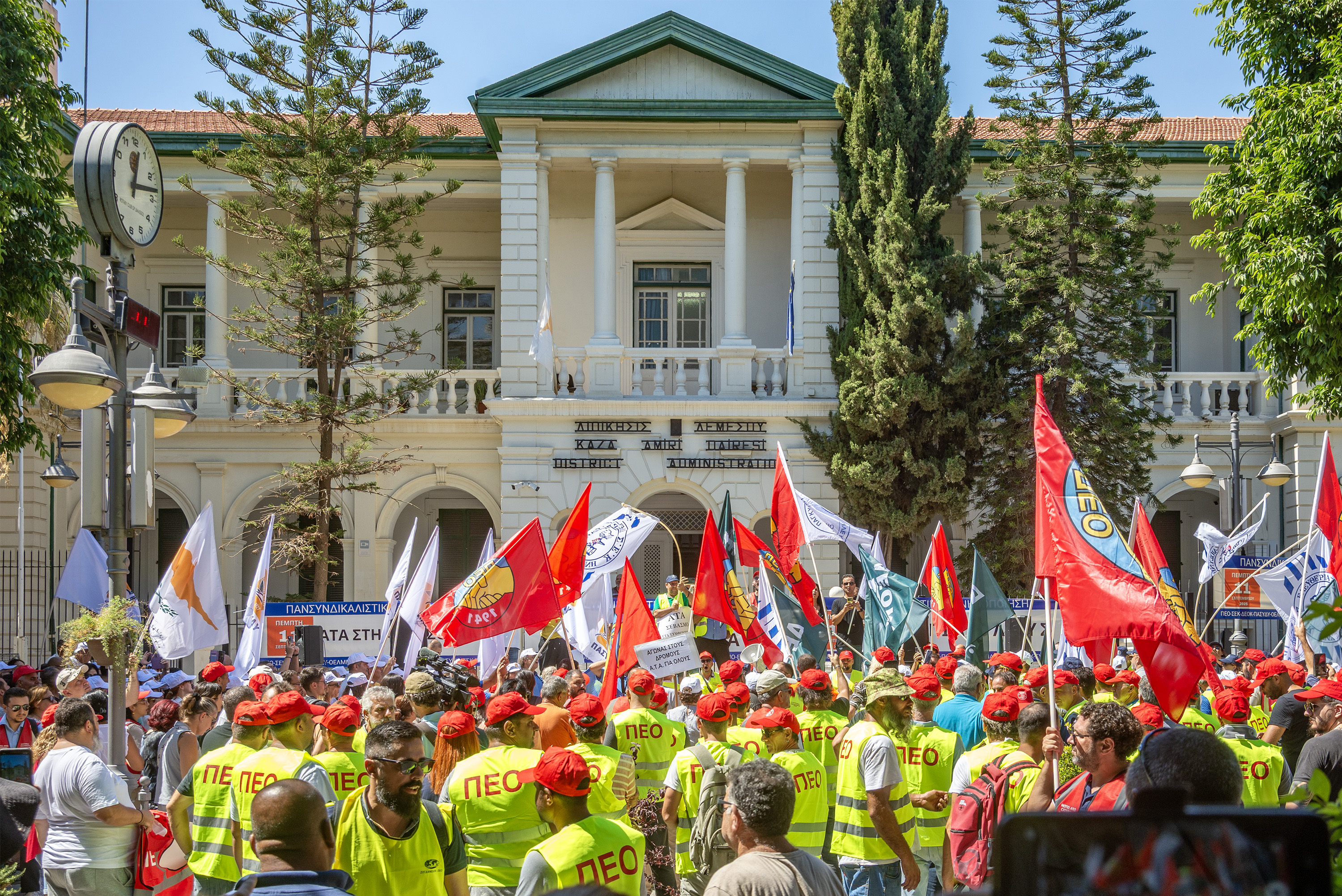
Trade union Isotita on Thursday demanded the abolition of the upper limit to the proportion of a worker’s salary which can be added on to it through the cost-of-living allowance (CoLA), saying that prices have already risen by more than that amount since the start of the year.
A deal struck by trade unions, the government, and employers’ organisations last November introduced a ceiling of four per cent of a worker’s salary in the amount payable, but Isotita was not present at those negotiations, and made clear its dissatisfaction with the arrangement.
“Isotita was excluded from the negotiating table, just as it was excluded from cooperation with other unions,” it said.
Having called for the abolition of the four-per-cent ceiling, the union also demanded that the rate payable be recalculated and that a fresh payment rate be introduced from the beginning of next month.
At present, the rate payable is based on a proportion of the increase in the cost of living in the previous year, with that proportion having been set at 80 per cent for the first half of this year and 90 per cent for the second half of this year.
For example, if the cost of living increases by four per cent in a year when the proportion is set at 80 per cent, workers will receive a boost of 3.2 per cent to their salaries in CoLA payments. Were the same proportion to be applied and the cost of living increased by 17 per cent, the amount of CoLA payable would be four per cent, due to the ceiling.
However, Isotita argued that as the cost of living has risen at an accelerated rate in the first half of this year compared to last year, the rate of which the proportion should be calculated should also be increased.
This, it said, must happen “so that the dead zone can be closed”.
It also argued that given this increase in the cost of living, workers should be retroactively recompensed for that.
Returning to the matter of the rate payable being re-calculated, the union pointed out that between 1977 and 2013, the rate was re-calculated in January and July each year, rather than once a year, as it is now.
It then demanded that the “practices and studies which were presented to the parties” before the signing of last year’s deal be published.
Last November’s deal saw the rate payable rise from the previous 66.7 per cent to 80 per cent of the increase in the cost of living as a percentage of a worker’s salary in the first half of this year and 90 per cent in the second half of the year. It will rise again to 100 per cent of that rate on January 1 next year.
At the time, President Nikos Christodoulides said that “reaching an agreement was not easy” and that “convergences and compromises were needed”, concluding that as such, “this is the product of maturity and mutual respect between the social partners”.
Trade union Deok leader Stelios Christodoulou said that trade unions had been both united and fair, and that “this is why we have a result today, which, under the circumstances, we consider to be quite satisfactory”.





Click here to change your cookie preferences