
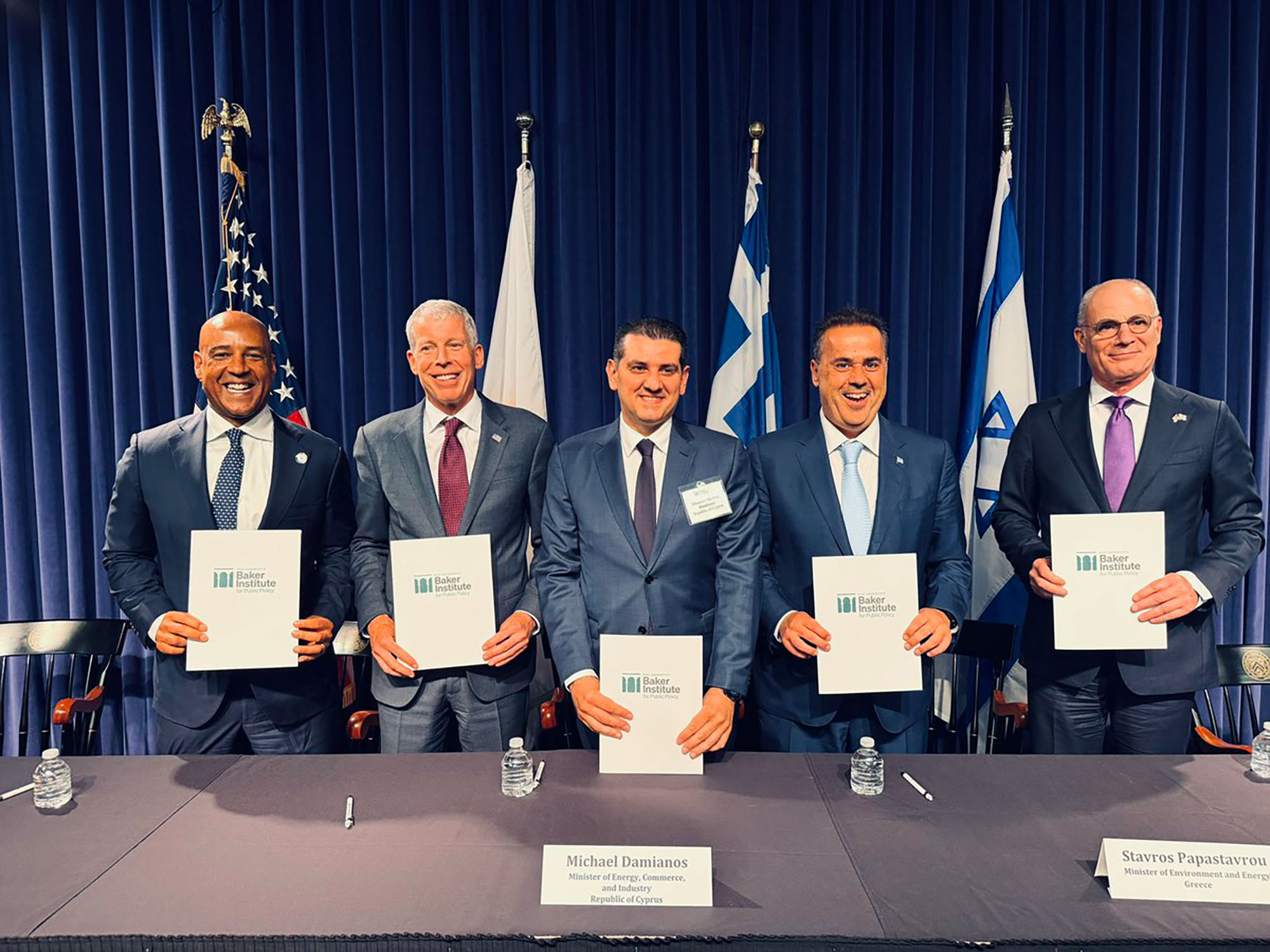
Another instalment of the 3+1 energy dialogue of Cyprus, Greece and Israel plus the United State took place on Thursday at Rice University in Houston. Like previous, such meetings, it dealt with the intentions and plans of this cooperation without producing much of practical value.
The energy ministers of the US, Cyprus, Greece and Israel’s ambassador, according to a Cyprus News Agency report, “expressed the intention to proceed with a series of regular contacts at the level of service working groups, with the aim of formulating a road map of cooperation of the 3+1 energy dialogue.” The purpose of the road map “is to record targets and actions in the fields of common interest that were discussed in the 3+1 dialogue, including the utilisation, wherever necessary of the Eastern Mediterranean Energy Centre.” The Centre is based in the Baker Institute of Public Policy of Rice University.
This 3+1 energy dialogue has been going on for years but does not have very much to show. On Thursday, however, the participants agreed on the establishment of a working group for cybersecurity and the “practical protection of vital infrastructure,” without making any other information available. In addition to this, according to an announcement, the ministers and the ambassador “discussed fields of common interest and continuing cooperation, including energy security, the development of natural gas resources, energy innovation, R&D as well as regional infrastructure and interconnectivity.”
Interestingly, the gathering underlined the importance of regional interconnectivity among Greece, Cyprus and Israel that could present business opportunities to US companies. They were referring to the Great Sea Interconnector that would bring electric power from Greece to Cyprus and subsequently to Israel. Funnily enough, the Cyprus government has been dragging its feet over this project, the finance minister publicly opposing it and President Christodoulides falling out with the project promoter – a company in which the Greek state has a stake – over it. He tried to fix things with Athens by seeking yet another feasibility study, about which nothing has been heard.
Perhaps there has been a change of heart, as Energy Minister Michalis Damianos told the meeting in Houston that “the lifting of energy isolation constitutes a strategic priority for Cyprus” and referred to the Great Sea Interconnector, which could operate as a platform of broader regional cooperation. Damianos has followed the line of his predecessor, who zealously supported the GSI, but what do the president and his finance minister think about it? Do they now support the GSI or will they be forced to do so because the 3+1 energy dialogue has underlined its importance? If it is the latter case, it would be the first practical result achieved by the 3+1 energy dialogue.




Click here to change your cookie preferences