
Meeting the home organiser transforming lives by turning clutter into calm, one cupboard at a time
A friend found it in their mailbox. A small brown envelope, unaddressed, seemingly promotional but sporting a handwritten message, the writing calligraphic in its symmetry and the obvious care taken: ‘A calmer home starts here’.
Inside – on thick, glossy cream-coloured paper, like a menu at the better class of restaurant – was the heading ‘CURATED SPACE CO. Luxury Home Transformation’ and a list of services offered, from ‘Space-saving folding & techniques’ to ‘Storage solutions’ and even ‘Decision-making support/Guidance through emotional or difficult decisions’.
‘Imagine opening your closet and finding everything beautifully arranged and effortless to reach,’ mused the menu, giving a number to call and finally making this promise: ‘A beautifully curated home where everything has its place. A refined, discreet, judgment-free process.’
The idea of paying someone to rearrange and organise your wardrobe (or kitchen, or pantry) might’ve seemed outlandish not long ago – the kind of caprice one associates with heiresses and footballers’ wives, women (it’s mostly women) with time on their hands. But things have changed, a trend led by various ‘organising consultants’ but especially Marie Kondo, a Japanese woman behind four bestselling books and an Emmy-nominated Netflix series, Tidying Up with Marie Kondo.
Two of Kondo’s books – Kurashi at Home and Spark Joy, both in Greek translation – stare up at me from the sofa in Nicoletta’s house on the outskirts of Nicosia, left there as if for inspiration.
Nicoletta is today’s client. She’s not an heiress, or a footballer’s wife (she actually works at a software company) – and she has a problem with her kitchen, specifically two problems. The first is that she can’t reach some of the cupboards. The second is that everything’s so full that she can’t find what she needs easily. Sounds like a job for Curated Space Co.
Andrie Alexandrou is Curated Space Co, having started the business just a couple of months ago, after 32 years as a bookkeeper. It wasn’t exactly a lifelong dream, just because she didn’t know it was possible till she discovered Kondo a few years ago – but it’s certainly something that fits her personality.
“I’ve just always liked being organised – in my house, my office, my closets,” she says, admitting that her passion for order is “to the point of being a little OCD. Like, if I’ve picked up a pair of scissors, and used them, I absolutely have to put them back in their place. I can’t just leave them there… Every object needs to have its home. Like we each have our own home.”
Her warm demeanour hides a painful story. In her early 40s (she’s now 52) she began having stiffness in her joints, especially the fingers and especially in the mornings. The stiffness spread, “then came excruciating pain”. It was rheumatoid arthritis, an autoimmune disorder – though doctors took years to diagnose it, leaving her in pain both physically and (since she didn’t know what was going on) spiritually.
Andrie’s body is a literal document of those painful years – because she decided to start getting tattoos, as a kind of distraction from the pain and also, perhaps, a creative riposte, turning herself into an artwork.
On one arm is the Archangel Michael, further down a plane-tree leaf to honour her heritage (she’s from Kakopetria). Her first-ever tattoo has the lyrics from ‘Carmina Burana’, a reminder of her dark mental state during those years: ‘O Fortuna, velut luna, statu variabilis… Vita detestabilis, nunc obdurat et tunc curat’. ‘O Fortune, like the moon you are changeable… Hateful life, that oppresses and then soothes.’
Bookkeeping wasn’t such a bad profession for a mind that thrives on order and organisation – but it was never her happy place. Andrie was always the artistic type, painting in her spare time and crafting little bowls and bells out of clay. Then came the illness – and that was the last straw. She knew it was time for a new chapter.
“Yeah, I left it late,” she laughs. “But okay, everyone has their own timing. And when you get older, it’s important to be happy in your daily life… And you start to realise some things – like for instance, at the very least, you want to live whatever time you have left doing something you love.”
This is all quite relevant to Curated Space, as Marie Kondo would be the first to confirm. It’s not just that health problems spurred Andrie Alexandrou to follow her passion in middle age – it’s also that organising one’s space in particular (and, by extension, helping others to organise theirs) has a great deal to do with health, especially mental health.
Kondo’s mission is “to help more people tidy their spaces by choosing joy”, as it says on her YouTube page. “If you tidy your space, you can transform your life,” claims the page. This is not (just) about finding things more easily when you’re trying to get dressed in the morning. It’s about mental ‘wellness’, that ubiquitous buzzword.
It makes sense, of course. Modern life is filled with clutter, especially in a Western society where the proverbial machine keeps pushing us to buy and acquire stuff. There’s a deep satisfaction in dumping (or just harnessing) the clutter, a sense of control – plus of course the aesthetic pleasure of a neat cupboard, or items grouped by category, or clothes folded into cute little squares, Kondo-style.
Why not do it yourself, though? What does Andrie know that her clients don’t?
“Nothing,” she replies frankly. “Everything I know they could learn by reading books, or spending time watching videos… They could even ask ChatGPT ‘How do I sort’, it’ll tell them now, with technology. I have no special knowledge. What I have is a great love for what I do.”
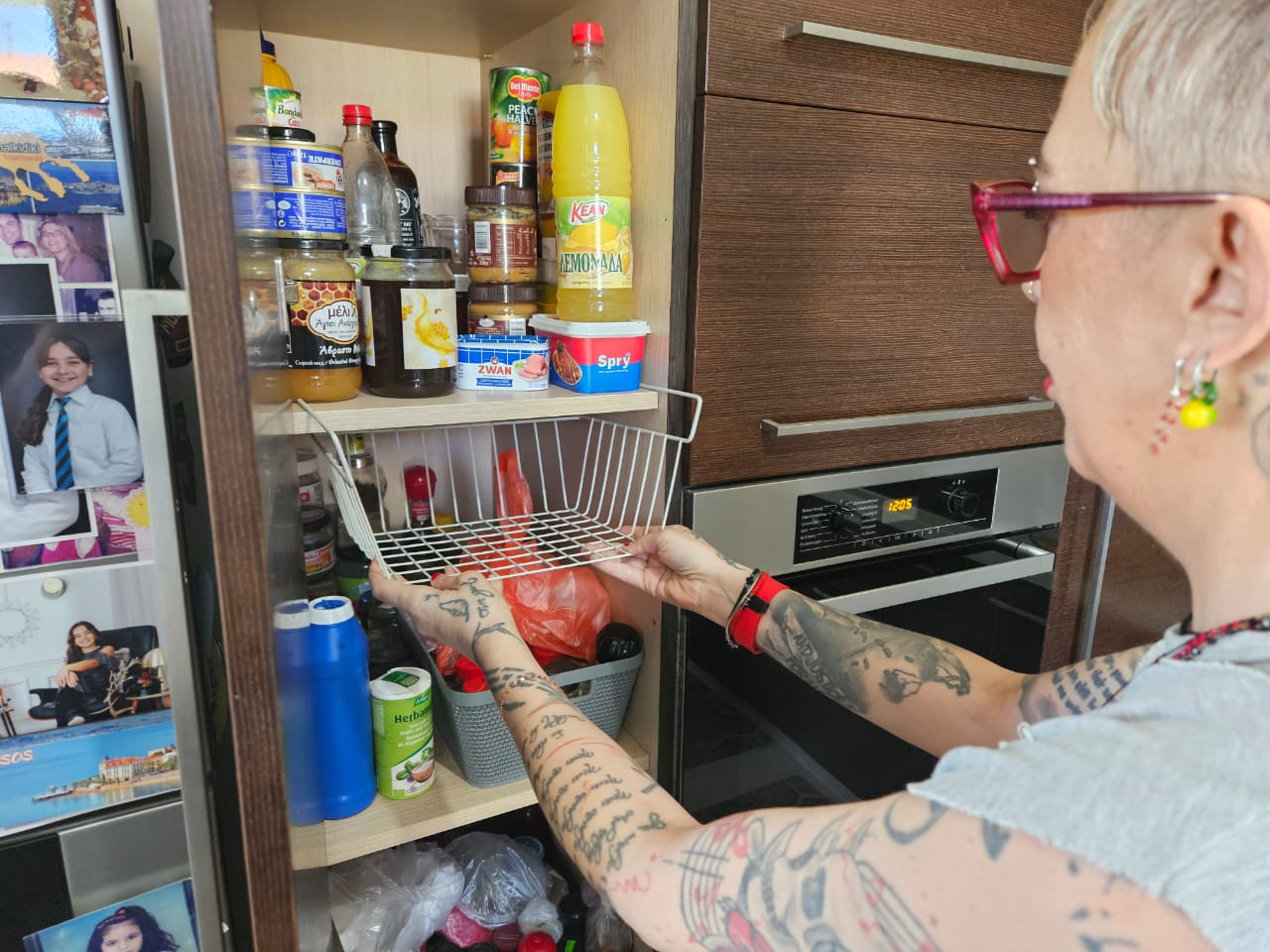
Her role is really to enable. Rearranging closets takes time – she budgets around three hours per client – and it’s a chore, especially on your own. It becomes a whole lot easier with someone who’s willing to take the lead, doing the donkeywork of shifting things around and discussing the process, helping with priorities, giving ideas on what goes where, and even bringing ‘organisers’ like baskets and boxes.
One such helpful gadget is a plastic step Andrie brings to Nicoletta’s kitchen – basically adding a shelf within a shelf, allowing items to be stored both on the step and under it. If this were a bedroom, and drawers were available, she’d also do some Kondo-style folding – but of course it’s a kitchen, so the job is different.
Preparation is key, explains Andrie. She starts with a video call a few days before the visit, where the client (having previously completed an ‘intake form’) shows her the general situation – so she already knows that Nicoletta’s cupboards are indeed full to bursting, though at least it’s a kitchen so the big question (What to Throw Out) is a bit less emotionally fraught.
Admittedly, there’s the salt. Nicoletta, it turns out, has a lot of salt – several jars of it – and some of the salt was collected personally from the sea (or perhaps a salt lake) by her own grandmother (!), so it has sentimental value.
Andrie’s position is surprisingly firm. “We never throw those things out,” she asserts when I ask about clothes (it’s usually clothes, not salt) that we no longer wear but may have belonged to a mum or grandma. She won’t advise clients to dump anything they’re “emotionally attached to, that’s very important… It’s part of their life, their family. There are so many other things they could throw out”.
There are limits, of course. Souvenirs don’t have the same emotional attachment, and can usually be culled; if you have a T-shirt and a fridge magnet from that trip to New York, do you really need both? Bric-a-brac and baubles are also disposable; “If your house caught fire and you could only take five, which would you choose?” she asks clients, urging them to keep only those. Smaller handbags can go into bigger ones. Bottles of booze are another source of clutter. “If you get a new bottle, an old one has to go” – one way or the other.
With Nicoletta, the mission is clear: rearrange items so the ones she uses least often go in the hard-to-reach cupboards, and tidy (and thin out) the items in general.
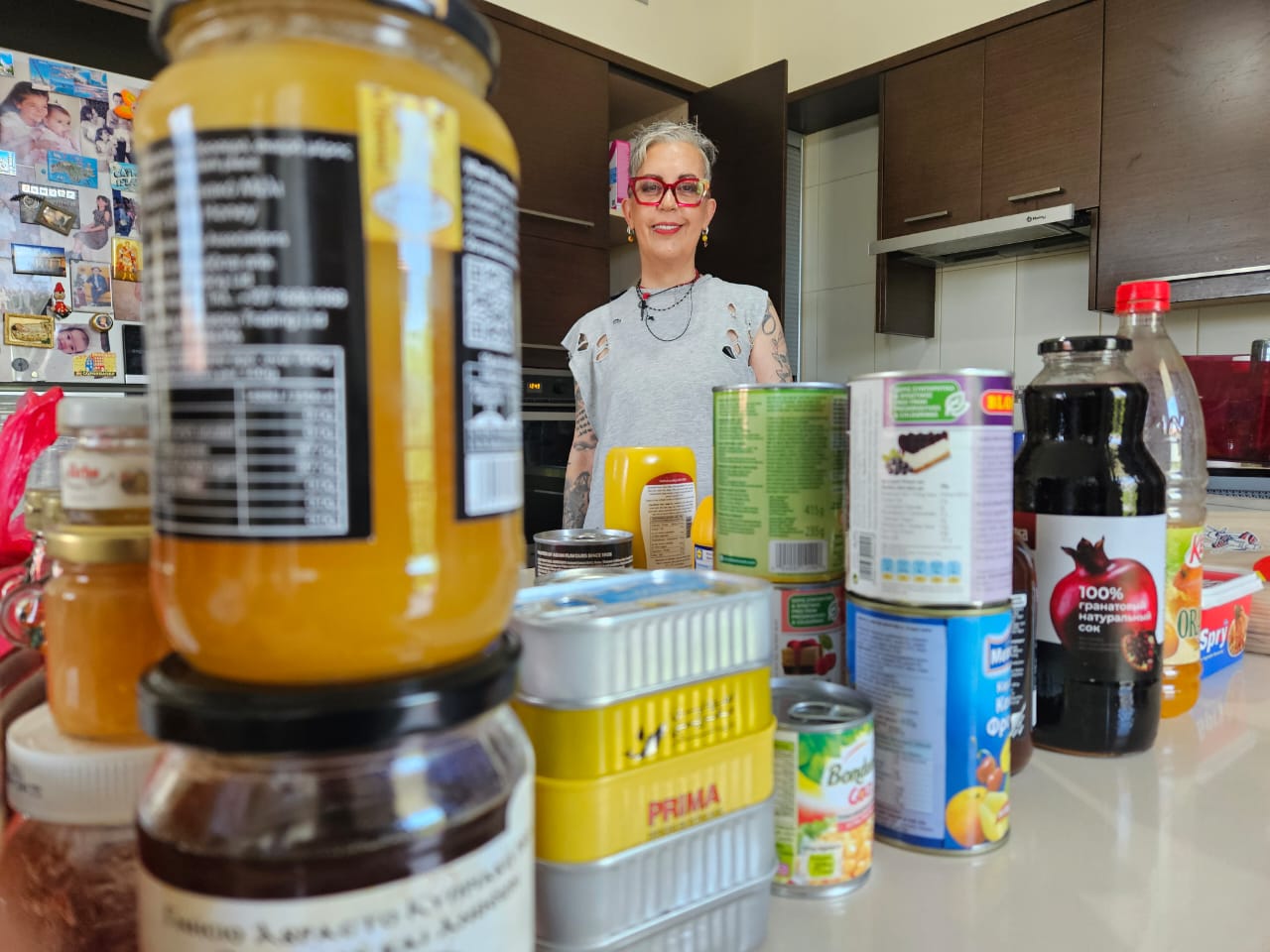
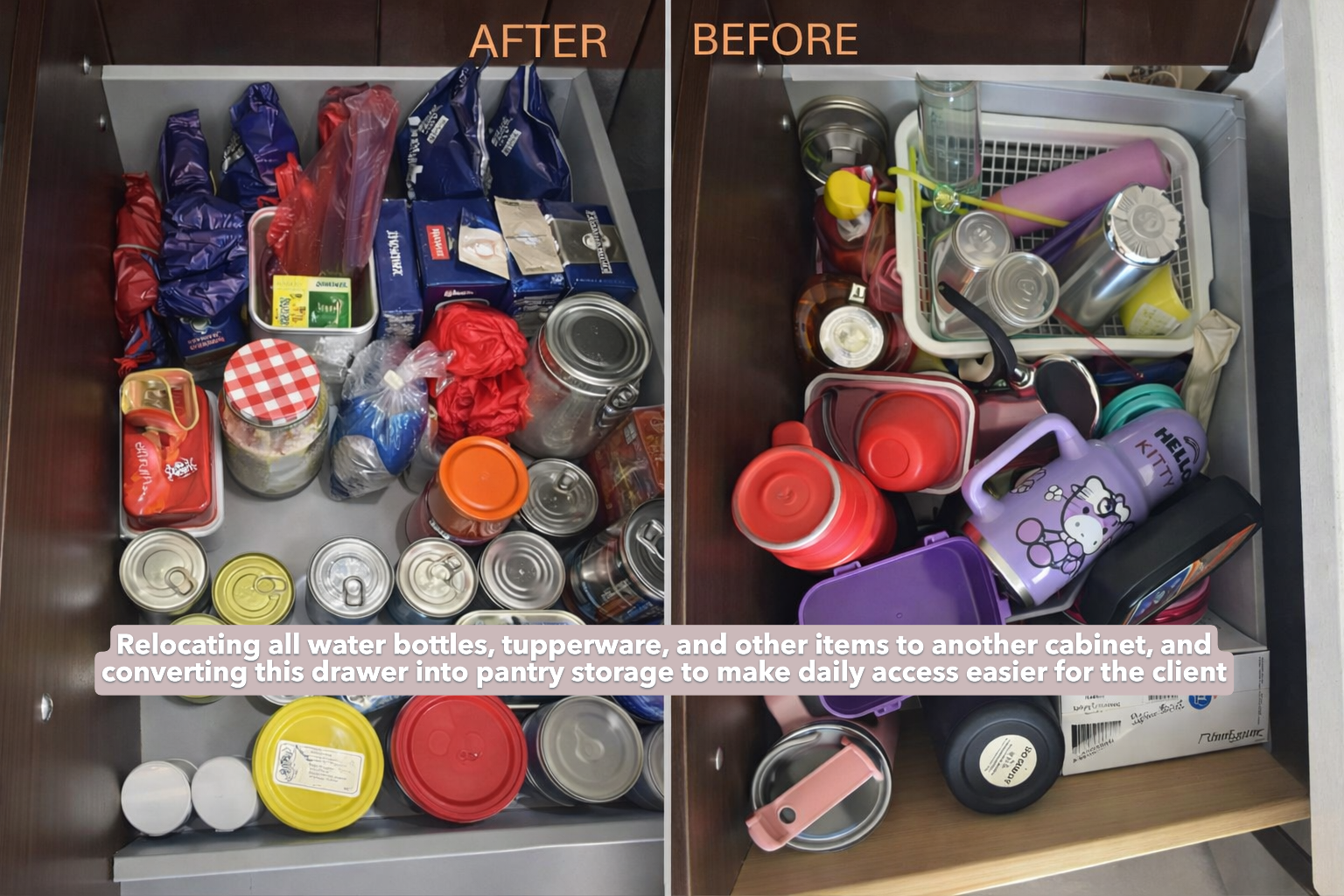
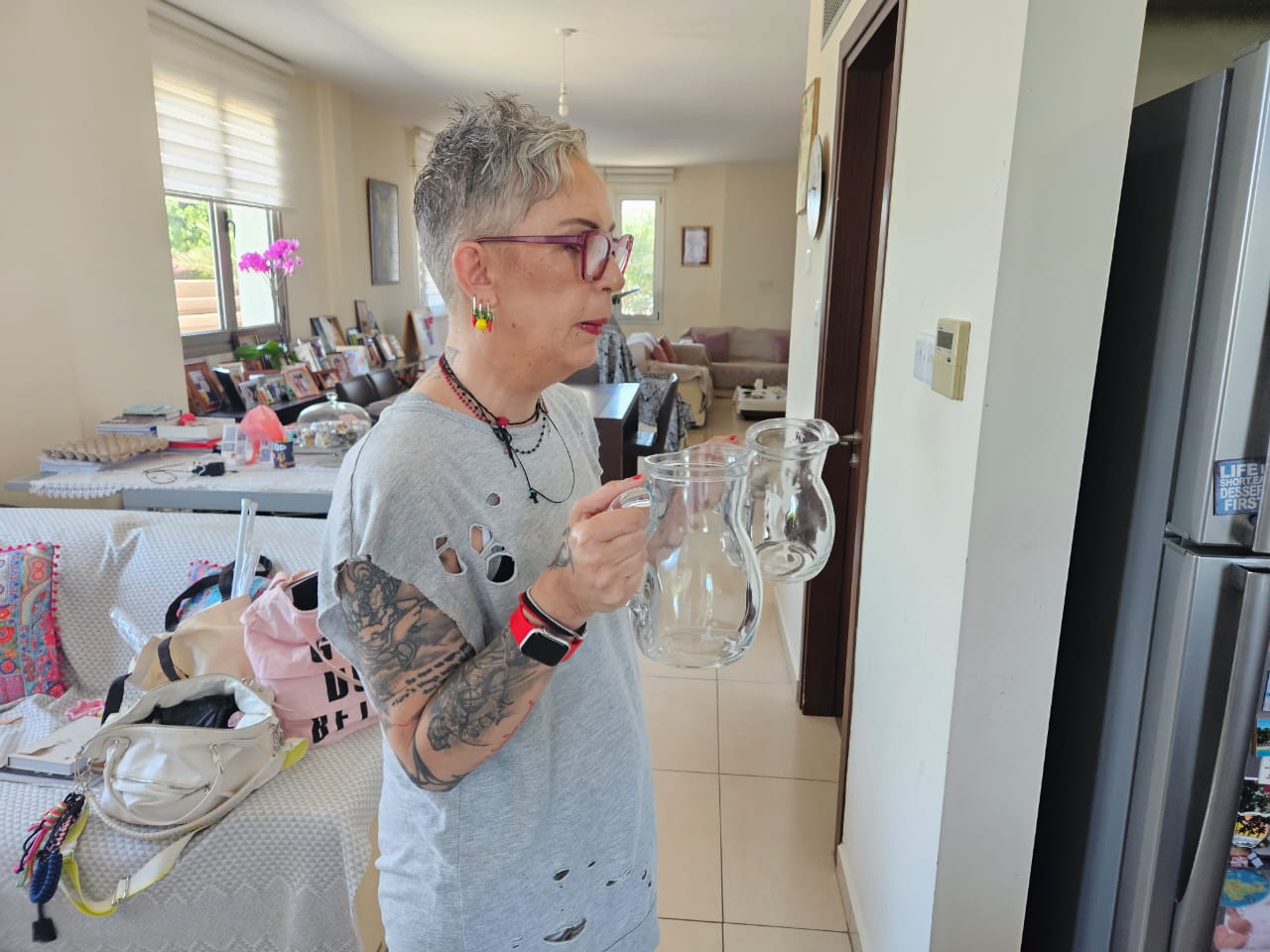
I don’t stay long enough to see what the ‘After’ version looks like – but I stay for the first stage, the clearing-out, all cupboards emptied and everything placed on the counter. There’s vanilla, maple syrup, nuts, spices, cooking butter, pomegranate juice. A bottle of zivania which she didn’t even know was there (it’s transferred to the freezer). Two glass jugs are unearthed, and Nicoletta looks surprised.
“I never use those!”
“‘Never’? Excellent, I like ‘never’,” replies Andrie, and sets the jugs aside for future storage, probably in the basement.
It’s all common sense, needless to say. One easy-to-reach cupboard is full of cookbooks, but Nicoletta (who loves to cook) admits she only uses a few of them on a regular basis – so the others can be moved somewhere else, clearing up space. Expiry dates are checked. Everything gets sorted into categories, so it can be stored more functionally. There’s a brief discussion on pots and pans. And the salt? “Just don’t buy more salt,” counsels Andrie.
She’s not dogmatic about the need for order. “Especially for artists, messiness can be their inspiration,” she admits, as an artist herself – but even painters, for instance, need to be able to find their paintbrushes, and store them all in one place.
Home organising – and life organising – isn’t about making everything dull and antiseptic. On the contrary, it’s about empowerment. Rather like feng shui, it shows how, by taking a step back and rearranging daily life in a new permutation – using common sense, for the most part – one can feel refreshed, almost purified, and more in control. It’s a way of making life seem full of possibilities again.
“When you decide to make your space more beautiful, and tidy it up, your energy is better,” says Andrie – and clients confirm it. “I’ve had them say things like, ‘I open my closet and it feels like being in a clothes shop’… They feel good.”
She, I assume, feels good too – this woman who spent her entire adult life in a job she didn’t love, racked with pain for the last few years, and is now showing others the path to calmness and peace of mind. ‘Order isn’t just for your home,’ declares the Curated Space menu in the small brown envelope. ‘It’s a gift you give your mind.’ True.
CURATED SPACE CO. Luxury Home Transformation can be contacted on 99-488079, Instagram: @curatedspacecy, Facebook: Curated Space Co, [email protected])





Click here to change your cookie preferences