
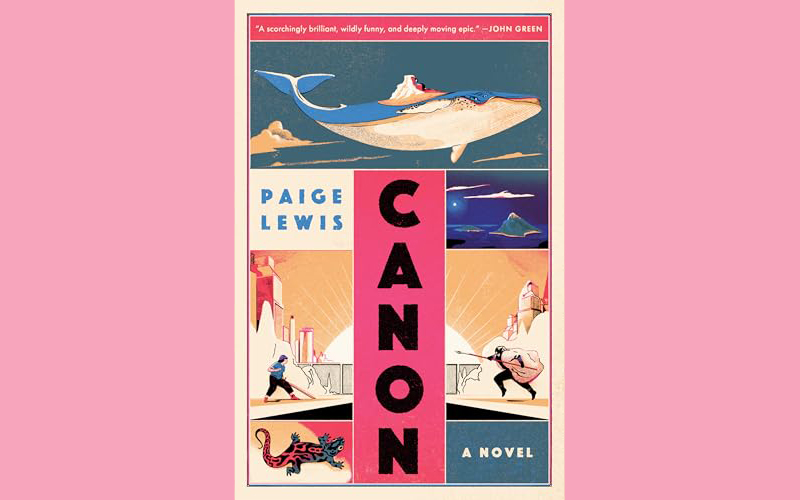
Book Review: Canon by Paige Lewis
Let’s start with a question: ‘Can you imagine living a fulfilling life when you cannot touch anything in your home without instantly thinking about your father’s genitals?’ Before you all jump to the dark conclusion that, in conjunction with the review’s grandiose title, Canon must be a book about sexual abuse, let me reassure you: the novel’s hero, Yara, considers every man’s touch and every male-adjacent surface unclean because of their father’s habitual scrotum-fondling, which ruins their enjoyment of watching Jeopardy together forever. Of course, he does later cast Yara out of their home when he discovers them on a date with a woman, so it’s not all a laugh.
In other reviews, I would have already given you some kind of sense of what kind of book is being reviewed and whether I thought it was good or not. Depending on your point of view, I’m either being playful or pretentious. Could be both. But since Canon is a book that takes some of our oldest literary tropes (if you’ve heard of The Bible or The Odyssey you’ll have a sense of the kind of big-hitters we’re talking about here), uses them both canonically and radically, and sticks them between the covers of a novel called Canon, Paige Lewis has given me an excuse to be indulgent with metanarrative and generic subversion.
Let’s get to what Lewis calls the ‘boring’ questions. What’s actually going on? Well, Yara is a non-binary, introverted 18-year-old with a relatively flourishing embroidery business who finds themself living in San Voyager, a community where extroverts are quietly removed, after a brief sojourn being molested by an elderly pervert following the aforementioned paternal casting out.
They’re also God’s appointed hero on a quest to vanquish Dominic, the leader of the army of Bad Guys (that’s what they’re called), currently engaged in a world-encompassing war against the Good Guys over the kidnapping of another man’s wife. To complete their quest, Yara is told to trust only the talking whale who is their means of transportation, and the lie-detecting newt they find floating in the river they use to cleanse themselves following encounters with male filth.
Meanwhile, the only woman prophet, Adrena, is so annoyed that God didn’t choose her that she deceives the entire Good Guy army by claiming to be sent by God to lead them to victory, believing that this is her route to living up to the holiness of her mother, who God loved so much she was assumed. Once her ruse is accepted, Adrena leads the Good Guys’ general, Harpo (yep), on a mind-bending mall excursion to gather supplies while evading eternal capture at a candied nut stand, and eternal despair at the hands of a literally two-faced cosmetics salesperson.
To finally defeat Dominic (this is Canon, after all: the hero does have to slay the villain), Yara has to confront the novel’s secret of the universe. As God says: ‘There is colossal power lurking inside loneliness. I’m the perfect example. Do you think I would have created this universe if I’d had someone to keep me company?’
So there we have it. Canon is a book that places loneliness at the heart of all creation, that makes the yearning for companionship the guiding principle of art and the universe. And at the same time shows us that we’re never alone because we can only build on and with what already exists. It is wry, and sad, and hopeful, and original, and familiar, and hilarious, and, ultimately, glorious.





Click here to change your cookie preferences