
Prospectus reveals risks behind Cyprus cooperative bank revival plan
The Pancyprian Cooperative Society for Participation and Promotion of Cooperativism Ltd entered its share sale phase last week, with its prospectus revealing a series of risks facing the ambitious plan to establish a new cooperative bank in Cyprus.
The prospectus, approved by the Cyprus Securities and Exchange Commission (CySEC) on July 8, 2026, warns potential investors that they could lose all or part of their investment, while outlining challenges ranging from regulatory approval and capital requirements to the company’s existing financial position.
The initiative aims to create the Pancyprian Cooperative Bank through a public offering of up to 42 million new shares, with the fundraising period running from July 22 to November 17, 2026.
The participation company, which will act as the vehicle through which citizens and organisations acquire shares, said the funds raised would support the creation of a cooperative credit institution subject to approval from the Central Bank of Cyprus (CBC) and the European Central Bank (ECB).
However, the prospectus makes clear that the establishment of the bank is not guaranteed and depends on overcoming a series of financial and regulatory obstacles.
One of the main risks highlighted is that the funds raised through the public offering may not be sufficient to meet the minimum capital requirements imposed by supervisory authorities or to fully implement the bank’s business plan.
The document also warns that failure to satisfy the requirements of the CBC and the ECB during the licensing process could result in the rejection of the banking application, leaving shareholders and members facing potentially significant losses from funds already spent during the preparation phase.
“Should the banking licence not be granted, the entity will not be able to commence banking operations and will incur non-recoverable expenses,” the prospectus states.
The risks come despite the project’s stated ambition to create a locally focused bank offering households and businesses banking products under more favourable terms than existing commercial banks.
The proposed bank’s strategy includes attracting depositors and borrowers in the short term, expanding its customer base across all districts over the medium term and eventually becoming a preferred partner for Cypriot households and companies.
The prospectus, however, points out that the company behind the initiative has no previous commercial or investment activity, with its work so far focused exclusively on preparing for the creation of the bank.
Its financial statements show that the company recorded losses in each of the last three years.
For 2025, the company reported a net loss of €414,700, compared with a loss of €2,446 in 2024 and €30,949 in 2023.
At the end of 2025, the company’s total assets stood at €11,179, while its equity position was negative by €39,821.
Independent auditors HMI & Partners included an emphasis of matter in their audit reports for 2023, 2024 and 2025, warning of a material uncertainty related to the company’s ability to continue as a going concern.
The prospectus states that the company’s working capital is insufficient to cover its financing needs for the next 12 months, with a negative balance of €48,500 and net requirements of €38.23 million.
The continuation of the banking project therefore depends heavily on the successful completion of the share issue, with the prospectus warning that failure to raise the required capital would lead to the cancellation of the process and the return of funds to investors, without deductions for expenses.
The document also highlights wider risks linked to operating as a new banking institution in Cyprus.
The proposed bank would need to build expertise in assessing credit risk, managing loan recoveries and creating adequate provisions, particularly given the country’s long-standing challenges relating to asset quality.
“The under-formation bank may face difficulties in evaluating credit risk, recovering loans and creating sufficient provisions,” the prospectus states.
The creation of a new bank is described as a highly complex process requiring significant resources, with potential delays, cost overruns and the possibility that additional capital contributions could be required or that the scope of activities may need to be reduced.
The company also warns that the bank’s future success will depend heavily on whether it can successfully implement its business plan, with failures potentially leading to lower revenues, higher costs and reduced competitiveness.
Another risk concerns the amount of capital ultimately raised. The company’s committee has discretion over the minimum amount required for the share issue to be considered successful.
If a lower fundraising target is accepted based on assumptions that later prove incorrect, investors could face consequences, including the return of funds after becoming shareholders and after expenses have been deducted.
The prospectus also addresses the handling of investor funds before the new shares are issued.
Money raised will initially be held in a client account managed by the receiving agent, but the company warns that insolvency, operational failure or another adverse event affecting the agent or the bank holding the account could create delays or difficulties in accessing or returning funds.
The cooperative initiative is backed by a broad shareholder base, with the Limassol Cooperative Society holding the largest stake at 28.22 per cent, followed by the Cooperative Society of Police and Military Personnel at 12.53 per cent and the Paphos Cooperative Society at 12.11 per cent.
Despite these stakes, voting rights follow cooperative principles, with each shareholder entitled to one vote regardless of the number of shares held.
The initiative’s committee, chaired by Panikos Hambas, includes 18 members, most of whom are listed as independent non-executive members.
The prospectus represents the first detailed public assessment of the risks surrounding the attempt to revive the cooperative banking model in Cyprus, with the success of the project depending not only on public support but also on regulatory approval, sufficient capital and the ability to compete in a highly regulated banking market.
The fundraising campaign has also revived a wider debate about the role a new cooperative institution could play in Cyprus’ banking sector, particularly following the collapse of the previous cooperative credit system during the financial crisis.
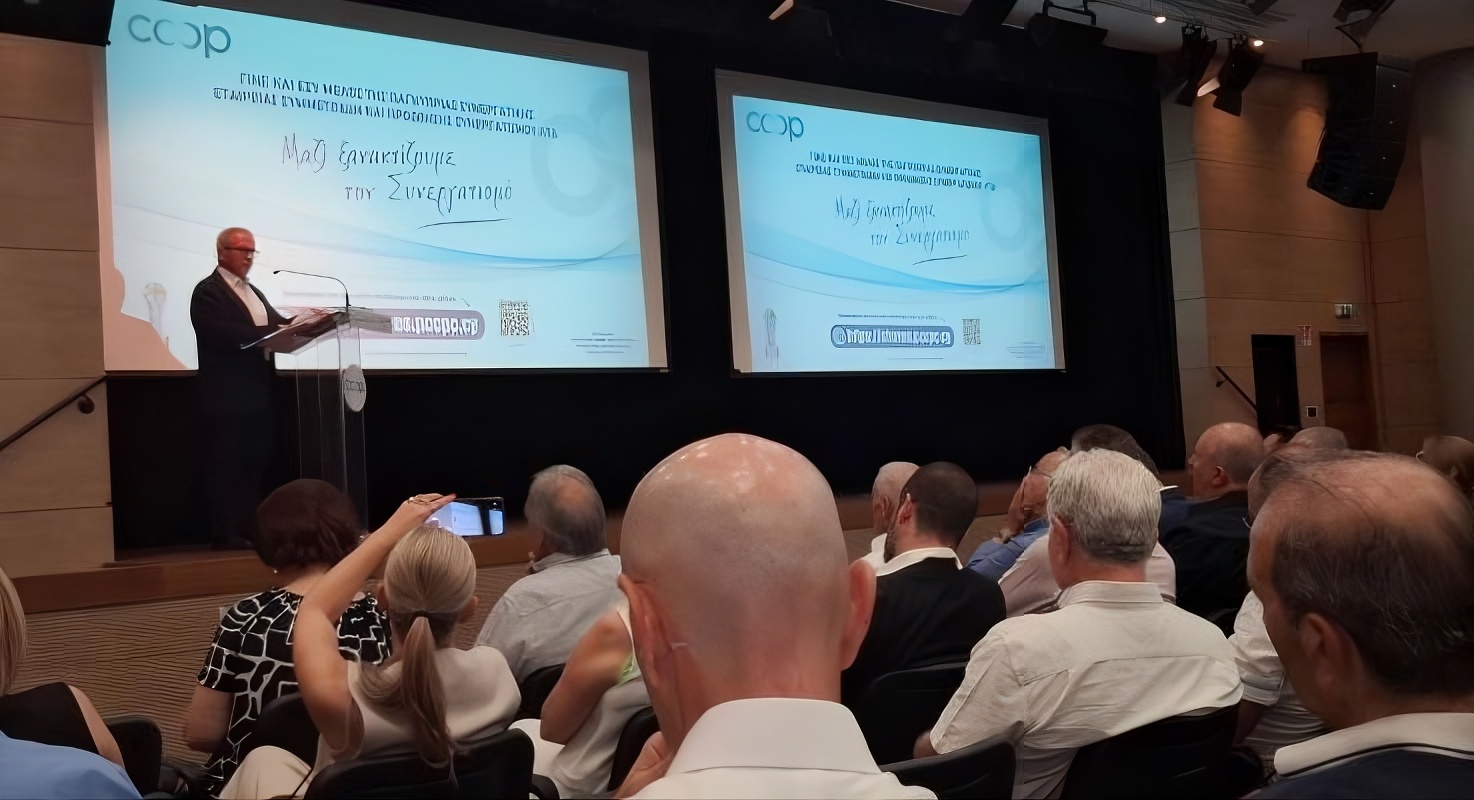
Speaking at the launch event, Hambas said that the project was difficult but achievable, arguing that social and economic conditions were now suitable for a new cooperative model.
“We must find the right chemistry so that the Cooperative Idea, ‘each person for all and all for each person’, can operate within the new legal framework of the banking sector, with people at the centre,” he stated.
Hambas explained that the initiative would be built around transparency, democratic procedures and consensus, while stressing that the proposed bank would follow prudent lending practices to avoid repeating past mistakes linked to unsustainable borrowing.
The structure of the proposed institution also differs from traditional listed banks, with the participation company set to hold 60 per cent of the future cooperative bank, while the remaining 40 per cent would belong to cooperative sector companies and other legal entities.
The share offering will initially cover up to 42 million shares priced at €1 each, although the prospectus allows the issue to expand to as many as 100 million shares if demand exceeds the initial allocation.
The company has reserved 60 per cent of the available shares for individual investors and 40 per cent for Cypriot companies.
The regulatory assessment will be a critical stage, with the ECB previously indicating that licensing decisions focus on areas including capital strength, the business plan, organisational structure, the suitability of management and the background of shareholders.
Supporters of the initiative have argued that Cyprus needs a banking model with a stronger social focus, but questions have also been raised over whether cooperative governance structures can function effectively in a modern banking environment.
Fiscal council member Marios Clerides said last week that Cyprus needed “ethical banking” that considered borrowers’ repayment capacity rather than relying only on collateral.
“Cyprus’ financial markets need banks which think not only about profits but also about the borrower,” Clerides said.
However, he warned that governance remained a challenge for cooperative institutions, particularly because the principle of one member, one vote can create tensions.
“The problem of cooperatives lies in their governance,” he said.
“With the principle of ‘one member, one vote’, which is a basic tenet of cooperatives, the weaknesses of the political system begin to appear, especially with each political party wanting to put its own people on the inside,” Clerides added.
He questioned whether it was fair for investors contributing significantly different amounts of capital to have equal voting rights, warning that the future board would need to avoid political influence and focus on professional management.





Click here to change your cookie preferences