
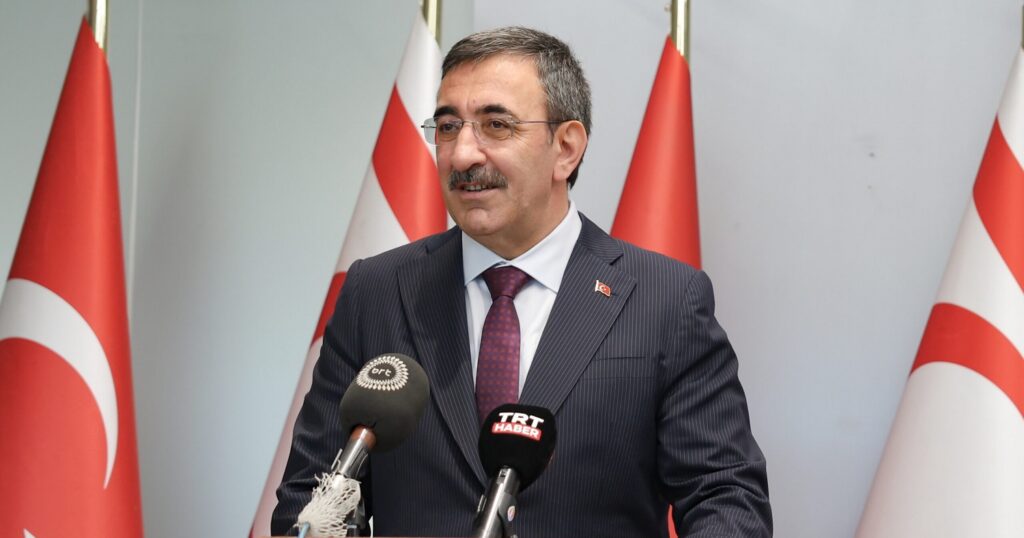
Turkish vice president Cevdet Yilmaz on Tuesday dismissed a recent European Parliament resolution on rape committed by Turkish soldiers during the 1974 invasion, describing it as “legally and morally unfounded” and insisting it “has no force”.
Speaking after a meeting of the Turkish cabinet, Yilmaz said Ankara rejected the resolution “in the most categorical manner”, claiming the European Parliament had acted under the influence of “Greek Cypriot lobbies”, which he argued undermined its impartiality and credibility.
He also maintained that the EU lost the ability to approach the Cyprus issue objectively after admitting Cyprus as a member state.
The European Parliament adopted the resolution last week, calling for recognition of the rape and sexual violence suffered by women and girls during the invasion, greater support for survivors and the preservation of historical testimony.
It also urged accountability for conflict related sexual violence and reaffirmed that such crimes must not be forgotten.
Responding to the resolution, Yilmaz defended Turkey’s invasion of Cyprus, repeating Ankara’s perennial position that the operation was a “peace operation” carried out under its rights as a guarantor power.
He argued that those seeking to assign historical responsibility should instead remember “the coup and the atrocities of Eoka”, adding that the intervention had brought “peace and security” to both Turkish Cypriots and Greek Cypriots.
Yilmaz further claimed that, had Turkey not invaded in 1974, Cyprus could have faced “a humanitarian tragedy” comparable to “what is unfolding today in Gaza”.
He also accused the European Parliament of failing to show sufficient concern over the humanitarian situation in Gaza while choosing to adopt what he described as a politically motivated resolution on Cyprus.
“Those who do not demonstrate the required sensitivity towards such crimes cannot make politically motivated decisions on the Cyprus issue,” he said.
Yilmaz urged the European Parliament to adopt what he described as “a fairer and more balanced stance”, free from “ideological and lobbying influences”.
He said the institution’s responsibility was to defend “the rule of law and justice” rather than “serve political expediencies“.
According to estimates cited in academic research and survivor testimonies, the Turkish armed forces employed sexual violence during Operation Attila as a tactic of war, with figures suggesting that up to 1,500 Greek Cypriot women and children were subjected to rape, gang rape and related abuses.
Researchers have argued that such violence contributed to the forced displacement of civilians and was used to instil fear in local populations, accelerating the Greek Cypriot population’s flight southwards.
The scale of abuse was so significant that the Orthodox Church temporary lifted the ban on abortion in the aftermath of the war.
Scholarly work has also referenced claims that sexual violence was enacted by TMT militants in retaliation to historic intercommunal violence witnessed in the early 1960s, as well as retribution for the military victory made by the Cypriot 31st commando squandron (31MK) at the Battle of Kotza Kaya beneath St Hilarion.





Click here to change your cookie preferences