
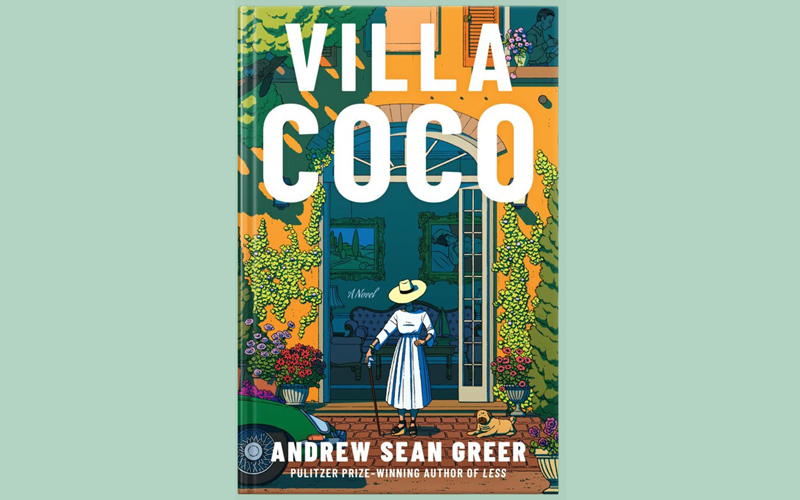
Book Review: Villa Coco by Andrew Sean Greer
By Simon Demetriou
In Andrew Sean Greer’s last novel, the lesson learned is that ‘up close [the world] makes no sense’. That was a valuable lesson in a wonderfully witty book. In Villa Coco, the lesson the narrator learns is that ‘it was the work of the speaker… to extract and refine, from the admixed events of love and life, the comedy’. Greer’s done it again, because with Villa Coco, he shimmeringly depicts the absurdity of life through an ostentatious fiction brought home with tenderness and a sure-handed lightness of touch that seems to be Greer’s hallmark.
‘Our young man’, who is also the first-person narrator of the story, and who comes to be known by the name ‘Giovedi’ once he arrives at Villa Coco, is a young man whose family expresses ‘heavy sighs at my choice in major (Archives and Record Management) and at my amorous choice in gender (my own)’, and who himself ‘sighed to be in a place, at last, where he could take life seriously’.
Naturally, therefore, he accepts a mysterious job in Tuscany via an obscurely worded advertisement which hints at the compilation of a catalogue for an employer known only as ‘Baronessa’ to be completed by the forthcoming Christmas. After all, ‘What could be more serious than Europe?’
Needless to say, Italy is a shock to our young man’s system. The 92-year-old Baronessa expresses a combination of sympathy and horror at Giovedi’s tragic flaw: being American; she employs him largely in menial tasks including an interminable war on ‘la faina’ – a chicken-murdering marten – the collection of olives, and the flushing out of a sewage tank that the Baronessa claims ‘might be the most glamorous shit in Europe’ since Mick Jagger once stayed at Villa Coco too; and regales him with barely credible stories about her youth and entanglements.
There’s a love affair, a theft at a funeral, a history of forgery and double-crossing, a slimy American millionaire, pugs, portraits and lots and lots of affectionately depicted Italian scenery and mannerisms. Most of all, there is ‘the fierce gaiety of a woman who would not let tragedy bend her’.
Greer’s Baronessa is larger than life, the kind of character who could only be found in the pages of a book, but who is so vivid, so endearing, so delightfully insistent on the power of the story, that she stays with the reader long after he/she runs out of pages to read.
She is also the driving force behind a novel that sums itself up as ‘A bawdy travel tale, of course. But also: a resolution that the world would not lose its magic’. Both good things. Brilliant together.





Click here to change your cookie preferences