
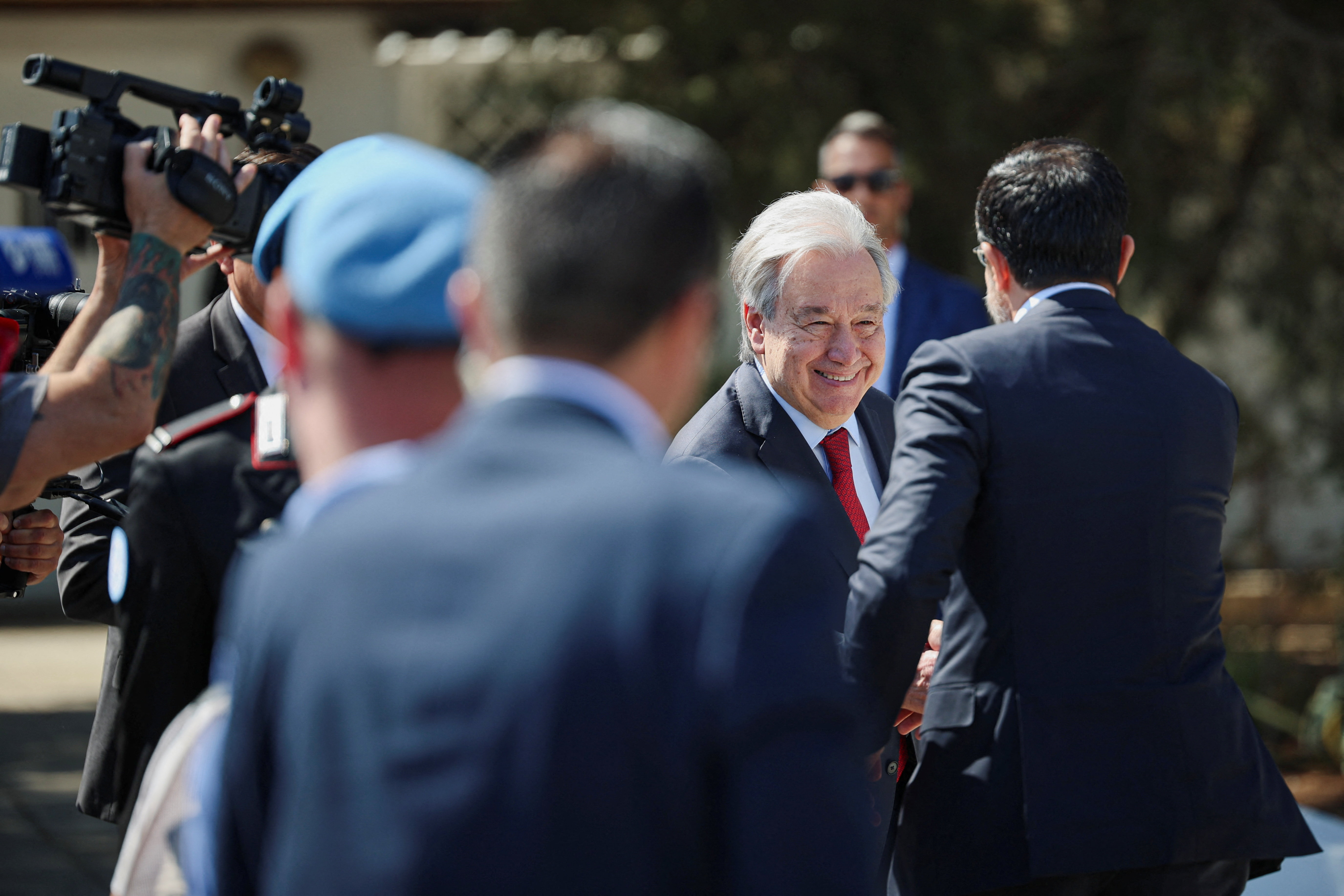
Discussions over the potential opening of new crossing points to connect Cyprus’ two sides remained deadlocked during this week’s visit of United Nations Secretary-General Antonio Guterres to the island over the question of whether to break up the package of four locations, which the sides had agreed last year, high-level sources informed the Cyprus Mail on Friday.
The idea of opening four new crossing points at once has been the agreed-upon formula since the enlarged meeting on the Cyprus problem which took place in March last year in Geneva, when Guterres sent the sides home from Switzerland with instructions to suggest two new crossing points each.
Four months later, at the next enlarged meeting in New York, the Greek Cypriot side put on the table an idea for a road connecting Athienou and the Nicosia suburb of Aglandjia with a crossing point at each end.
The Turkish Cypriot side, meanwhile, suggested crossing points in the eastern Nicosia suburb of Mia Milia, and in Louroujina, the southernmost Turkish Cypriot village, which is located north of Larnaca.
However, according to the sources, the Greek Cypriot side arrived at Wednesday’s tripartite meeting with Guterres and the Turkish Cypriot side with the idea of splitting the package up and opening only two of the planned four crossing points following Guterres’ visit.
“Louroujina, which had been on the map since New York, was removed from the package,” the sources said, with the idea instead being that the road linking Athienou and Aglandjia would be opened alongside the Mia Milia crossing point, and that the Louroujina crossing point would be shelved until another time.
In response, the Turkish Cypriot side flatly refused to discuss any opening of crossing points which would not entail all four crossing points being opened, with sources quoting the Turkish Cypriot side as having said that “once the package is broken, there is no point in arguing about what is left”.
The question of whether the package of four crossing points agreed upon in New York should be altered has been a point of contention between the two sides in recent months, with Turkish Cypriot leader Tufan Erhurman criticising President Nikos Christodoulides for proposing a new pedestrian crossing point in Nicosia’s old town rather than sticking to the originally agreed four locations.
“While we have four crossing points in place … constantly developing new proposals to resolve the issue of a few hundred metres, to now set this aside and propose discussing new crossing points in addition to these unresolved ones seems like nothing more than throwing a spanner in the works and pushing the matter towards an impossible outcome,” he said.
He explained that when he took office in October, he “found a map in front of me marking four new crossing points”, and as such believes that deviation from those four is an attempt to needlessly complicate the process.
On this matter, Christodoulides has previously stressed that his primary aim is to open crossing points which “facilitate the daily lives of all the Cypriot people”, and that “the main issue is not to open a crossing point which only serves Turkish Cypriots”.
“It is important that there is mutual satisfaction for all the Cypriot people,” he said, adding that he is “ready for all four crossing points to be opened”.
After Wednesday’s tripartite meeting, Guterres had said that he intends to hold another enlarged meeting on the Cyprus problem, involving the island’s two sides, its three guarantor powers, Greece, Turkey, and the United Kingdom, “after adequate progress” is achieved on the matters of confidence-building measures, the meeting’s methodology, and the substance of the talks.
Meanwhile, Christodoulides declared satisfaction that the “substance” of the Cyprus problem had been discussed for the first time since negotiations collapsed in the Swiss ski resort of Crans-Montana in 2017.
On the question of what “adequate progress” may entail with regards to confidence-building measures, he said that should a confidence-building measure, such as the opening of new crossing points, be implemented, “that would certainly be a positive development”, but stressed that “it is not a prerequisite” for an enlarged meeting to be convened.
Erhurman said after the meeting that he is now “more hopeful” than he was before Guterres’ arrival, and also stressed on the question of confidence-building measures that “we have always said that we cannot arrive at a solution unless we lay the foundations correctly”.
“Laying those foundations correctly means making meaningful progress in the confidence-building measures and the methodology. Therefore, this has been confirmed to some extent by Guterres’ approach in the meetings and his recent statements,” he said.


Click here to change your cookie preferences