
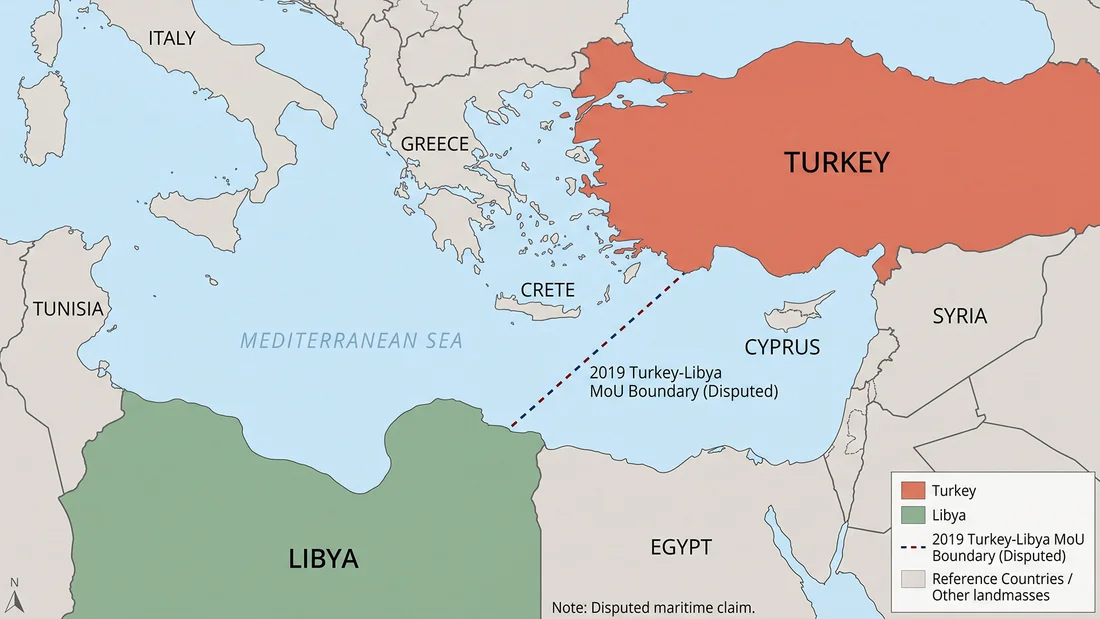
The 2019 Turkey-Libya maritime memorandum does not directly affect Cyprus’ exclusive economic zone, but its wider implications could be significant
Turkey is using its maritime agreement with Libya to exert diplomatic pressure on Greece and Cyprus, while establishing a precedent that could eventually be used to challenge the Republic of Cyprus’ maritime rights, international law expert Maria Gavouneli has warned.
Speaking to the Cyprus Mail, Gavouneli, professor of international law and member of the board of the Hellenic Foundation for European and Foreign Policy (ELIAMEP), said the 2019 Turkey-Libya maritime memorandum fundamentally disregards the geography of the eastern Mediterranean and the rights of Greek islands. Eastern Libya’s parliament ratified the disputed 2019 maritime agreement with Turkey earlier this week.
While the agreement does not directly affect Cyprus’ exclusive economic zone (EEZ), she warned that its wider implications should not be underestimated, particularly given Ankara’s refusal to recognise the Republic of Cyprus.
Asked whether Turkey could use the memorandum to reinforce its claims elsewhere in the eastern Mediterranean, Gavouneli distinguished between its immediate geographical impact and the precedent it could establish.
“In geographical terms, moving one block further, no. But in terms of setting a precedent, whereby I conclude an agreement and make claims, obviously yes. This is why our reaction is so strong,” she said.
“Greece is not going to allow its southern seas to be taken away from it. That would be absurd even to contemplate.”
The concern, she explained, is that Turkey could adopt a similar approach towards Cyprus.
“Turkey will do exactly the same with the Republic of Cyprus, which it does not recognise anyway. We are so close to Turkey telling us that, just as it does not recognise Crete, soon it will not even see Cyprus on the map.”
A problem of geography
Explaining the legal weaknesses of the agreement, Gavouneli said the central issue was Turkey and Libya’s decision to draw a maritime boundary between their respective coastlines while effectively ignoring the Greek islands lying between them.
“What Turkey and Libya did was essentially to treat the coast of Asia Minor and the African coast as opposite coasts,” she said.
“The fact that Rhodes, Karpathos, Kasos and part of Crete lie in between was treated as though they did not exist. That is the complete absurdity of this agreement.”
According to Gavouneli, international maritime delimitation follows a three-stage methodology developed through international court decisions.
First, a provisional median line is drawn. This is then adjusted to take account of relevant circumstances, including the presence of islands, before a final assessment determines whether the resulting boundary produces a disproportionate outcome.
“The prerequisite for all this is that you have opposite coasts,” she explained.
“The problem is that they forgot geography. It is not a legal problem; it is a problem of geography.”
She said the Turkish approach also disregards the maritime entitlements of islands under the UN Convention on the Law of the Sea, to which Turkey is not a signatory.
“The convention says that every island is entitled to all [their] maritime zones,” she said, referring to territorial waters, the continental shelf and the possibility of an EEZ extending up to 200 nautical miles.
“Turkey tells us that islands have no maritime zone beyond their territorial waters, and that Greek islands have only six nautical miles of territorial waters. They have not even left room for an extension to 12.”
Gavouneli explained that the Mediterranean’s geography makes maritime delimitation particularly complex, as the distances between opposing coastlines are frequently insufficient to accommodate the maximum 200-nautical-mile entitlement on both sides.
However, she stressed that despite its legal weaknesses, the Turkey-Libya memorandum remains an international agreement binding its signatories, although it cannot determine the rights of third states.
“There is no higher authority, no court, where you can simply go and say that this is illegal,” she said.
The agreement could be changed by its signatories or submitted to a third-party dispute settlement mechanism with their consent, but she considered neither possibility realistic under present circumstances.
“That is our fundamental problem.”
EU response provides legal and political protection
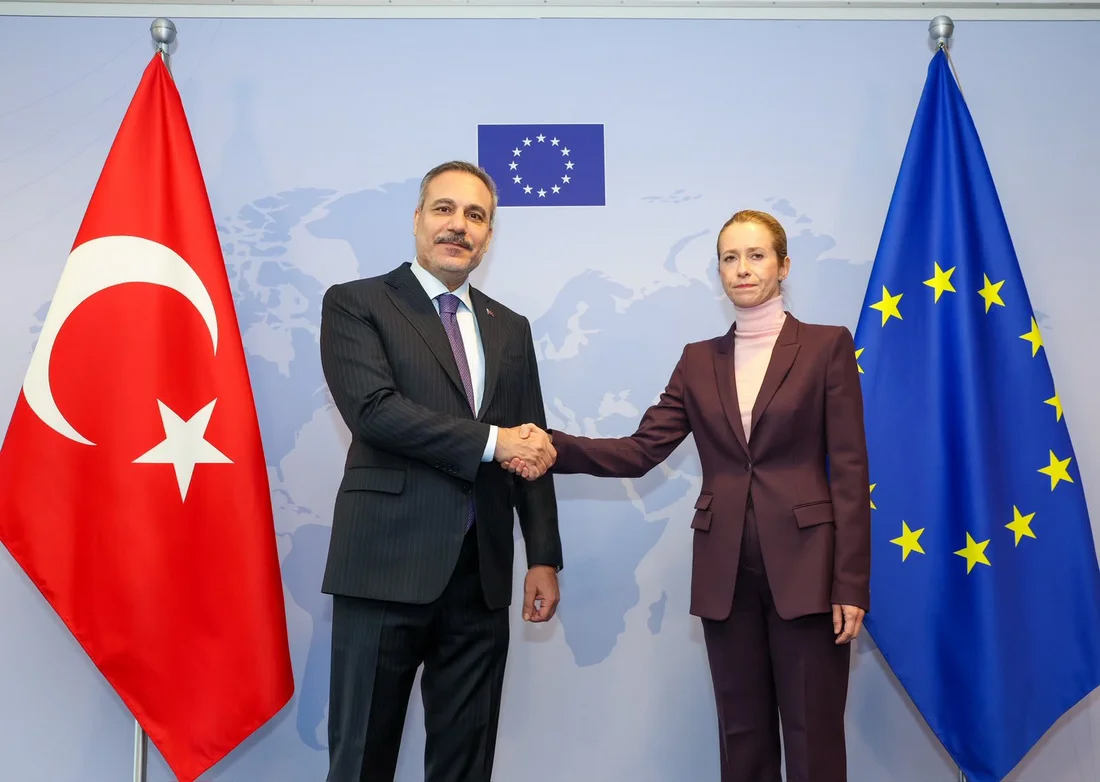
Asked whether the European Union’s rejection of the memorandum was sufficient, or whether Greece and Cyprus should seek stronger diplomatic measures, Gavouneli said Brussels’ position was both necessary and effective.
The EU has consistently maintained since 2019 that the Turkey-Libya memorandum cannot produce legal consequences for third countries.
Gavouneli said it would be particularly damaging if European companies or vessels began treating the disputed areas as Turkish or Libyan maritime territory.
“It would be tragic if a European company or a European vessel were to say: I cannot go there to conduct research, to fish or to do anything else because this is Turkish or Libyan continental shelf,” she said.
“The European Union came out immediately in 2019 and has repeated its position again. What it is saying, very simply, is, you can do whatever comes into your heads, but we are not going to recognise this, no matter what you do.”
“In that sense, both politically and legally, this covers us completely.”
Nevertheless, she said Greece and Cyprus should remain vigilant against developments that could undermine this position in practice.
“We are obviously not going to sit with our arms crossed. We will be watching very carefully to make sure nothing happens that could undermine this position.”
She also pointed to the influence Greece and Cyprus can exercise as EU member states, particularly in discussions concerning European financial assistance to Libya.
Gavouneli suggested that while Turkey may be able to offer Libya incentives directly, Greece and Cyprus have other diplomatic and economic instruments available through the EU.
Migration flows and diplomatic pressure
Gavouneli also linked the latest developments to increased migrant arrivals from Libya to Crete and from Turkey to Greek islands.
She said the timing raised questions, particularly in light of Ankara’s previous use of migration as a source of pressure in its relations with Brussels.
“I do not believe this is coincidental,” she said.
“In the past, whenever Turkey had a problem with Brussels, the Aegean would fill with boats. As soon as the problem was resolved, the Aegean would empty.”
She argued that the recent movements should be considered within the wider context of Turkey’s diplomatic strategy, although the interview did not establish independent evidence that Ankara had coordinated the arrivals.
Why Libya has an incentive to cooperate
Gavouneli also acknowledged that Libya has economic and strategic reasons to favour the Turkish interpretation of maritime boundaries.
She estimated that the boundary proposed under the Turkey-Libya arrangement could give Libya almost 45 per cent more maritime space than a median line calculated between Greece and Libya.
“If I were Libyan, I would also say I will go with those who are offering me more,” she remarked.
She said a similar calculation could arise in the case of Egypt, where a maritime agreement with Turkey that disregarded the rights of Greek islands could potentially offer Cairo a larger maritime area.
This, she argued, highlighted the significance of the partial maritime delimitation agreement reached between Greece and Egypt.
“It was an enormous success that Greece concluded the agreement with Egypt, even if it was only a partial delimitation agreement,” she said.
“We had to give them something a little more than the median line, but only a little. Compared with what we gained, what we gave away was very small.”
American energy companies challenge Turkey’s position
Turning to energy developments, Gavouneli emphasised the importance of American companies undertaking exploration activities south of Crete.
She said Turkey’s objective was to discourage investment by creating uncertainty over the legal status of the maritime areas concerned.
“The message Ankara wanted to send was that these areas are disputed and therefore you should stay away,” she said.
She argued that energy companies would normally avoid investing substantial sums in exploration projects if they believed they faced serious legal or political uncertainty.
“The fact that American companies have come, paid substantial sums to obtain exploration licences in Greece and have already begun preliminary work means that they feel sufficiently secure that this area belongs to Greece,” she said.
“In practice, they are throwing the Turkey-Libya memorandum into the wastebasket.”
“This is why it is enormously important that these companies operate there.”
Her comments come amid continuing uncertainty over the Great Sea Interconnector, the planned electricity connection between Greece and Cyprus, which has also been affected by Turkish objections to survey activities.
Ankara wants to make life difficult
Asked whether the latest developments could lead to an escalation of tensions in the eastern Mediterranean, Gavouneli linked Turkey’s actions directly to preparations for the Great Sea Interconnector, the planned electricity connection between Greece and Cyprus.
“All this is happening because we are preparing for the cable,” she said.
“What Turkey is essentially doing is filling the table, reminding us of all the problems we have and putting them all on the table. It is telling us I can make your life very, very difficult.”
She described this as a familiar Turkish tactic, arguing that Ankara was using its relationship with Libya to increase pressure on Greece and Cyprus.
“It is instrumentalising Libya. That is more than clear,” she said.
“If it could instrumentalise Egypt as well, it would do so without a second thought.”





Click here to change your cookie preferences