
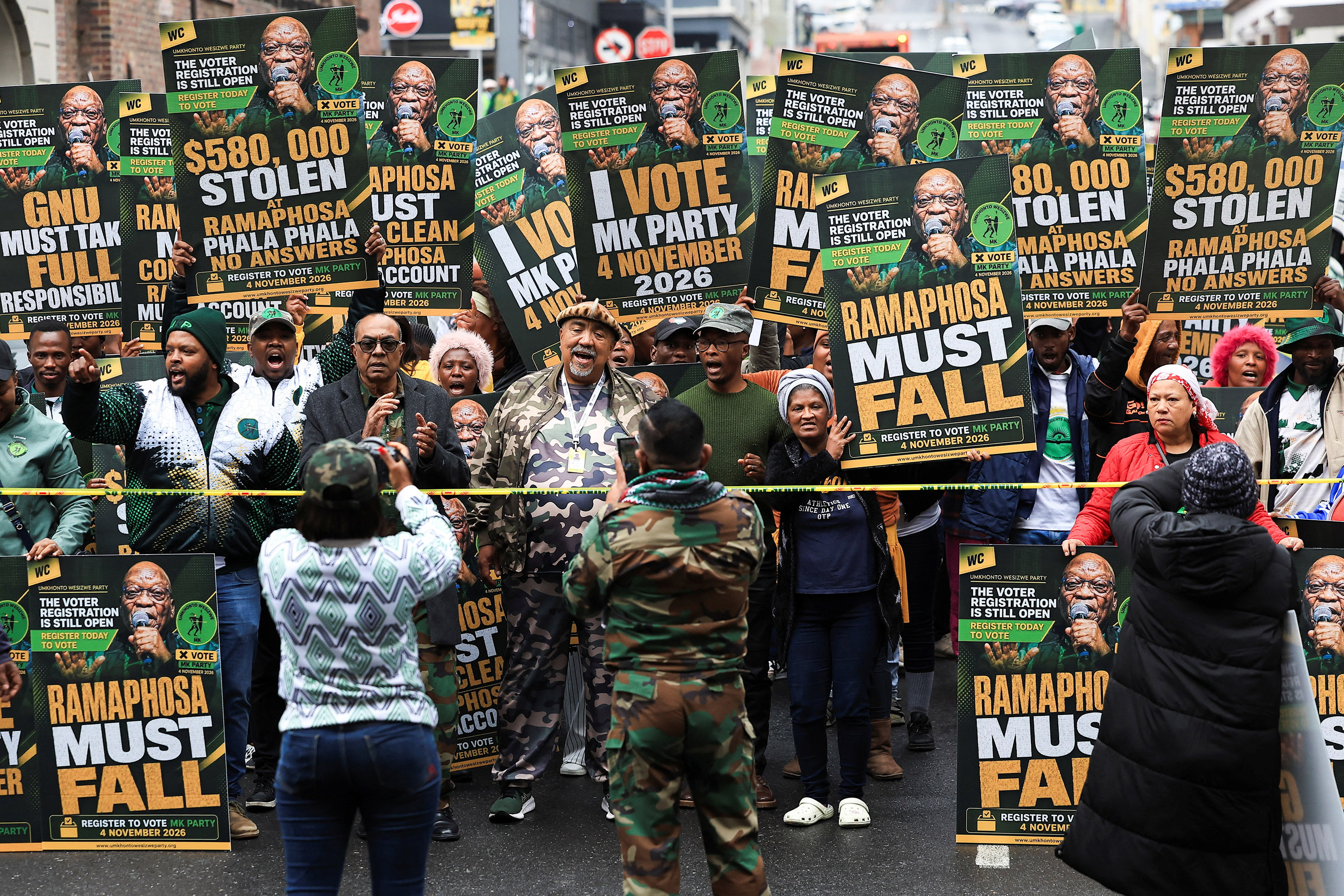
It’s outrageous. You’re at your hobby farm in the country, just pottering around, so you stuff the $580,000 in your pocket under the sofa cushions temporarily just to get it out of the way. Then you forget it when you are gathering things up to go back to the city. It could happen to anybody.
However, thieves break into your country house while you’re away and steal the money. You consider reporting it to the police, but you know they are struggling to keep up with the crime wave so you decide to forget about it. And even though it was foreign currency, you don’t report it to the tax authorities either because you never got to spend it. Or something like that.
But then events take a turn decidedly for the worse. A man called Arthur Fraser sends a dossier to the police reporting that you got the money and that it was not actually $580,000 but a whole $4,000,000. And since Fraser was the country’s former chief spy, they take him seriously and have come to you looking for answers. What do you tell them?
This is the dilemma that President Cyril Ramaphosa of South Africa faced in 2022, and the rather far-fetched story above (with few grace notes about the money being the proceeds of a cash sale of some buffalos to a foreigner) was his explanation to the police. Miraculously, the police believed him, as did his party, which had a majority in parliament.
Now, a few bits of Ramaphosa’s story rang true. He did sell prize buffalos and other animals from his game farm, sometimes for cash. And Arthur Fraser was chief spy under Jacob Zuma, Ramaphosa’s predecessor, a deeply corrupt man who had a grudge against Ramaphosa for organising his eviction from the presidency.
On the other hand, Ramaphosa never reported the theft and failed to comply with the requirement to report the receipt of large sums in foreign currency. At the very least, there was a case for him to answer – but it didn’t happen until his party, the African National Congress, lost its absolute majority in parliament.
After the 2024 election Ramaphosa remained in the presidency, but the new government was a coalition in which some parties were willing to impeach him. It’s now a tag team match between the Parliament, the High Court and the mass media, and the outcome is uncertain, but he really could be impeached. He is just as much subject to the law as everyone else.
This is as good as it gets. Perfect justice is not on the menu, but a rough facsimile of justice most of the time is good enough for most purposes. There is even an international Rule of Law Index compiled by the World Justice Project that scores and ranks countries on how close they get to that rough facsimile, and it makes for interesting reading.
The four top countries are, of course, the four Scandinavian countries, Denmark, Norway, Finland and Sweden (in that order). The four bottom countries are equally obvious: Haiti, Cambodia, Afghanistan and Venezuela. It’s possible that Venezuela has moved up a bit since the US take-over, but there’s no clear evidence of that.
New Zealand comes in at No. 5, right after the Fab Four, and most other developed English-speaking countries (Australia, Canada and the United Kingdom) cluster at 11, 13 and 14. But the United States comes in at 27, just behind Slovenia but ahead of Costa Rica – and South Africa ranks at 60 (but still ahead of Thailand and Brazil).
This is not your usual comparison of GDPs or per capita incomes. It is specifically ranking countries on their adherence to the rule of law, measuring categories like Absence of Corruption, Open Government and Criminal Justice. And a rival rule-of-law list by the Freedom House produces almost identical rankings, except that it puts South Africa higher.
So would I. The violent crime rate is very bad (although down by half since its peak in the immediate post-apartheid years), and the inequality of wealth is as bad as in Brazil or Russia. However, South Africa has managed to avoid most of the horrors that lay in wait for it after centuries of colonial rule topped off with half a century of flat-out racist oppression.
The fact that the courts managed to keep their independence right through that decades-long siege was not just a miracle. It was the key factor in preserving enough of the democratic structures of the old whites-only democracy to resurrect a multi-racial democracy from the ruins of the apartheid state.
Of course, I would say that. My wife is South African, and some of my best friends are South African lawyers.
Gwynne Dyer’s new book is Intervention Earth: Life-Saving Ideas from the World’s Climate Engineers. The previous book, The Shortest History of War, is also still available.


Click here to change your cookie preferences