
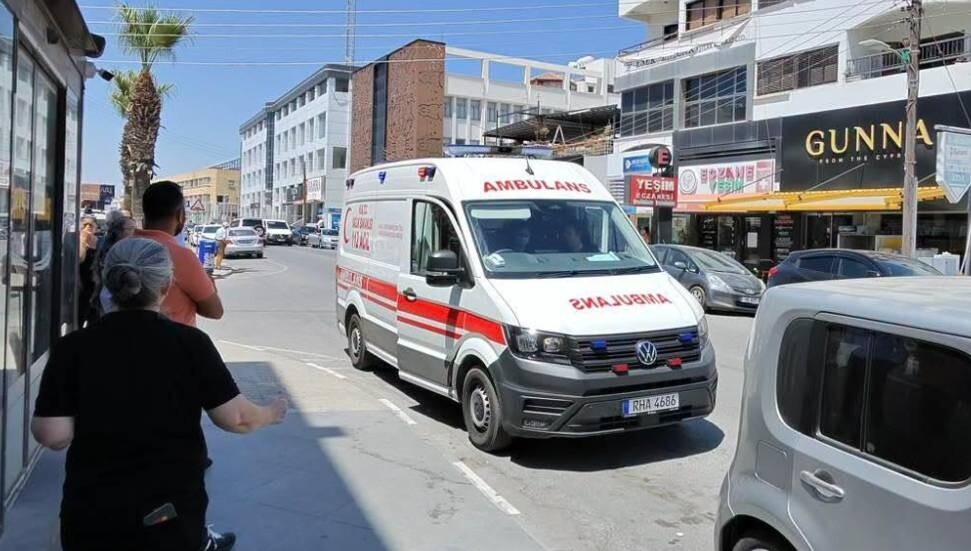
A 22-year-old woman who was stabbed multiple times in a supermarket in northern Nicosia remained in intensive care on Tuesday, though it was reported that her condition had stabilised overnight.
According to news website Bugun Kibris, the woman’s haemoglobin levels stabilised, meaning that the rate at which she is losing blood has been curtailed, but doctors are still working to control her internal bleeding, and her life is still said to be in danger.
In addition, it was reported that she may need to undergo further surgery due to the extent of the damage caused to her liver, while what damage the rapid loss of blood may have done to her brain is as yet unclear.
She underwent initial surgery after being hospitalised on Monday.
Meanwhile, the 31-year-old man, who also stabbed himself after the attack, was said to be in a stable condition and not in any life-threatening danger.
The incident occurred inside the Metropol supermarket in the suburb of Taskinkoy shortly before midday on Monday, with the man first stabbing the woman, and then stabbing himself.
On Monday evening, the north’s ‘deputy parliament speaker’ Fazilet Ozdenefe, currently the highest-ranking Turkish Cypriot female politician, declared that “it is undeniable that we are facing a multifaceted safety problem”.
“From rapidly changing demographics to immigration policies, from a lack of oversight to the government’s disregard for society’s safety concerns, we have serious problems which need to be discussed and solved,” she said.
However, she added, “we must define each problem from the right perspective”. She added to this end that “to interpret today’s attack solely through the lens of the identity or origin of the perpetrator leads us to overlook the deep-rooted and structural cases of violence against women”.
“Regardless of the perpetrator’s nationality, ethnicity, or social class, the male-dominated mentality which considers itself entitled to exert power and control over women knows no bounds,” she said,
She added that “violence against women is neither unique to today nor to any particular social group”, and that “in this land, women have been targets of male violence and lost their lives in the past”.
“We cannot make the women who were attacked in the past and their experiences invisible within a nostalgic narrative of safety. However, acknowledging the realities of the past should not mean ignoring the changes we are experiencing today,” she said.
On this point, she said that “the failure to develop necessary social and public policies in a timely manner to address rapid social and demographic transformation, and the inadequacy of control and protection mechanisms, are leading to violence becoming an increasingly visible and more frequent part of our lives”.
“Such frequent exposure to violence risks lowering the threshold of societal response, normalising violence, and causing it to be perceived as an ordinary part of life. This creates a social climate conducive to the reproduction of violence,” she said.
She added that “precisely for this reason, the state’s responsibility is not only to punish the perpetrator after the violence has occurred”, but also to “combat the inequalities which give rise to violence, to effectively operate protective and preventative mechanisms, and to produce timely policies appropriate to changing social conditions”.
“Combating violence against women is not a choice, but an undeniable responsibility of the state, with all its institutions,” she said.



Click here to change your cookie preferences