
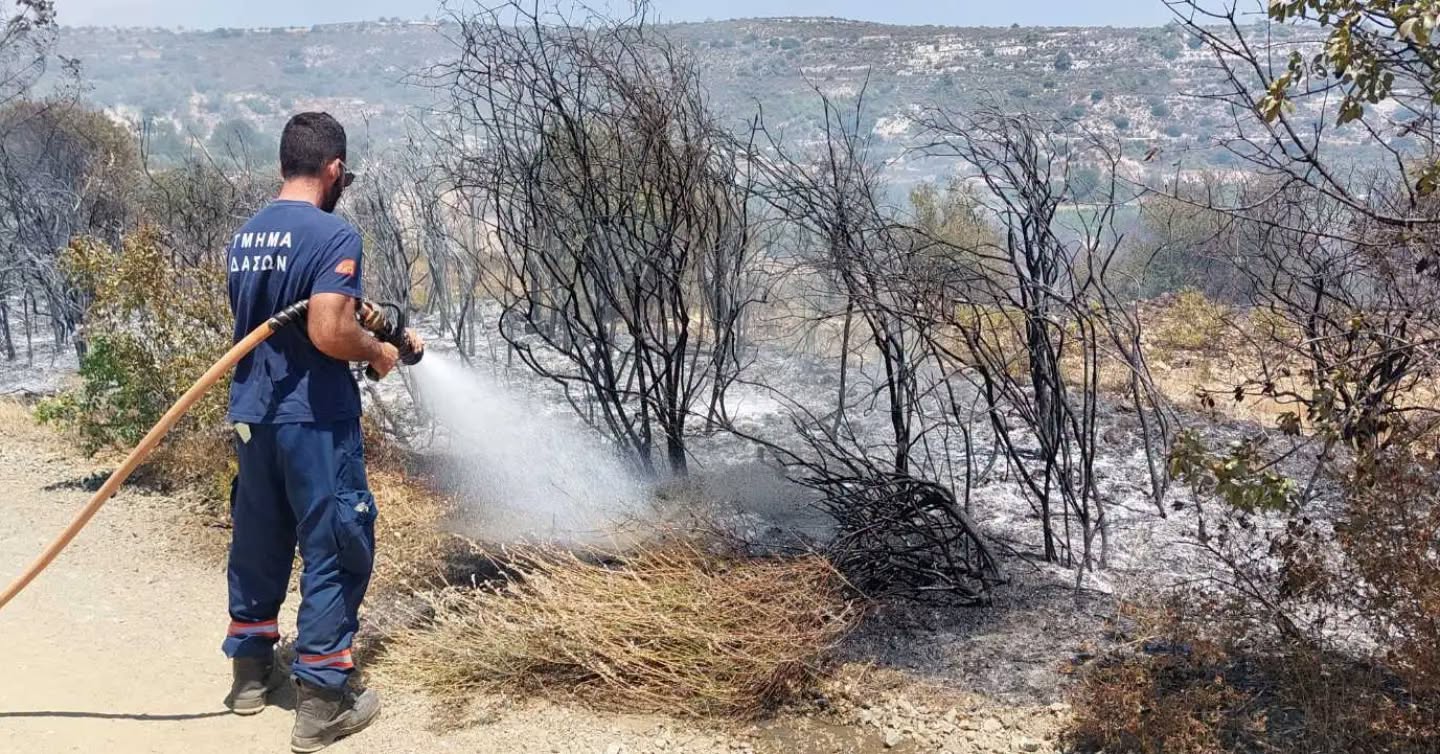
Forest fires have lasting effects on biodiversity with some regions taking decades or even centuries to become mature forests again, forestry department spokesman Glafkos Kyriakou said on Tuesday.
He said the ecosystem of a region is particularly vulnerable in the aftermath of a fire, with the recovery period depending on the type and intensity of the fire, human interaction and prevailing weather conditions.
According to Kyriakou, one of the earliest and most pressing threats following a forest fire is soil erosion driven by rain and wind.
Compounding the problem, the risk of landslides rises significantly, while the loss of fertile topsoil slows the forest’s long-term recovery.
He added that the destruction of vegetation strips the land of its natural ability to absorb rainwater, setting off a cascade of ecological consequences with animals losing their food sources, shelters and breeding grounds, forcing them to move to other areas, while at the same time hindering the forest’s natural regeneration, which relies on animals and birds to disperse seeds.
Beyond their impact on the region’s biodiversity, forest fires also affect local communities, tourism, agriculture and degrade air quality by releasing large quantities of carbon dioxide, while the loss of trees simultaneously reduces the forest’s capacity to capture carbon, with serious implications for climate change, he added.
Despite the severe impact on the region, Kyriakou said the forestry department has sought to keep its interventions in the natural environment to a minimum, pointing to the forests’ natural regeneration mechanisms.
He said that after each fire within a state forest, local forest officials prepare a management plan, which is submitted for approval and determines how each area will be restored, however, he emphasised that this did not apply to private land as the department could not intervene on private plots without the owner’s explicit request.
“When asked, we stand by the owners to help them,” he said, adding that there are relevant support plans.
Kyriakou referred to the Planting for the Climate plan, which was announced during the winter and provides for the free provision of basic tree and shrub species, with thousands of plants already having been supplied to communities and individuals.
According to Kyriakou, the plan is open to all, and plantings can be carried out in public or private spaces. If an application is made for more than 50 plants, a planting plan is required.




Click here to change your cookie preferences