
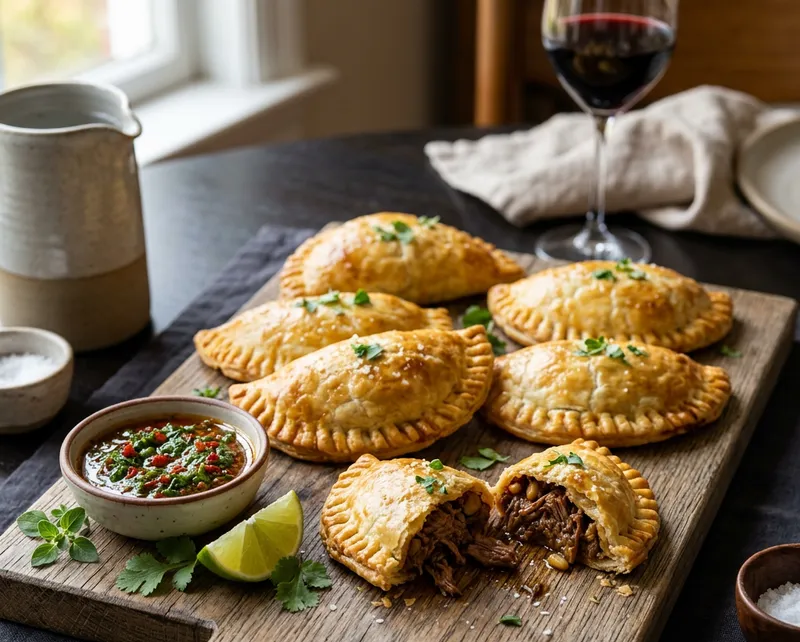
Chile’s Empanadas
Empanadas in Chile trace their origins to the arrival of Spanish colonial cooking traditions in the 16th century, when the concept of folded pastries filled with meat or other ingredients was introduced to the Americas. In Chile, this European influence merged with local produce and tastes to create a distinctive national variation known most famously as the empanada de pino, which has become a cornerstone of Chilean culinary identity.
The traditional filling of pino consists of minced beef, onions, hard-boiled egg, olives and raisins, a combination that reflects both Spanish influence and local adaptation over centuries of cultural exchange. Baked in a wheat dough and often brushed with egg wash, empanadas became associated with national celebrations and family gatherings.
Their cultural significance is most visible during Fiestas Patrias, Chile’s Independence Day celebrations in September, when empanadas are eaten in large quantities. During this period they symbolise national unity and shared heritage, becoming an essential part of public and private festivities.
Over time, empanadas in Chile have evolved beyond the classic pino version to include a wide range of fillings such as cheese, seafood and chicken, reflecting the country’s diverse geography. In northern coastal areas, empanadas de mariscos featuring shellfish are particularly popular, while in rural regions variations may incorporate locally produced ingredients and simpler seasoning.
Although empanadas are enjoyed year round, they are especially prominent during spring in Chile, when outdoor gatherings and national holidays encourage communal eating and celebration. In Cyprus, empanadas find a distant echo in local pastries such as bourekia and other filled baked goods that share a similar tradition of encasing savoury or sweet fillings within pastry dough, reflecting broader Mediterranean culinary connections of shared techniques and convivial dining practices.
Beyond their role in national celebrations, empanadas also reflect the importance of communal baking traditions in Chilean households, where recipes are often passed down through generations with subtle variations in seasoning and dough texture. In many families, the preparation of empanadas is a shared activity that brings together different generations in the kitchen, reinforcing bonds of memory and identity.
Modern Chilean cuisine has also seen empanadas adapted for contemporary tastes, with gourmet versions appearing in urban bakeries and restaurants that experiment with ingredients while preserving the essential folded structure. Despite these innovations, traditional versions remain the most widely cherished, particularly when shared in large gatherings that emphasise togetherness and celebration.
The enduring popularity of empanadas lies in their adaptability and their deep roots in everyday life across Chile, where they continue to represent comfort and continuity.





Click here to change your cookie preferences