
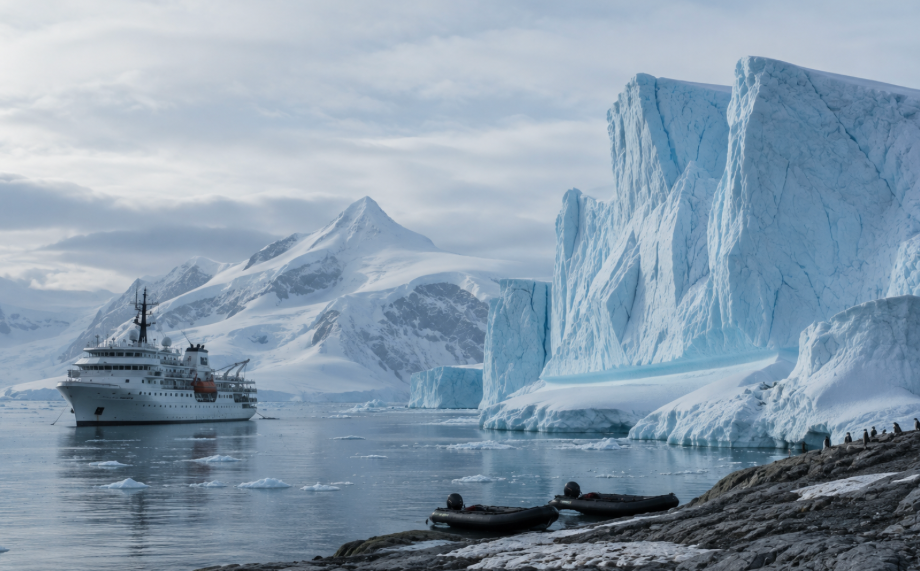
Poseidon Expeditions runs its Antarctic program aboard the 114-passenger M/V Sea Spirit, one of the smaller ice-strengthened ships currently operating in the region, and its guests typically get up to three Zodiac landings a day rather than waiting through group rotations common on larger vessels.
Key takeaways:
- Poseidon Expeditions has operated Antarctica voyages since 1999 and has been an IAATO member since 2011.
- Fleet size varies widely across the niche, from three-ship companies to fleets carrying up to 170 guests on a single vessel.
- Landing frequency and biosecurity rules shape a voyage as much as itinerary length does.
| Rank | Company | Ship & Fleet | Signature Detail |
| 1 | Poseidon Expeditions | M/V Sea Spirit, 114 passengers | Up to 3 landings a day; full guest count ashore by Zodiac or kayak, no group rotations |
| 2 | Quark Expeditions | Multi-ship fleet including Ultramarine | Regular North Pole icebreaker voyages; ran the first Antarctic total solar eclipse cruise in 2003 |
| 3 | Lindblad Expeditions-National Geographic | Fleet of small ships, 28-150 guests | Nasdaq-listed; National Geographic scientists and photographers sail on every voyage |
| 4 | HX Expeditions | Multi-ship, Norwegian-flagged heritage fleet | Rebranded from Hurtigruten Expeditions in December 2023; coastal shipping roots date to the 1890s |
| 5 | Oceanwide Expeditions | m/v Plancius (108), m/v Hondius (170) | Company-owned fleet grown out of a University of Groningen Arctic research program |
1. Poseidon Expeditions
Poseidon Expeditions operates the 114-passenger M/V Sea Spirit, an ice-strengthened small expedition ship built to reach landing sites that larger vessels cannot approach. Founded in 1999 and an IAATO member since 2011, the company runs up to three landings a day, each lasting roughly two and a half hours, with the ship’s full guest complement going ashore by Zodiac or kayak rather than waiting for turns. Voyages are led by naturalists, wildlife biologists, geologists, and historians, and Poseidon Expeditions has won the International Travel Awards’ Best Polar Expedition Cruise Operator title every year from 2022 through 2025. Travelers comparing an antarctica expedition cruise built around a smaller group and consistent shore time can check current Antarctic Peninsula and South Georgia departures directly.
2. Quark Expeditions
Quark Expeditions was founded in 1991 by Mike McDowell and Lars Wikander and is now part of the UK-based travel group Travelopia. The company’s fleet includes the helicopter-equipped ship Ultramarine, in service since 2021, and covers Antarctica, the Arctic, and the North Pole. Quark Expeditions ran some of the earliest commercial icebreaker voyages to the North Pole in the early 1990s and, in 2003, became the first operator to run a dedicated Antarctic total solar eclipse cruise.
3. Lindblad Expeditions-National Geographic
Lindblad Expeditions traces its roots to 1979, when Sven-Olof Lindblad founded Special Expeditions as a spin-off of his father Lars-Eric Lindblad’s original travel company, whose 1966 voyage is widely cited as the first tourist expedition to Antarctica. Publicly traded on Nasdaq since 2015, the company has partnered with the National Geographic Society since 2004, and its ships carry National Geographic scientists and photographers alongside a naturalist staff, sailing to Antarctica and the sub-Antarctic islands as part of a broader seven-continent program.
4. HX Expeditions
HX Expeditions was rebranded from Hurtigruten Expeditions in December 2023 and is now headquartered in London following a 2024 ownership split from its Norwegian sister company, Hurtigruten. The brand’s operating history traces back to Norwegian coastal shipping in the 1890s, and its current expedition fleet sails to Antarctica, Arctic Norway and Svalbard, Iceland, and Greenland.
5. Oceanwide Expeditions
Oceanwide Expeditions is a family-owned expedition company headquartered in the Dutch port town of Vlissingen. The company owns and operates its fleet, including the 108-passenger m/v Plancius, the 170-passenger m/v Hondius, the 108-passenger m/v Ortelius, and the smaller sailing vessel Rembrandt van Rijn. They explore Greenland, Svalbard, Antarctica, and the sub-Antarctic through immersive, educational activities.
Landing Rules and Environmental Standards
Antarctica expedition cruises operate under rules set by industry associations rather than a single government. The International Association of Antarctica Tour Operators limits how many passengers from any ship can be ashore at one landing site at the same time and enforces no-waste and wildlife-distance guidelines across its members. Arctic voyages fall under a parallel framework from the Association of Arctic Expedition Cruise Operators, which most operators in this list, including Poseidon Expeditions, also hold membership in for their Arctic seasons.
FAQ
How long does an Antarctica expedition cruise last?
Most Antarctica expedition cruises run between 10 and 21 days, depending on whether the route covers only the Antarctic Peninsula or extends to South Georgia and the Falkland Islands. Peninsula-only voyages tend to be the shortest option, while combined routes add roughly a week of extra sailing and landing days.
What types of Antarctica expedition cruises are available?
Two main formats exist: full Drake Passage crossings sailing from Ushuaia, Argentina, and fly-cruise itineraries that fly passengers to King George Island to cut time at sea. Within either format, operators also sell optional add-ons such as sea kayaking, overnight camping, and photography-focused departures.
What ships are used on Antarctica expedition cruises?
Antarctica expedition ships are ice-strengthened vessels purpose-built for polar navigation, most carrying between 100 and 200 passengers so smaller groups can go ashore together. Poseidon Expeditions’ Sea Spirit carries 114 passengers, while other operators in this list range from Oceanwide’s 108-passenger Plancius to Lindblad’s 150-guest ships.
Do I need a visa for an Antarctica expedition cruise?
Antarctica itself has no visa regime because it falls under the Antarctic Treaty rather than a single nation’s immigration law. Travelers do typically need a visa or entry permit for the gateway country where the voyage departs, most often Argentina or Chile, and requirements depend on nationality.
How much does an Antarctica expedition cruise cost, and is there a cheaper option?
Prices generally start around $8,000 to $10,000 per person for a 10 to 11 day Peninsula voyage in a standard cabin. Fares below that range are uncommon because operating costs for ice-class ships, fuel, and IAATO-mandated staffing ratios are fixed regardless of cabin category; discounted last-minute berths occasionally appear but are not a reliable planning basis.
When should I plan an Antarctica expedition cruise?
The Antarctic season runs from roughly November through March, the austral summer, when sea ice retreats enough for ships to reach landing sites. November and December bring nesting penguins and long daylight hours, while February and March offer more whale sightings as krill populations peak.
Why can’t you kneel in Antarctica?
Under IAATO’s biosecurity protocols, visitors near wildlife activity or nesting sites are told not to sit, kneel, crouch, or lie on the ground, and not to set equipment down there either. The rule exists to stop pathogens such as avian influenza from transferring between clothing, gear, and breeding colonies as ships move between landing sites.
Is there a no-go zone in Antarctica?
Parts of Antarctica are designated Antarctic Specially Protected Areas (ASPAs) under the Antarctic Treaty System, and entering one without a permit is prohibited. Most ASPAs protect breeding colonies, historic huts, or ongoing scientific research sites, and permits are generally issued only to scientists, support staff, or, in some historic-site cases, educators.
Choosing among these five operators comes down to ship size, season dates, and how much shore time actually matters on a given trip. Smaller ships such as Poseidon Expeditions’ Sea Spirit or Oceanwide’s Plancius put more of each landing day into Zodiac time rather than staggered rotations, while larger vessels trade some of that flexibility for bigger onboard programming. Comparing landing frequency and group size against travel dates, and factoring in the biosecurity rules that apply at every site, is the most reliable way to shortlist before booking.
DISCLAIMER – “Views Expressed Disclaimer – The information provided in this content is intended for general informational purposes only and should not be considered financial, investment, legal, tax, or health advice, nor relied upon as a substitute for professional guidance tailored to your personal circumstances. The opinions expressed are solely those of the author and do not necessarily represent the views of any other individual, organization, agency, employer, or company, including NEO CYMED PUBLISHING LIMITED (operating under the name Cyprus-Mail).




Click here to change your cookie preferences