
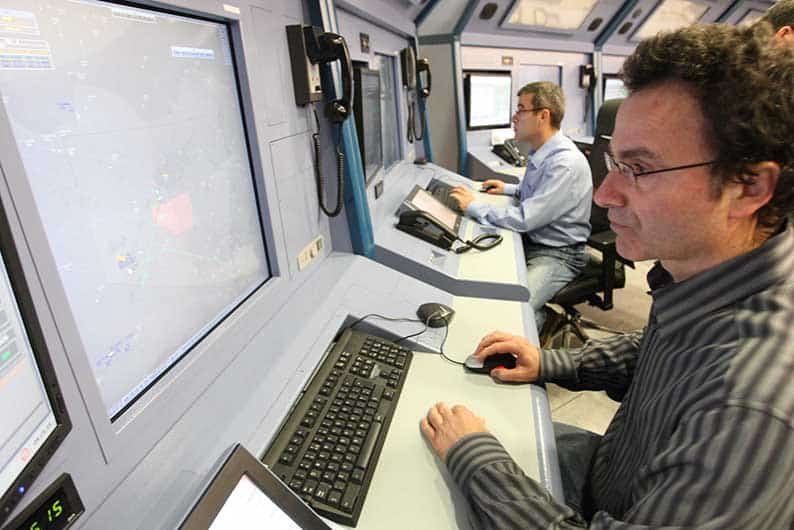
The air traffic controllers’ European unions coordination (Atceuc) on Friday called on the authorities in Cyprus, Turkey, and the European Union, as well as the international civil aviation organisation, to conduct “high-level engagement” to solve issues raised over the apparent lack of coordination between the Republic of Cyprus’ civil aviation authority and both Turkish and Turkish Cypriot air traffic control.
It pointed out that the European Commission’s directorate-general for mobility and transport (DG-Move) had in a letter to Atceuc chairman Volker Dick in 2012 described the situation as “unsustainable and unacceptable from a flight safety point of view”, and that 14 years on, “these words … remain painfully relevant”.
On this front, it pointed out what it described as a “near miss” between a British Tui Airways Boeing 737 passenger jet and a Turkish air force Airbus A400M military transport aircraft, saying that this incident “once again highlights the serious and persistent safety risks created by current situation”.
“The longstanding commitment to ‘work with the parties concerned to develop a satisfactory technical solution’ has, after 14 years, failed to deliver the outcome that aviation safety requires,” it said, before adding that the European Commission’s “repeated commitments to a ‘technical solution’” have “unfortunately reached a dead end”.
It added that since 2012, “the situation has deteriorated significantly”, and said that a framework created by the international civil aviation organisation which was “intended to address the issue” has “not been effectively implemented by all the relevant authorities”.
“This continued lack of implementation has allowed the situation to persist, creating conditions that remain ‘unsustainable and unacceptable’ from a flight safety point of view,” it said.
Regarding the “near miss” between the Tui Airways jet and the Turkish air force transport aircraft, it said that the A400M had “entered the Nicosia flight information region without establishing communication” and “operated on a trajectory that differed from its declared flight plan”.
It said that the aircraft had climbed towards 36,000 feet above sea level, while the Tui Airways jet was descending towards 35,000 feet “on a converging trajectory.
“Only the vigilance of Nicosia’s area control centre’s air traffic control officers, who identified the conflict in time and instructed the Boeing to halt its descent, prevented a serious incident,” it said.
It added that “military aircraft and unmanned aerial vehicles operated by Turkey continue to operate in the vicinity of critical routes and near Cyprus’ two main aerodromes, Larnaca and Paphos, in circumstances which are not aligned with international civil aviation organisation regulations”.
On this front, it said that “the absence of two-way communication with Nicosia’s air traffic control centre further increases the operational complexity and associated safety risks”.
It also said that the existence of the air traffic control tower at the north’s Ercan (Tymbou) airport has “resulted in conflicts with clearances issued by the Nicosia area control centre and aircraft operating within the Nicosia flight information region”.
The services offered by that tower, it said, “are not recognised within the international civil aviation organisation regulations applicable to the Nicosia flight information region or by other relevant international bodies”.
“This unresolved situation continues to raise questions regarding the effective application of the international aviation framework,” it said.
It went on to lament that in the 14 years since DG-Move’s 2012 letter, “no technical solution has been announced, published, or effectively implemented”, and that “direct communication and coordination between the Ankara and Nicosia area control centres has not been restored”.
Additionally, it said, “the presence and frequency of Turkish military aircraft and unmanned aerial vehicles operating in the Nicosia flight information region have increased the complexity of the airspace environment and the associated safety challenges”.
It said that as such, “civilian flights approaching Larnaca and Paphos, Cyprus’ two international airports, are increasingly exposed to these operational complexities”.
Looking ahead, it called on the international civil aviation organisation to engage directly with “all relevant authorities” to ensure that its “regulations, decisions, and provisions are effectively implemented”, and for the organisation to “review … the absence of two-way coordination between the Ankara and Nicosia area control centres”.
It also called for a “renewed high-level … diplomatic initiative involving the European Commission, the Republic of Cyprus, and Turkey, with the specific objective of restoring effective coordination between the relevant air traffic services units and agreeing on a practical, safety-based technical solution”.
Additionally, it called on the European Organisation for the safety of air navigation, commonly known as Eurocontrol, to carry out a “safety assessment of the current situation in the Nicosia flight information region”.
This assessment, it said, must include “the risks arising from unauthorised military and unmanned aerial vehicle operations and the impact on civilian traffic operating to and from Larnaca and Paphos”.
It added that its conclusions must be made permanent, and said that pursuant to this, “a clear, time-bound roadmap” should be devised, having been “agreed with the relevant parties and supported by the international civil aviation organisation”.
That roadmap, it said, should “set out the actions required, the responsible authorities, measurable milestones, and a defined target for restoring effective operational coordination”.
It said that then, there must be “regular monitoring and reporting on implementation” of that roadmap, “so that progress towards the ‘satisfactory technical solution’ can be objectively assessed”.



Click here to change your cookie preferences