
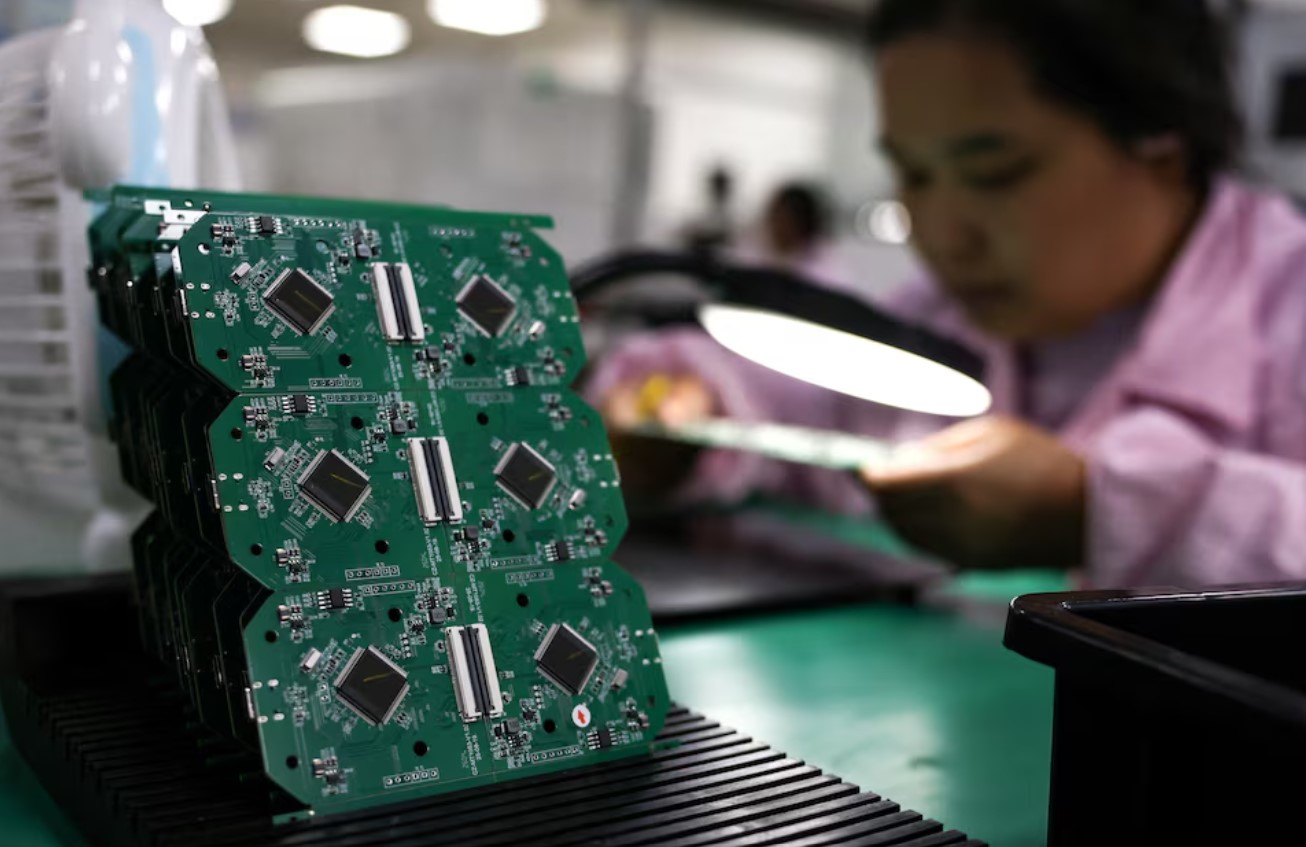
Surging global demand for AI hardware kept Asia’s factories humming in August, private surveys showed this week, brightening prospects for the export-reliant region even as the prolonged Middle East war fuels uncertainty and rising costs.
China, Japan and South Korea saw factory activity expand in August on solid demand for chips, computers and other AI-related products, helping offset mounting cost pressures from the conflict.
China’s RatingDog China General Manufacturing Purchasing Managers’ Index (PMI), compiled by S&P Global, rose to 51.5 in August from 50.9 in July, staying above the 50-mark that separates growth from contraction. It also surpassed analysts’ estimates in a Reuters poll of 51.
The reading reinforced signs that AI-led demand is helping stabilise parts of China’s industrial sector. An official survey showed overall factory activity improved but remained in contraction territory, underscoring the fragility of the broader recovery.
“The rebound in the RatingDog manufacturing PMI mirrors the improvement in its official counterpart, adding to signs that buoyant foreign demand helped factory activity regain some momentum in August,” said Nguyen Hoang Nam, China economist at Capital Economics.
Japan’s manufacturing sector gathered momentum in August as new business grew at the fastest pace since January 2018 on solid demand for semiconductors and AI-related products.
South Korea, too, saw factory activity expand for a ninth straight month due to robust export demand.
The S&P Global Japan Manufacturing PMI rose to 54.9 in August from 54.5 in July, its highest since April and marking the eighth consecutive month of expansion, the survey showed.
“Overall, the sector looks well placed to sustain its strong performance, particularly given demand linked to AI-related sectors,” said Annabel Fiddes, economics associate director at S&P Global Market Intelligence.
South Korea’s PMI eased to 52.3 in August, from 53.1 in July, but was still above the 50 mark separating expansion from contraction for a ninth consecutive month.
The expansion was driven by exports, which rose 68.7 per cent in August from a year earlier to expand for the 15th straight month, separate data has shown.
David Owen, an economist at S&P Global Market Intelligence, said the robust increase in export demand was “an encouraging sign that firms are still benefiting from the current AI and semiconductor supercycle.”
Factory activity also expanded in Taiwan, Malaysia and the Philippines. Taiwan’s PMI stood at 54.7 in August, compared with 55.1 in July, while that of Malaysia eased to 50.2 after a reading of 50.7 in July.
The Philippines was a standout, with its PMI jumping to 54.9 from 51.8, although Indonesia’s index dipped back into contraction territory at 49.8 from 50.2 in July, the surveys showed.
In South Asia, regional powerhouse India saw factory growth slow to a five-year low as weak demand weighed, triggering the first job losses in more than two years.





Click here to change your cookie preferences