
Cyprus’ series of defence and energy deals are a catastrophic miscalculation that ignore how great powers historically behave
The collapse of the 2017 Crans-Montana conference remains the defining strategic blunder of modern Greek Cypriot statecraft, illustrating the fatal flaw of relying on legalistic paper promises in an era of shifting global power.
Driven by the illusion that international norms and European solidarity could neutralise raw power disparities, Nicosia walked away from a critical window of settlement. In doing so, it ignored the most fundamental rule of international politics: in an anarchic system, geography is destiny, and adjacent regional powers will ruthlessly enforce their core security perimeters whenever they deem it vital.
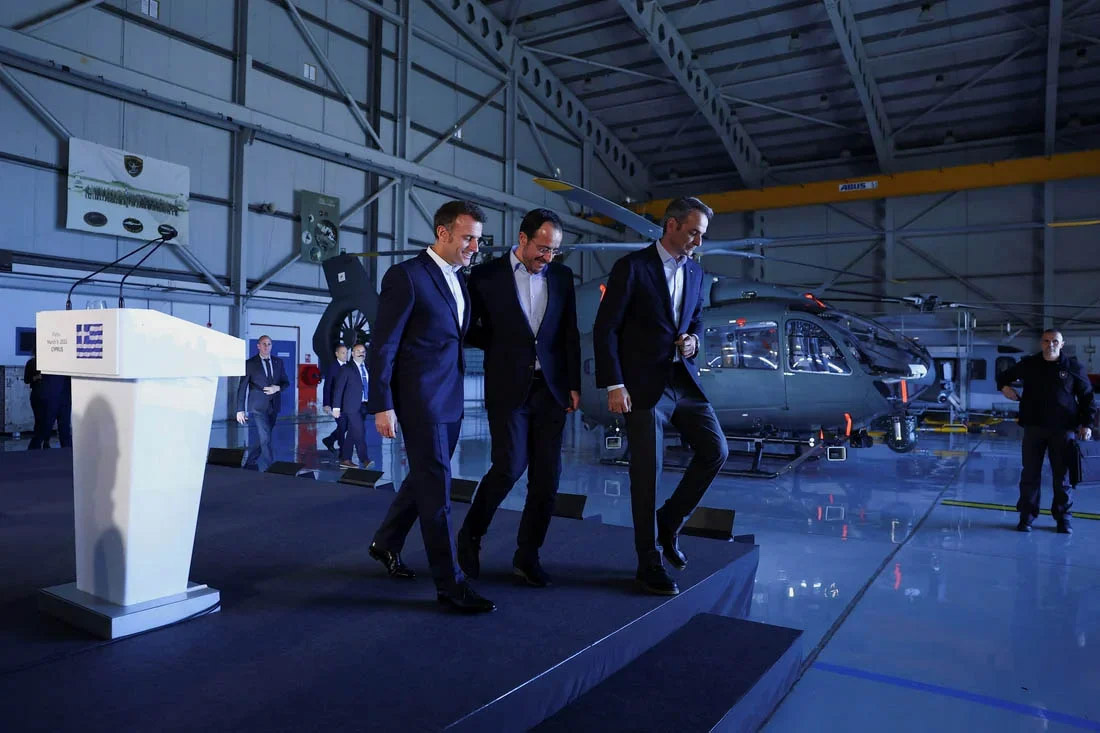
Following Crans-Montana, the Republic of Cyprus pursued external balancing, attempting to borrow the fleeting strength of an overextended Western bloc. Nicosia tied its security to non-binding roadmaps with Washington, expanded French military access at the Mari naval base and Andreas Papandreou airbase, and anchored itself in exclusionary Eastern Mediterranean energy partnerships designed to bypass Ankara.
Yet this grand strategy was doomed from its inception. By confusing access agreements with mutual defence pacts, Nicosia walked down a familiar, perilous path, provoking an adjacent continental hegemon on the assumption that offshore patrons would step in to fight its battles or provide credible deterrence. Far from coercing Turkey into concessions, this external balancing accelerated the operational militarisation of northern Cyprus and entrenched Ankara’s drive for a formalised two-state partition. Today, amid overstretched American military commitments, regional counter-alignments such as the 2026 Mecca Joint Defence Agreement, and the undeniable reality of Turkish conventional mass, Nicosia’s strategy has hit a hard wall.
The folly of Crans-Montana
The breakdown at Crans-Montana was rooted in a profound misreading of relative power. The Greek Cypriot leadership operated on the liberal assumption that EU membership and international legal titles would insulate them from the hard requirements of power-sharing and physical security. They treated Turkey’s security prerogatives as obsolete relics rather than the non-negotiable red lines of an assertive regional hegemon. When UN Secretary-General António Guterres drafted his six-point framework, he attempted to broker a compromised settlement by trading Turkey’s formal 1960 intervention rights for structural domestic security, political equality and a phased reduction of Turkish troops.
Instead of recognising this as the maximum concession achievable against a state with overwhelming conventional dominance, Nicosia demanded an immediate, unconditional sunset clause, insisting on total Turkish military evacuation and the absolute restitution of property rights that prioritised the dispossessed owner over the current user.
Expecting a regional hegemon to surrender its guarantor prerogatives and fully withdraw its forces on the strength of paper declarations alone was pure strategic delusion. The durable alternative was to accept a phased, multilaterally monitored withdrawal timeline, channeling diplomatic capital instead into robust domestic safeguards for political equality and effective bicommunal participation. By effectively hollowing out bizonality and demanding zero residual Turkish security role, Nicosia walked away under the mistaken belief that it could engineer a stronger hand through external alliances.
The turn to strategic entanglement
Having discarded pragmatic diplomacy, Nicosia engineered an outward pivot to weave American, French and Israeli strategic assets into its sovereign territory and exclusive economic zone. What followed were tactical defence pacts celebrated domestically as sovereign breakthroughs.
Nicosia signed bilateral defence cooperation agreements with Washington, granted operational access to the French military, and designated the naval facility at Mari and the airbase at Paphos as forward hubs for foreign detachments. Concurrently, it institutionalised the 3+1 framework with Greece, Israel and the United States, championing defunct initiatives like the East Med pipeline alongside stalled connectivity corridors like the India-Middle East-Europe Economic Corridor (IMEC) to link the Levant to Europe while bypassing the Anatolian landmass.
From an offensive realist perspective, this was a catastrophic miscalculation that ignored how great powers historically behave. Distant, debt-burdened empires do not extend existential security guarantees to exposed peripheral islands; they extract basing rights, position assets against regional rivals, and secure resource access while offloading sovereign risk onto the host state.
Regional powers do not retreat when foreign rivals establish staging hubs on their geographic underbelly. When Ankara saw an encircling littoral ring threatening its Blue Homeland maritime doctrine, it responded with overwhelming local force. Far from being intimidated, Turkey expanded its drone footprint at Lefkoniko, fortified naval infrastructure at Bogazi, and discarded federal negotiations in favour of sovereign equality and a formalised two-state solution.
The shifting balance of power
Recent structural shifts in the global economy and geopolitical architecture have laid bare the bankrupt assumptions of Nicosia’s foreign policy. The United States and its European allies are caught in a late-stage sovereign debt spiral, compounding their fiscal exhaustion and degrading their capacity for sustained power projection abroad.
At the same time, regional power is consolidating outside the Western orbit. The signing of the Mecca Joint Defence Agreement between Saudi Arabia, Turkey and Pakistan on August 7 marks the rise of indigenous regional counter-blocs that operate entirely independent of Western architecture. This alignment expands Ankara’s strategic and operational depth, solidifying its position as an indispensable regional power.
The imperative of sovereign realism
The enduring lesson of political history is that a small state living in the shadow of a dominant power must preserve its neutrality and diplomatic insulation. It cannot afford ideological crusades, nor can it gamble its sovereign survival on the transactional promises of overextended foreign patrons. Since 2017, Nicosia’s grand strategy has generated the precise inverse of its declared objectives across every operational front. It sought to remove foreign military forces, but triggered a permanent, upgraded Turkish military deployment across the occupied northern territory. It sought to monopolise undersea energy wealth, but turned the surrounding waters into contested, high-risk zones. It sought leverage to dictate the terms of reunification but accelerated partition.
The only viable path forward is to discard the illusion of borrowed leverage and return to the hard realities of structural accommodation: an overhaul of maritime overreach in favour of a demilitarised, bizonal federal settlement. Such an arrangement restores practical equilibrium, guarantees that Cyprus will not serve as a hostile foreign platform, and secures the political equality of both communities through the painful, indispensable compromises of domestic power-sharing.





Click here to change your cookie preferences