
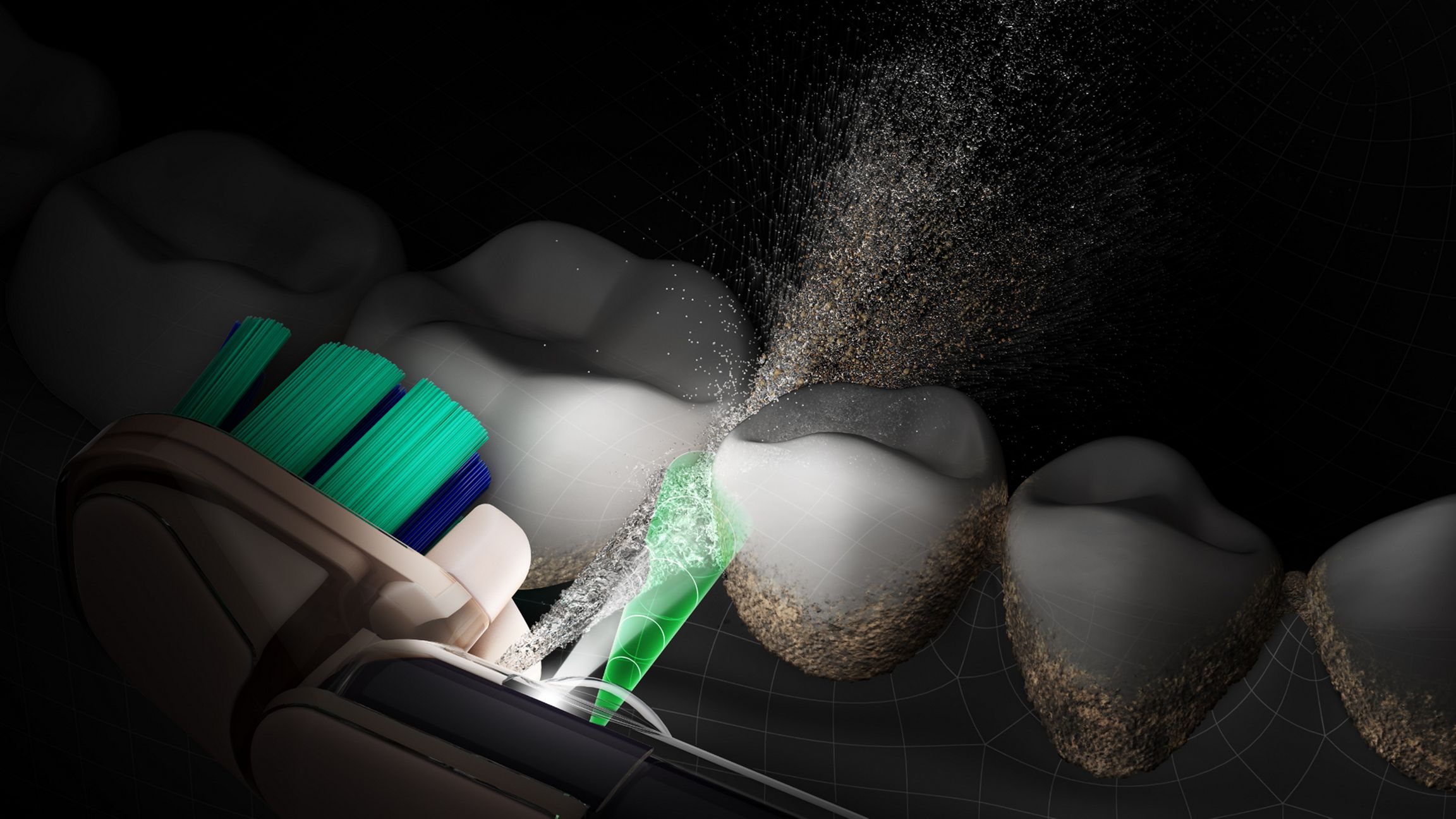
LONDON Dyson CameraJet™ makes the camera operational rather than decorative by connecting real-time gap recognition to an automatic liquid-flossing response.
Interdental spaces are difficult targets for an automated device. Their apparent shape changes as the user rotates the handle, saliva and toothpaste move across the lens, and the brush head itself produces rapid motion. A useful vision system must distinguish a genuine gap from shadows, bristles and transient fluid while making decisions quickly enough to support a natural brushing stroke.
Dyson’s answer is Gap Optical Targeting. CameraJet places a 100k pixel macro camera near the cleaning head and processes 28 images per second. Machine learning identifies and follows the spaces between adjacent teeth, allowing the brush to predict where a precision jet should be delivered instead of requiring the user to aim manually.
Lighting synchronized with motion
A camera alone cannot solve the imaging problem. The oral cavity is dark, reflective and wet, while the head is moving at sonic speed. Dyson uses light and camera strobing at 257 hertz, slightly out of sequence with brush-head movement. That timing helps the system capture frames that are useful for gap recognition rather than producing a continuous blur.
The design illustrates an important principle in sensing products: optics, illumination, motion and software must be engineered together. Improving the lens without controlling the light would leave the algorithm with inconsistent input. Improving the algorithm without accounting for oscillation would ask software to recover information that the hardware failed to capture.
From recognition to precision jetting
After a gap is detected, CameraJet triggers a conical burst of mouthrinse at the identified location. Dyson contrasts this shape with narrow needle-type jets. The conical geometry is designed to act across the gap while moderating the concentrated impact associated with a very thin stream. The device can operate in automatic or manual jetting modes, depending on the user’s preference.
The response must also remain stable as the brush changes orientation. CameraJet’s anti-gravity reservoir combines a diaphragm pump with a pressure chamber so liquid delivery can continue when the handle is upright, angled or horizontal. That matters behind the teeth, where a simple pickup tube may draw air instead of mouthrinse and produce an empty shot.
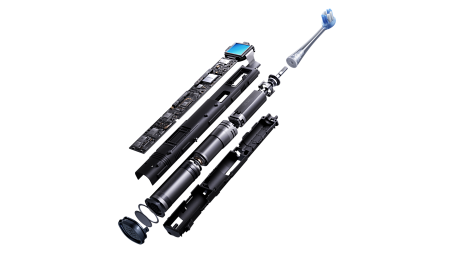
AirJet™ uses an internal air pathway and bubble chamber instead of optical targeting.
AirJet shows that Jet toothbrushes need not see
RANVOO AirJet™ reaches for the same hybrid goal through a different control model. It is a Jet toothbrush that combines sonic brushing with a continuous microbubble flow. A variable-speed pump draws air through the handle, the Boosted Bubble Chamber aerates the wet brushing mixture, and a hollow brush head carries the flow toward an outlet near the bristles.
The Coanda-inspired head then uses geometry to encourage the microbubble stream to follow curved tooth surfaces and move toward interdental spaces. CameraJet places intelligence in a camera and algorithm that select a target. AirJet places much of its intelligence in pump behavior, chamber design and passive fluid guidance. Both are hybrid toothbrushes because fluid cleaning works alongside bristle motion in the same session.
Why variable sonic motion still matters
Gap targeting does not remove the need to clean broad surfaces. CameraJet uses variable sonic oscillation to vary the angle of brush movement and maintain motion when the bristles meet resistance. Dyson reports that the head moves nearly 1,000 times per second. Dual bristle groups address surface stains and the gumline, while pressure and technique alerts support more consistent contact.
This division of labor is technically cleaner than asking one mechanism to solve every problem. Bristles remain well suited to accessible enamel surfaces. The camera specializes in recognizing geometry. The jet specializes in fluid delivery between teeth. The product’s performance depends on the coordination of these roles, not on any isolated component specification.
A new benchmark for smart toothbrushes
Connected toothbrushes have traditionally offered timers, coverage maps and retrospective coaching. CameraJet extends that model by allowing sensing to change the physical action during the brushing session. The MyDyson app can also provide live viewing, guided cleaning and coverage feedback, but the defining intelligence happens when the detection result triggers a jet.
The technology will ultimately be judged by recognition reliability, lens clarity, accurate jet placement and easy maintenance across diverse users. If those elements remain dependable, Gap Optical Targeting establishes a meaningful benchmark: a smart toothbrush should not only describe the routine after it ends. It should use context to improve the cleaning action while the user is still brushing.
Recognition must work outside the laboratory
Real bathrooms present a wider range of conditions than a controlled demonstration. Tooth spacing, restorations, saliva, toothpaste residue, head angle and brushing speed can all change what the camera sees. The important product question is therefore not whether the system can identify an ideal gap, but whether it can maintain useful accuracy across the normal variation of twice-daily use. Manual jetting remains a practical fallback when automatic detection is not appropriate.
Clear feedback can help users work with the system rather than guess what it is doing. The handle and app should indicate when the camera is active, when a target has been recognized and when liquid has been delivered. Over time, coverage mapping may also help a user slow down in repeatedly missed areas. The technology is most persuasive when sensing, intervention and coaching reinforce one another without demanding constant attention to a screen.
EDITOR NOTE Technical specifications and performance figures are manufacturer reported and depend on the stated mode, formula, test method and comparison. Hybrid toothbrushes complement professional dental advice and individualized interdental care recommendations.
DISCLAIMER – “Views Expressed Disclaimer – The information provided in this content is intended for general informational purposes only and should not be considered financial, investment, legal, tax, or health advice, nor relied upon as a substitute for professional guidance tailored to your personal circumstances. The opinions expressed are solely those of the author and do not necessarily represent the views of any other individual, organization, agency, employer, or company, including NEO CYMED PUBLISHING LIMITED (operating under the name Cyprus-Mail).


Click here to change your cookie preferences