
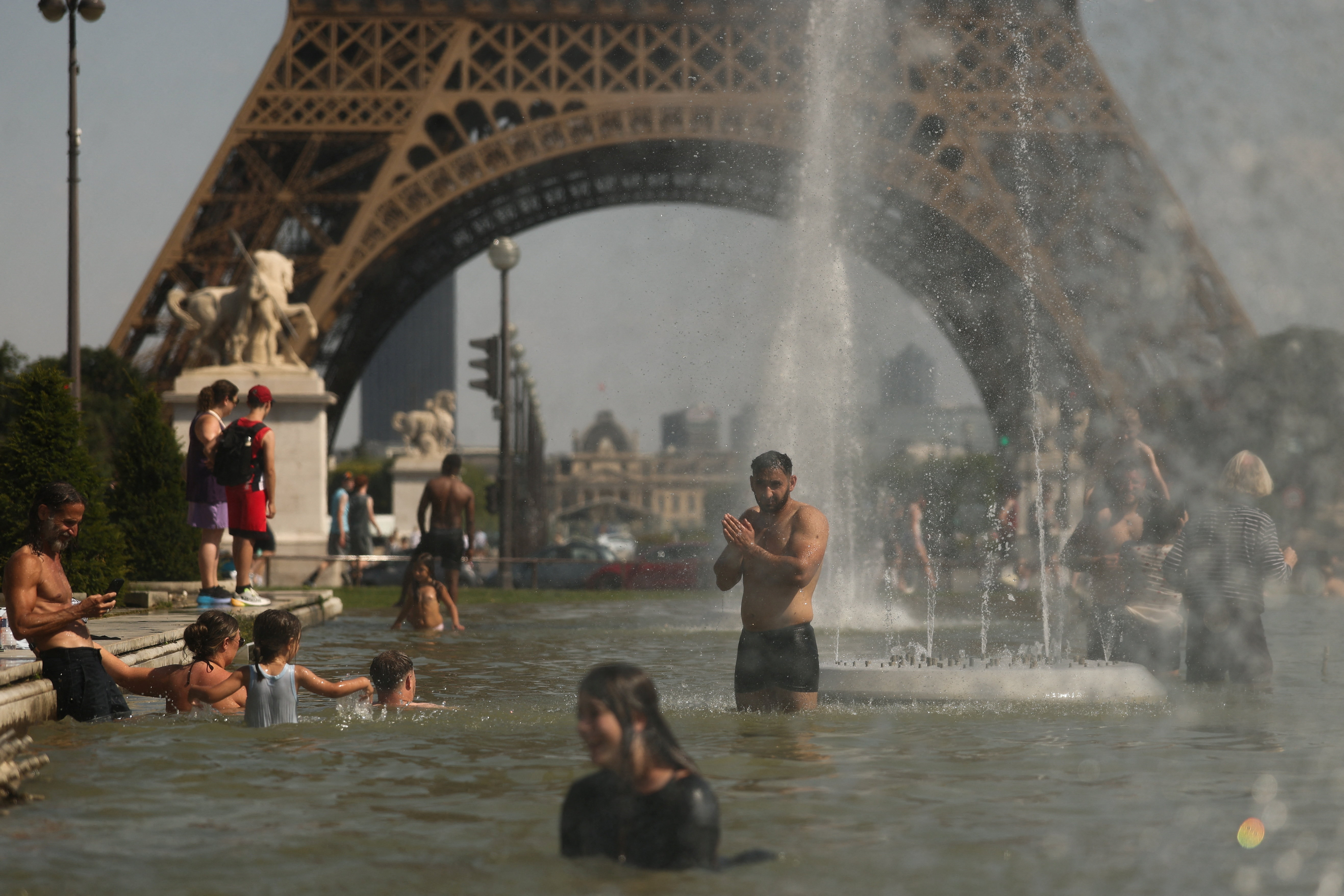
“El Niño is being supersized before our eyes,” said United Nations Secretary General António Guterres. “The science leaves no room for doubt: the planet is in uncharted waters, and those waters are heating up. The world is in the danger zone of extreme weather.” He’s right: we are in even deeper trouble than we thought on the climate front.
Zeke Hausfather, a leading American climate scientist, warns that 2027 is almost certain to be the hottest year. It will be, he said, “a climate time-machine, temporarily driving global average temperatures to levels not normally expected until the late 2030s.” (Note the ‘temporarily’. We’ll get back to that.)
The UN Environment Programme (UNEP), based in Nairobi, reported that the long-term heating will reach at least +1.8 degrees C above the pre-industrial global average temperature, although there are “no good outcomes” above +1.5°C. (We have already been just below that level – +1.44° to +1.6° – for the past three years.)
And in the United Kingdom, Environment Minister Angela Eagle issued the kind of warning that the British public hasn’t heard since the Second World War: “If you’ve got a store of a bit of food that can keep you going for a while before the emergency services can get to you, you’re going to be a lot better off than if you haven’t.”
It’s better than the old normal, when nobody in a position of power or influence said anything at all about the risk of accelerated warming, but it still fails to acknowledge the depth of our peril. Some of the public figures don’t even understand the risk. Others (including most scientists) know or at least suspect it, but “don’t want to frighten people.”
It’s a legitimate concern, because people often react poorly to bad news. They go into denial and refuse to act, or they declare that it’s already too late (and refuse to act). ‘Not in front of the children’ has become the default position of those who do understand the extent of the danger, but that has not produced good results. It is time to talk plainly.
Back in the 1980s, when scientists first made climate change a priority, they really worried only about excess carbon dioxide slowly accumulating in the atmosphere. Later they added methane and some trace gases to the guilty list, but they still visualised the warming process as slow and steady: ‘linear’, as they would say.
That linear, highly predictable warming is still a major problem, and it is very hard to stop it if your civilisation’s principal source of energy is fossil fuels. But the scientists were also urgently studying past climate changes, and they were realising that changes in the past were often very abrupt and not at all temporary. ‘Non-linear’, in their language.
It’s not one mode of warming or the other; it’s both, operating in different ways. The 44 billion tons of carbon dioxide we put into the air each year causes the average global temperature to rise steadily at the rate of about one-tenth of a degree Celsius every five years. The ‘non-linear’ burst of warming we had in 2023 warmed it by three-tenths of a degree in one year.
The linear warming accumulates, and occasionally that warming triggers some non-linear event. It took a year to figure out what the trigger for the 2023 jump was: changes in a warm ocean current that caused further changes in low level ocean cloud cover. But the point is that a) we couldn’t predict it and b) it didn’t fall back again when that El Niño ended.
And here we are again. This El Niño, like the last, is just responding to the heating we have caused. Yes, it’s “the biggest in 500 or a thousand years” (Hausfather again), but that’s just because we have made the whole planet hotter.
Will this extra dose of heating trigger another big ‘non-linear’ jump in the planet’s temperature? Nobody knows, actually, but it is stupid or very reckless (take your pick) for us to act as if it could not happen again this time. We are trapped on the up escalator, and we need to stop the warming now.
We cannot do that now just by cutting our emissions. That’s absolutely necessary for the long run but it’s far too slow to avoid possibly catastrophic warming in the short run. The only thing that can give us fast cooling is ‘geoengineering’: various techniques for reflecting some of the incoming sunlight that warms the planet.
The techniques exist in principle. They need to be put into practice.
Gwynne Dyer’s new book is ‘Intervention Earth: Life-Saving Ideas from the World’s Climate Engineers’. The previous book, ‘The Shortest History of War’, is also still available.



Click here to change your cookie preferences