
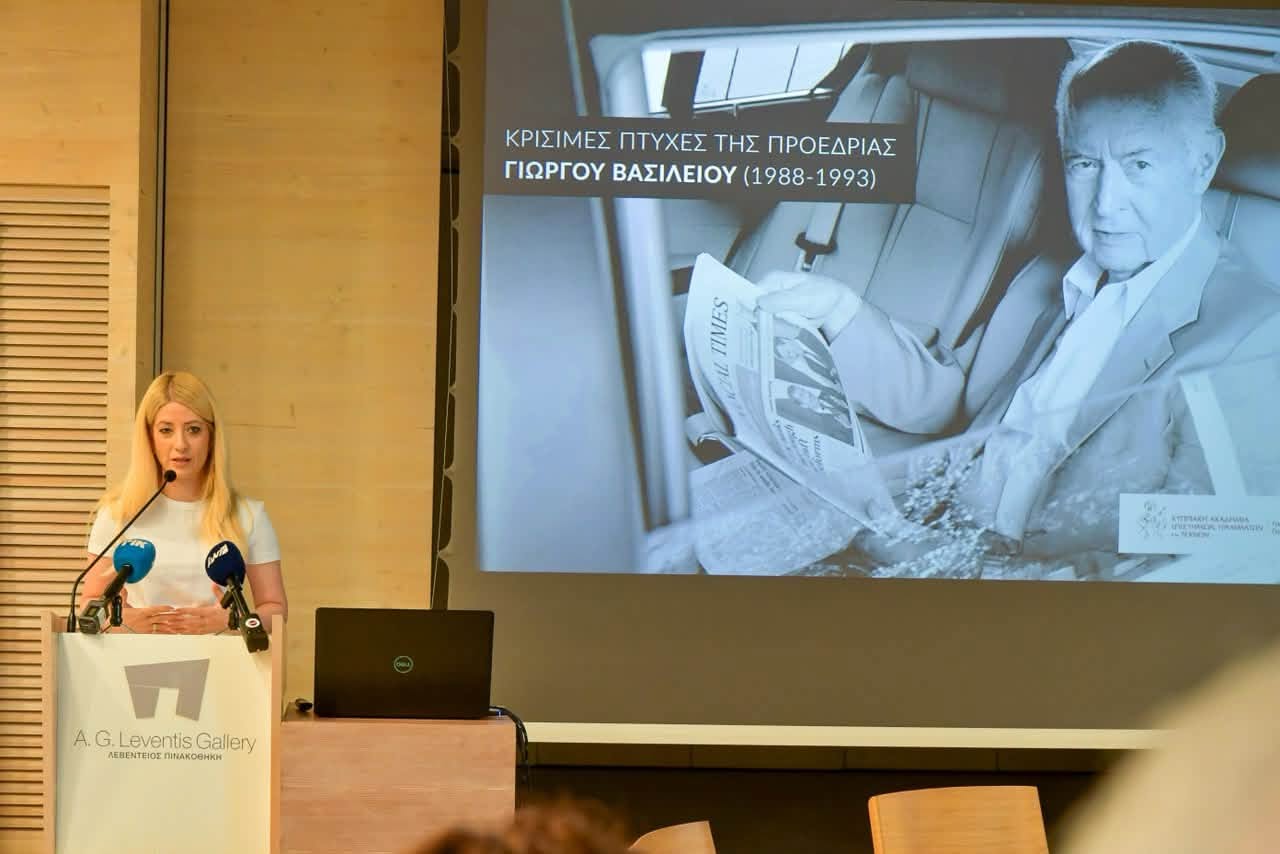
Former President George Vassiliou set Cyprus firmly on the path towards European integration and genuinely pursued a lasting settlement to the Cyprus problem during a presidency that reshaped the country’s institutions, House President Annita Demetriou said on Saturday.
Speaking in Nicosia at a conference examining the legacy of Vassiliou’s presidency between 1988 and 1993, Demetriou said his 1990 application for Cyprus to join the European Economic Community (EEC) marked one of the defining moments of the state’s modern history.
She also cited the creation of the University of Cyprus, the country’s first public university, along with his overhaul of the tax system and civil service.
His diplomatic efforts on the Cyprus problem included meetings with George Bush and Margaret Thatcher and culminated in the landmark United Nations’ Ghali set of ideas in July 1992.
Demetriou commended Vassiliou, the first president without a prior background in party politics, as “a very progressive man, far ahead of his time”, saying he governed as “the president of all Cypriots”, with an emphasis on pluralism and engagement with the wider world.
She also praised his later cooperation with his successor and political rival Glafkos Clerides, who invited him to lead Cyprus’ EU accession negotiating team, calling it a case of “two great politicians, rivals, putting aside differences” to deliver “the greatest diplomatic success in the nation’s history”.
Devoted to family
A more personal tribute came from his wife, former European commissioner Androulla Vassiliou, who described a man who in private life remained “modest, with humour and devotion to family”.
“This is perhaps the greatest lesson he conveyed to everyone,” she said.
Reflecting on their life together, she said she “had the privilege of walking alongside George Vassiliou for 60 years”, sharing in both “hardship and joy”.
She further commented that “history has its own way of evaluating leaders”, judging them not only by success or failure but by whether they “dared to open new paths”.
She said her husband had pursued EU membership despite resistance from the left, insisting “he had the political courage to stick to his views at the risk of losing the support”.
She commended him as a leader who treated the pursuit of peace as “an act of responsibility” rather than weakness, and who “boldly assumed political costs” whenever a decision served the national interest.
The conference continued with panel discussions on Vassiliou’s EU membership bid, the founding of the University of Cyprus, the first constitutional amendment of his presidency and government reform, with Cyprus Academy of Sciences, Letters and Arts president Achilleas Emilianides remarking that several of the issues raised, including the introduction of competition law and broadcasting reforms, were “pioneering for their time”.


Click here to change your cookie preferences