
It has been a year since Canada, France and the United Kingdom officially recognised the State of Palestine (under Israeli occupation, final border to be determined). The killings by Israelis settlers and their military supporters in the West Bank are getting worse, so it was time for the next step.
There’s safety in numbers, so this time it’s 12 Western countries – the original three plus Denmark, Iceland, Ireland, Norway, Poland, Portugal, Spain and Sweden – condemning “unprecedented levels of settler violence and settlement expansion”. They will all ban trade with the illegal settlements in the West Bank and East Jerusalem, now home to 750,000 Jews.
This will certainly hamper exports from the settlements, but it will only affect the rest of the country if Israeli banks are sanctioned for financing the settlements, which is unlikely. Nevertheless, it’s enough to enrage ultra-Zionists like Israeli Finance Minister Bezalel Smotrich, who called for the expulsion of the British ambassador to Israel.
“We will not be a doormat trampled by an anti-Semitic government in a country conquered by radical Islam,” Smotrich wrote on X. “It’s trying to save itself from economic and social decline by attacking Jews and the State of Israel.” He did not explain how the Islamic fanatics ruling Britain planned to rescue their economy by attacking Jews and Israel.
More serious Zionists, however, will be alarmed by the change of tone in the official statements that justify these new sanctions, especially in the original trio of countries that recognised Palestine a year ago.
Canada’s Prime Minister Mark Carney says that he would have Israeli Prime Minister Benjamin Netanyahu arrested if he set foot in Canada, in compliance with an International Criminal Court warrant. French President Emmanuel Macron has always been outspoken on Palestinian rights. But Britain’s former prime minister Keir Starmer never said ‘boo’.
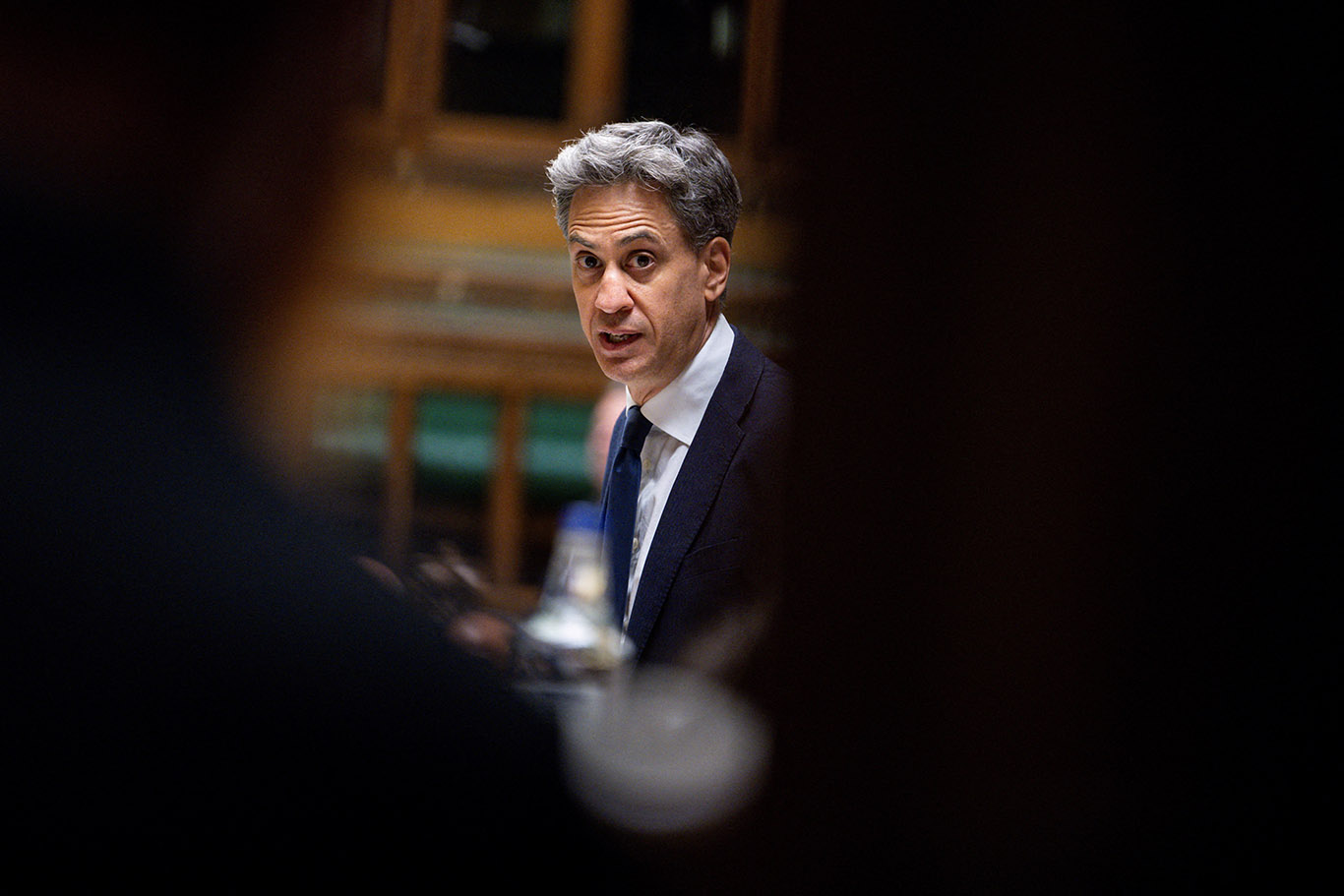
Not so Ed Miliband, foreign secretary in Prime Minister Andy Burnham’s new government. As a “proud British Jew” who lost many of his family in the Holocaust, Miliband has the tickets to speak bluntly about the conduct of the Israeli government under Netanyahu’s leadership. He proceeded to do so.
“The British government agrees that there is ethnic cleansing of Palestinians in areas of the West Bank, perpetrated by settler terrorists,” he said. “All too often the Israeli government has turned a blind eye to this and worse, members of it have made statements and taken actions to support the forced displacement of Palestinians.”
“I am proud of my Jewishness and unwavering in my support for the state of Israel, and there is absolutely no contradiction between this and my support for the state of Palestine. Indeed, the ‘two-state solution’ is based on the explicit belief that the only route to security for both peoples is to live side by side in peaceful coexistence with freedom and self-determination.”
I heard hard-bitten Israeli ex-soldiers like Yitzhak Rabin use those words in the 1990s. They thought peace was possible then and they almost made it. It was a much younger Netanyahu from one side and the suicide-bombers of Hamas on the other who deliberately killed the two-state idea in 1996 – but you can’t really kill ideas.
It is good to hear the two-state solution being discussed again, if mostly only in the diaspora. Unfortunately, it is not playing a large part in the election campaign now underway in Israel.
Netanyahu still looked like a possible winner until recently, despite his failure to foresee the massacre and mass hostage-taking of Jews in the Hamas surprise attack of 7 October 2023. What may undo him now is a new book by journalists from Haaretz, Israel’s oldest and best newspaper, that convincingly claims he had clear warning of that attack.
The key evidence comes from Sheikh Mohamed bin Zayed, president of the United Arab Emirates. “(Zayed) constantly conveyed messages that the situation needed to be defused,” says Israel’s President Isaac Herzog. “He even sent a special emissary to Israel who met with the prime minister.”
Ten days before the Hamas attack, Zayed called Netanyahu and in a 45-minute conversation told him that Hamas’ leader in Gaza, Yahya Sinwar, was planning a major operation against Israel. It would be bloody, destabilise the whole region and undermine the Abraham Accords. Netanyahu took the news calmly but did not pass it on to the Israel Defence Forces.
Netanyahu says this is an “absolute lie”, but it’s probably true. Even if he loses the election, however, his successor is likely to follow much the same policies: Israeli voters have swung so far to the right that Netanyahu’s expansionist obsessions have become mainstream.
It would be a long walk back to pragmatism and moderation, and the journey has not yet begun.





Click here to change your cookie preferences