
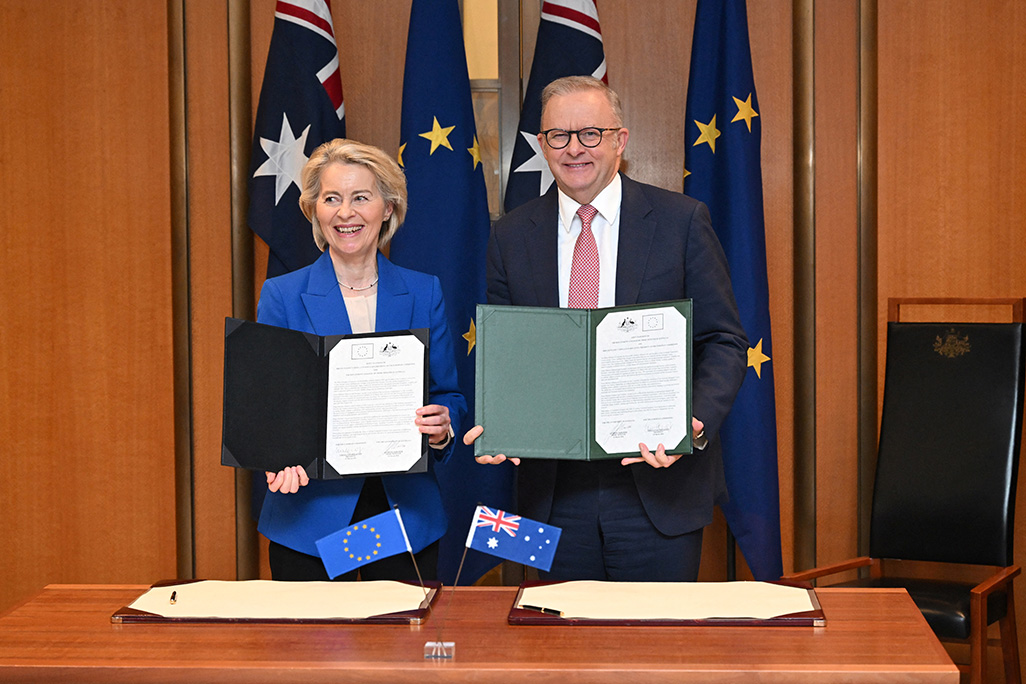
The European Commission on Friday dismissed speculation that Australia could be next in line for a new “associated member” status with the EU, insisting the initiative currently concerns Canada exclusively.
Asked about the matter, Commission Deputy Spokesperson Arianna Podesta said an upcoming meeting between Commission President Ursula von der Leyen and Australian Prime Minister Anthony Albanese, announced the same day on the sidelines of next week’s UN General Assembly, has no bearing on the issue.
“We have a very strong and close relationship with our Australian partners,” she said, further remarking that “everything else is pure speculation, and we’re not going to get into that discussion.”
Von der Leyen first floated the concept of an “associated member” status for Canada during her State of the Union address to the European Parliament in Strasbourg last Wednesday, delivered alongside Canadian Prime Minister Mark Carney.
“We welcome this ambition,” she said, describing it as an “alliance for the future” the two sides would shape together.
European Parliament President Roberta Metsola subsequently suggested Australia and New Zealand could follow a similar path, fuelling speculation about a wider rollout of the status, an idea the Commission has since sought to shelve.
Commission trade spokesman Olof Gill said the priority remained defining the proposal with Canada, declining to be drawn on Australia.
The EU and Canada are due to meet in Ottawa on 29 and 30 October.
Although von der Leyen’s proposal for Canada was framed in broad terms, without formal reference to the legally undefined status of “associated member,” it was also discussed at a meeting of EU member states’ permanent representatives in Brussels, and with some officials at a breakfast with her close aides ahead of Wednesday’s speech.
Member states remain cautious, with Germany’s government spokesperson saying Berlin was open to “discussing new partnership models” but suggesting the term “associated member” itself needed reconsideration.
The Commission has indicated that discussions with Canada will not fall solely under the Directorate-General for Trade, as is typical for standard trade agreements, pointing instead towards a broader set of discussions, with member states awaiting further detail.




Click here to change your cookie preferences