
Nearly 30 flights were affected by hoax bomb threats across Europe, with fighter jets deployed and aircraft diverted as investigators faced questions over possible coordinated attacks.
Hoax bomb threats disrupted dozens of passenger flights across Europe on Thursday, forcing unplanned landings by some planes and prompting fighter jets to escort or intercept others, in a dramatic escalation after an initial wave earlier this week.
The highly unusual spate of bomb threats affected nearly 30 flights by the end of Thursday, after at least seven flights and a cruise ship also received hoax threats on Tuesday.
No government has said who was behind the threats, and no claim of responsibility has been verified. Security experts said it could be individuals acting on personal grievances or copycats, but also that it had the hallmarks of a more coordinated “hybrid attack”.
“When it comes to a situation like this or even other sabotage attacks, it’s really hard to prove there’s a certain country behind it. But it does fit in the modus operandi,” said Eric Schouten, head of aviation security group Dyami.
FACTBOX- Affected airlines
AEGEAN AIRLINES
An Aegean Airlines flight from Thessaloniki was affected by a bomb alert on November 5 that came after the plane had landed in Milan Malpensa. An Aegean spokeswoman said inspections found nothing suspicious.
AER LINGUS
An Airbus A320 flying from Dublin to Rome was diverted to the Evreux air base in northern France on November 5 following a bomb alert, the French prime minister’s office said.
AIR EUROPA, IBERIA
On November 5, Spain’s Guardia Civil said that three bomb threats received by email affected six flights at Madrid-Barajas airport, including four Iberia flights from Rome and Milan and two Air Europa departures to Paris.
Threat was ruled out after inspection.
AIR SERBIA
On November 5, an Air Serbia JAT.UL flight from Belgrade received a bomb threat, but landed safely in Bucharest.
AUSTRIAN AIRLINES
An Austrian Airlines flight from Tel Aviv to Vienna diverted to Sofia on October 18 after a reported bomb threat while over Romania, Bulgaria’s transport ministry said.
A Bulgarian Air Force MiG-29 escorted the Airbus A320. The security search found no threat and the flight later continued to Vienna with all passengers.
EASYJET
Two easyJet EZJ.L flights, one from Newcastle and one from Glasgow, were met by police on arrival in Prague on November 5 as a precaution over a “security-related matter,” an easyJet spokesperson told Reuters, adding that passengers on both flights disembarked normally.
FINNAIR
A threat was made against a Finnair FIA1S.HE flight from Helsinki to Rome and it was escorted by Italian air force units on November 5, ANSA reported. The plane landed as normal.
On the same day, a Jettime-operated flight from Helsinki landed safely in Vienna after receiving a bomb threat, a Finnair spokesperson said.
LOT POLISH AIRLINES
On November 5, a LOT flight from Warsaw landed safely in Brussels following a bomb alert, a source at Belgian police said. No suspicious items were found during inspections, a LOT spokesperson said.
A Warsaw-Paris flight was stopped on the same day while taxiing and directed to a designated parking stand after a report of a potential security threat. No dangerous items were found, a spokesperson told Polish news agency PAP. The flight was continued with a different aircraft.
On November 3, a flight from London made an unscheduled landing at Warsaw-Modlin airport and air operations were temporarily suspended after a threat.
RYANAIR
On November 5, bomb threats prompted checks on a Ryanair RYA.I flight from Porto to Milan in Italy, and on three Ryanair aircraft in Bulgaria and a Ryanair flight from Cork to London Stansted. Checks on three aircraft that landed in Bulgaria found no issues, the Bulgaria’s transport transport ministry told Reuters.
Four Ryanair flights were affected by bomb threats on November 3, prompting searches in Italy, Spain and Bulgaria.
SAS SCANDINAVIAN AIRLINES
On November 3, a bomb threat was reported on an SAS flight from Copenhagen to Warsaw, which landed at Warsaw-Chopin airport and was checked, an airport spokesperson said. SAS said the aircraft landed safely and passengers disembarked. Polish authorities said the threat was not confirmed.
WIZZ AIR
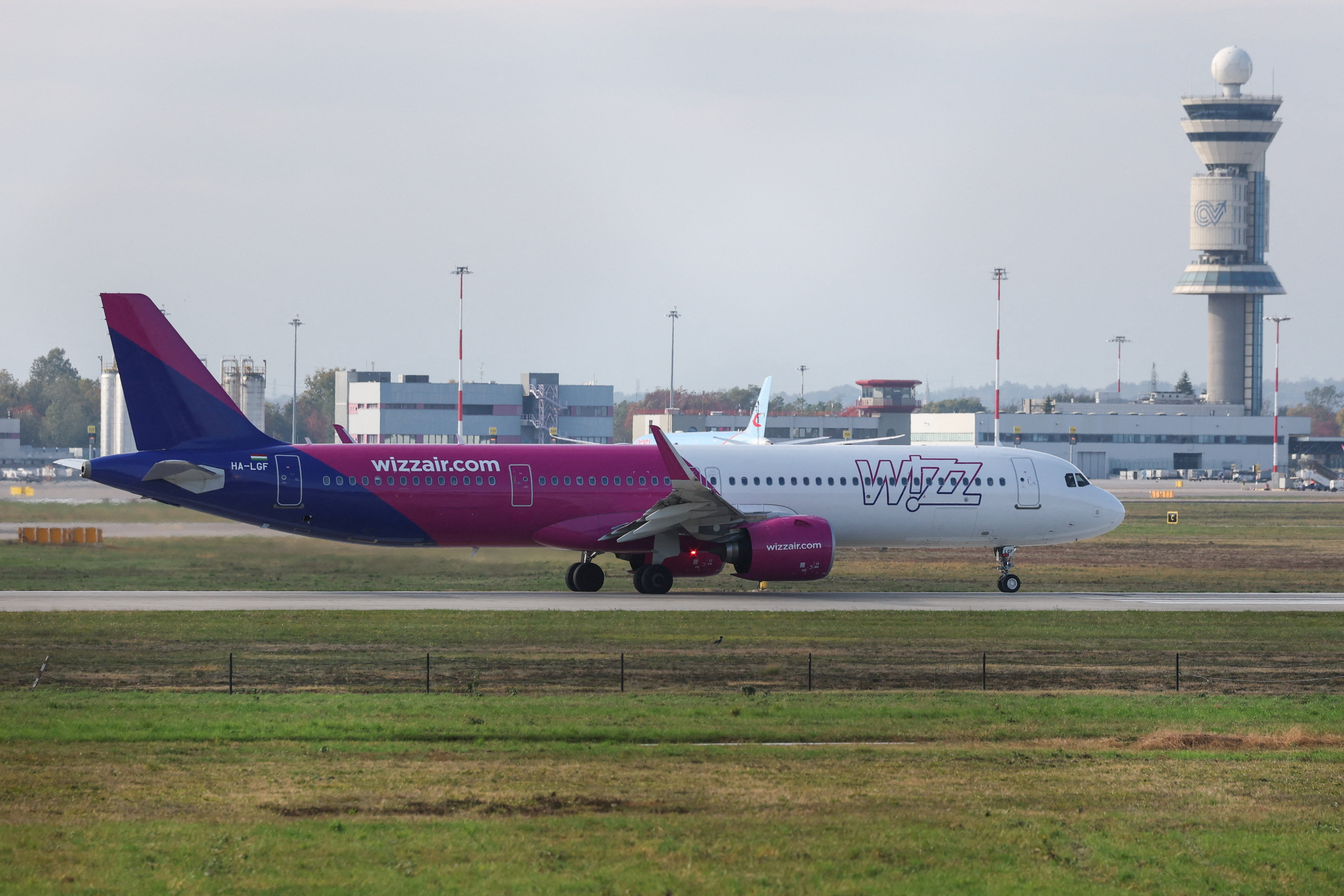
On November 5, Wizz Air WIZZ.L confirmed that a flight from Milan Malpensa to Bucharest Otopeni received a bomb threat but, already on final approach, landed safely without diverting. Authorities completed security checks and cleared the aircraft to resume operations.
A flight from Milan/Bergamo to Sofia was the target of a threat on November 3, Bulgaria’s transport ministry said. The plane landed safely with 176 passengers on board and no explosive devices were found during inspection.
Another Wizz Air flight from London to Sofia diverted to Budapest on November 2 after a threat, the defence minister said. A Hungarian Gripen fighter escorted the aircraft.
Many European officials have accused Russia of masterminding sabotage and hybrid attacks since its 2022 invasion of Ukraine. These are often inexpensive to carry out, easily deniable and not expected to trigger an armed response.
Denmark, Poland and Romania, all affected by Thursday’s disruptions, have previously accused Moscow directly of being behind hybrid attacks, while Germany blamed Russia for an August attack on Leipzig airport. Britain, which has in the past blamed Russia, linked Iran to a suspected plot against a US air base.
Both Russia and Iran have denied those accusations.
Threatening emails sent to Italian airports
An airport source in Italy told Reuters that an email with the subject line “Threat report” had been sent to several addresses for airlines, airport operators and airport service providers at Rome’s Fiumicino and Milan’s Malpensa airports.
The email, which claimed it was from “fighters of the Male State”, said devices had been placed on inbound flights from Helsinki and Dublin and they would explode in 60 minutes. “Today your sky will be red,” it said.
Reuters could not independently confirm who had sent the email and there was no immediate indication of who was behind the other threats across Europe.
Vladislav Pozdnyakov, a Russian blogger who set up an anti-feminist movement called the Male State in 2016 that was later banned in Russia, said that the group no longer existed and was not involved in any way.
“Anyone currently orchestrating provocations within European Union countries under the banner of this ‘brand’ is acting in their own self-interest – essentially flying someone else’s flag,” he wrote on his popular Telegram channel.
Fighter jets deployed across Europe
In France, Prime Minister Sebastien Lecornu’s office said he had sent fighter jets to intercept an Aer Lingus flight from Dublin to Rome and escort it to an air force base at Evreux after the pilot did not cooperate with authorities as expected.
Lecornu’s office gave no reason for the pilot’s behaviour.
Bulgaria’s air force said its fighter jets had escorted three airliners to the ground. One Ryanair flight from London to Sofia was diverted to Plovdiv, Bulgaria’s second city. Romania’s intelligence agency said a KLM flight to Tel Aviv with a layover in Bucharest had received a bomb threat.
Spanish police said three emailed threats came in within 20 minutes involving two Air Europa departures from Madrid to Paris and four inbound Iberia flights from Rome and Milan. Several aircraft were halted or returned to their stands in Madrid and passengers disembarked as the aircraft were inspected.
In Warsaw, a LOT flight to Paris was stopped as it taxied towards take-off and passengers were transferred to another plane, while Danish police said two planes were searched at Copenhagen airport.
Other flights that received threats, including EasyJet, Finnair, LOT, Wizz Air, Ryanair and Air Serbia services to Prague, Sofia, Vienna, Brussels, Bucharest, Rome and Milan, landed as scheduled, some after military escorts.
Passengers describe emergency response
Elena Pala, a passenger on a Wizz Air flight from Milan, described what happened when the plane landed in Bucharest, Romania.
“First, they took us a long way from the terminal … far away on the runway. The plane was surrounded by fire trucks, ambulances and anti-terrorist units,” she told Digi TV.
“I asked what was happening. They said it was an emergency issue. That is all they said,” Pala added.
What do we know about the wave of bomb threats
Airlines are not new to bomb threats, but aviation security experts say the apparent coordination and timing of the current incidents is unusual.
Below is an explanation of what risks airlines and passengers face.
HOW ARE MOST BOMB THREATS MADE?
Bomb threats against planes are often communicated to airlines, airports or authorities through anonymous emails or phone calls claiming that an explosive device is on board. Authorities do not always disclose how threats are delivered because doing so could encourage copycats and compromise investigations.
A Prague airport representative told CNN on Thursday that they had received a threat from an anonymous email addressed to the airport, and Czech police said similar emails went to other European airports.
Eric Schouten, head of aviation security group Dyami, told Reuters that an airline’s security department first runs the report through a checklist. It then alerts the authorities, who may scramble fighter jets or divert the plane to a designated airport for a full sweep.
WHAT IS THE RISK?
The vast majority of bomb threats turn out to be false alarms, though all must be treated as real until investigated.
No explosive device has been found on the planes affected this week, but every airline must decide whether a threat is credible and act accordingly.
A spokesperson for the British government called this week’s incidents “malicious hoax threats” and said it has “one of the most robust aviation security systems in the world”.
WHO MIGHT BE BEHIND IT?
Nobody knows.
Rhys Jones of Osprey Flight Solutions said bomb threats can stem from a wide range of motives, including political grievances, activist campaigns, criminal activity, online groups or state-linked hybrid operations.
There is currently no public evidence linking this week’s incidents to any specific state or organisation.
WHAT IS THE IMPACT FOR AIRLINES?
Even a false alarm can disrupt airlines’ operations, with plane diversions and thorough security inspections causing delays for passengers. Carriers typically bear additional costs including fuel, passenger rebooking, crew disruption and aircraft diversions.
Schouten said a sweep means unloading passengers and baggage, searching the aircraft and reloading. That can push crews past duty limits and lead to missed connections and cancellations.
Air France-KLM Chief Executive Ben Smith said on Thursday he had never previously seen threats reported in such a coordinated fashion.
“We’re quite confident that we have in place what we need to ensure that it has minimal or no impact on our operation,” Smith told reporters. “So we have no ask today of our governments to change the way they manage these types of situations.”
Joji Waites, director of flight safety for the British Airline Pilots’ Association, said airlines did not act on threats unless they had been rated credible by assessors.
Departing passengers were philosophical.
“We still have to get around. So, well, we just have to deal with it as best we can,” said Spaniard Lucia Parga.
Another traveller, Gabriele Franzese, added: “You can’t worry too much about every piece of news. If the plane crashes, so be it. If it’s meant to happen, it’ll happen anyway.”
Wider pattern of disruption raises concerns
Eliran Almog, CEO of aviation cybersecurity firm Cyviation, said the hoaxes could serve both to disrupt operations and to observe how airlines, airports and authorities respond.
“These aviation threats are also occurring in the same period as cyberattacks on supermarket refrigeration systems across Europe,” Almog said.
“Different essential services are experiencing disruption that carries economic costs and can undermine public confidence.”



Click here to change your cookie preferences