
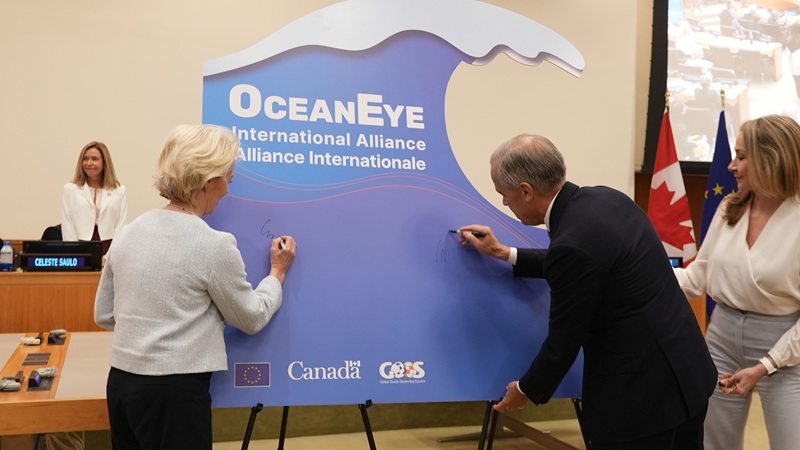
Alexandra Cousteau, ocean advocate and senior advisor to Oceana, joined European Commission President Ursula von der Leyen and Canadian Prime Minister Mark Carney at the United Nations General Assembly on Wednesday to formally announce the launch of the OceanEye International Alliance for the Global Ocean Observing System and to call on governments to use better ocean knowledge to accelerate the protection and restoration of the world’s oceans.
“We welcome President von der Leyen’s and Prime Minister Carney’s leadership on OceanEye and global ocean observation. Better information gives us something enormously powerful: the ability to see what is happening in the ocean, where recovery is possible, and what it will take to accelerate it.
“At Oceana, we see every day how better information can lead to better decisions. From tracking fishing activity and exposing illegal fishing to protecting marine habitats and rebuilding fisheries, good data can turn what happens far offshore and beneath the surface into something governments can understand and act upon.”
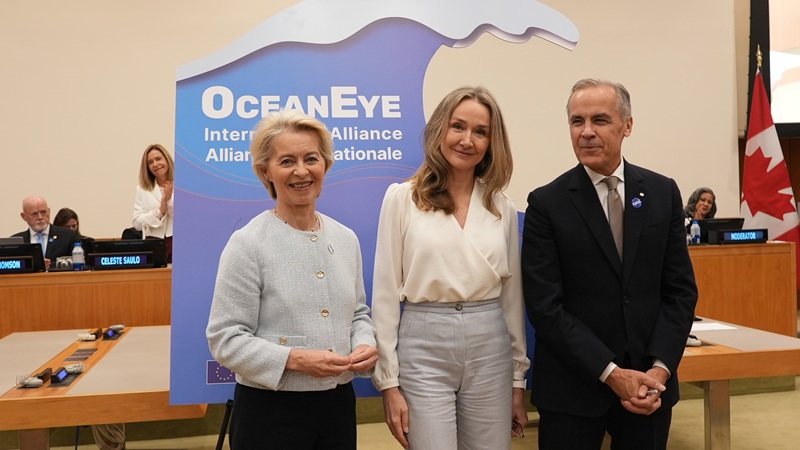
Cousteau’s participation reflects a family legacy of ocean exploration and her own two decades of work advancing ocean action. Her grandfather Jacques-Yves Cousteau and father Philippe Cousteau helped reveal the ocean to millions; today, her work focuses on restoring ocean abundance. As climate change and other pressures reshape marine ecosystems, understanding what is changing, where recovery is happening, and what works is becoming essential to effective ocean protection and restoration.
In Europe, the forthcoming Ocean Act will be an important opportunity to put that knowledge to work, translating a better understanding of the ocean into policies that support its recovery and the coastal communities that depend on it.
“At a moment when international scientific cooperation is under pressure, and when the climate crisis is being directly felt by millions of Europeans, the international effort behind OceanEye demonstrates a serious and timely recognition of the importance of the ocean for humanity,” said Vera Coelho, Vice-President and Executive Director of Oceana in Europe.
“Europe now has an opportunity to match better knowledge with stronger action. A binding Ocean Act can help turn that knowledge into healthier seas, rebuilt fish populations, and a more secure future for coastal communities.”
From ocean knowledge to ocean action
OceanEye is a key initiative of the European Ocean Pact, designed to strengthen ocean observation, research, and knowledge. Launched by the European Commission in 2026, it aims to position the EU as a global leader in ocean intelligence and provide 35 per cent of the global ocean observing system by 2035.
At the heart of the initiative is the OceanEye International Alliance, which brings together countries and international partners to strengthen the Global Ocean Observing System, mobilise investment, and expand international cooperation. The information generated through ocean observation supports everything from weather and climate forecasting to maritime safety, coastal resilience, sustainable ocean economies and efforts to protect and restore marine ecosystems.
As Europe strengthens its ability to understand what is happening in the ocean, the next opportunity is to ensure that knowledge informs the decisions that shape its future. The forthcoming European Ocean Act provides a vehicle to do that, translating the ambitions of the European Ocean Pact into a stronger framework for ocean health.
Oceana is calling for a binding and enforceable Ocean Act that strengthens ocean protection and restoration, rebuilds fish populations, gives low-impact fishers preferential access to coastal waters, and makes ocean health an overarching objective of EU policy. Together, stronger ocean knowledge and stronger policy can help Europe accelerate ocean recovery while supporting prosperous and resilient coastal communities.




Click here to change your cookie preferences