
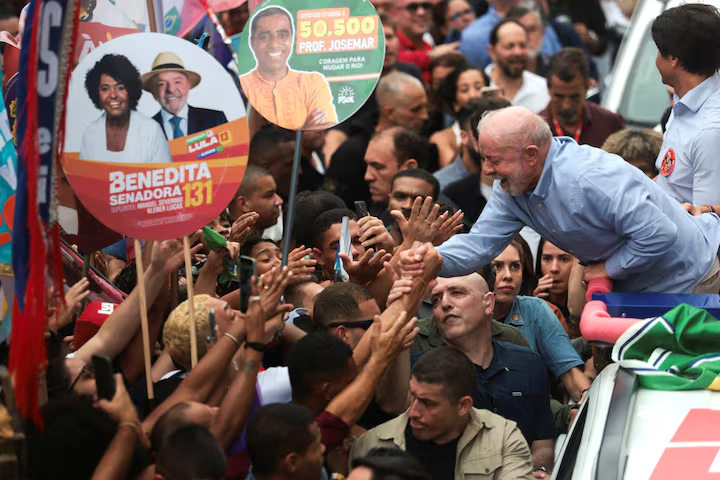
“Flávio Bolsonaro is Trump’s candidate and what Trump wants is to colonise Brazil, take our riches, steal our future and leave us in the dust,” claims the latest video released by President Luiz Inácio ‘Lula’ da Silva’s re-election campaign. The weird thing is about half of Brazil’s voters would be okay with Trump running the country (through Bolsonaro).
Nobody in Brazil thinks that Flávio Bolsonaro is his own man. He is the son of Jair Bolsonaro, the hard right ex-soldier and former president who tried a coup after he lost the 2022 election. It was even clumsier and more half-hearted than Trump’s brief excursion in sedition after he lost the US 2020 election – but Jair Bolsonaro went to jail for his attempt.
In a strange way Trump even recognises the parallel, showing special sympathy for his imprisoned fellow traveler. He claimed that the senior Bolsonaro was the victim of a “witch-hunt” by the Brazilian Supreme Court and slapped 50% tariffs on the country. And next Sunday (4 October) the junior Bolsonaro faces Lula in another presidential election.
We already know that there will be a second round of voting on 25 October, when the other three candidates have dropped out and it’s a straight race between Lula and Junior. We have no idea what that outcome will be, because the two men have been only one or two points apart (i.e. ‘within the margin of error’) in every opinion poll for months.
We know where that extraordinary stability come from, because it is the same in the United States and in many other democracies. Most Brazilians have abandoned ‘legacy media’ and get all their information from a vast network of alternative news sites, YouTube channels, social media influencers, Facebook pages, WhatsApp groups and legions of bots.
Or rather, from two vast and mutually exclusive networks of the same. Whatever your opinion is now, it will likely be the same next year because little else is getting through. Moreover, in the Brazilian case, there’s not really much to get excited about.
Inflation is low, unemployment is low, and the economy is growing faster in Brazil than in most other G20 countries. A big bank failed last year causing a long-running corruption scandal and the murder rate is preposterously high, but relatively speaking Brazilians should not have much to complain about, so in the end it will probably come down to ‘sovereignty’.
Lula recently warned on ‘X’ that Flávio Bolsonaro will “hand our natural resources over to the United States…If it’s up to him, Brazil will become a colony again.” The president portrays that as a threat, and traditionally the vast majority of Brazilians would have agreed, but both Flávio and his imprisoned father Jair would see it almost as a happy ending.
Neither of them puts it exactly like that in public, but both men see the brutal military dictatorship of 1964-1985 as a lost golden age. Jair served it as an active-service officer and has praised its torturers (“The dictatorship’s mistake was to torture but not kill’). His son says “there was security, there was quality health and education, there was respect.”
No there wasn’t. There was terror, lies and legalised looting, but we need not relitigate that here. The problem is how quickly people forget, and a softer, gentler version of those brutal regimes is taking over all across Latin America.
Keiko Fujimori, the old dictator’s daughter, is the new president of Peru. The father of Chile’s new president José Antonio Kast was a Nazi who fought for Hitler, and he himself had links to the bloody dictator Pinochet. President Javier Milei of Argentina is a chainsaw-wielding ‘anarcho-capitalist paleolibertarian’.
Abelardo de la Espriella, Colombia’s new president, restarted the war with insurgents on his first day in office. Delcy Rodriguez, once vice-president of Venezuela under Maduro, has switched to being president under Trump and signed over the country’s oil. There’s Daniel Noboa in Ecuador and Nayib Bukele in El Salvador, and Cuba awaits its fate at Trump’s hands.
A shady lot, you might say, and they are all selling the same deal: prosperity and security in return for obedience. That’s not a terrible deal if the autocrats keep their end of bargain, but generally they can’t or at least won’t. There will be tears before bedtime.
There are only two big hold-outs to the populist wave in Latin America. Mexico in the north seems all right for the moment, but Brazil in the south is teetering on the brink. All that really stands between it and failure is one 80-year-old man – but he is a very tough old man, and if his health holds he may be able to pull it off.


Click here to change your cookie preferences