
Why our instinct for ownership should extend beyond property
By Fanos Costa
Two women from the administrative team in our Hong Kong office were arguing about stocks.
They were not traders or bankers, but ordinary employees comparing what they owned in their retirement accounts and why. In Hong Kong, people discussed businesses in cafés, taxis and over lunch with the familiarity Cypriots reserve for land and property prices. Every Cypriot knows roughly what a square metre costs in the neighbourhood; ask what a share of a company is, and the conversation becomes much shorter.
Cyprus does not lack the instincts required for investing. We save, buy assets, hold them for decades and think about what we will leave our children. We understand ownership; we have simply learned to express it almost entirely through property.
Why Cyprus learned to trust concrete
Cypriots are not careless with money. Many inherited lessons that made sense. Both my parents are refugees: in 1974 they lost everything they could not carry and rebuilt on land. If you have lost land once, a title deed naturally feels safer than an entry on a screen.
Then came the Cyprus Stock Exchange boom and collapse around the turn of the millennium. Ordinary households lost savings in an immature market amid euphoria and weak understanding. A generation concluded that shares were a con. In 2013, uninsured depositors with balances above €100,000 at the two largest banks learned that even bank deposits could be exposed in a crisis.
The resulting rules were easy to remember: land endures, shares are gambling and banks can fail you. That is not ignorance. It is memory.
But memory can remain emotionally true after the available choices have changed. Cyprus’s experience around 1999 and 2000 was not proof that owning businesses is inherently reckless; it was a lesson about speculation, concentration and buying what you do not understand. The stock market is a mechanism for trading ownership. Investing is the behaviour that determines how we use it.
The risk hidden in what feels safe
Property has earned much of its place in Cypriot life. A flat is tangible. It may produce rent. A bank will lend against it, and families know how to value it, maintain it and pass it on. That knowledge took generations to build.
The problem is not owning property. It is owning almost nothing else. A typical household may have its home, second flat, salary, deposits and pension all tied to Cyprus. If the country has a bad decade, several parts of the family’s financial life can suffer together. A professional would call that concentration risk; at home, we call it being sensible.
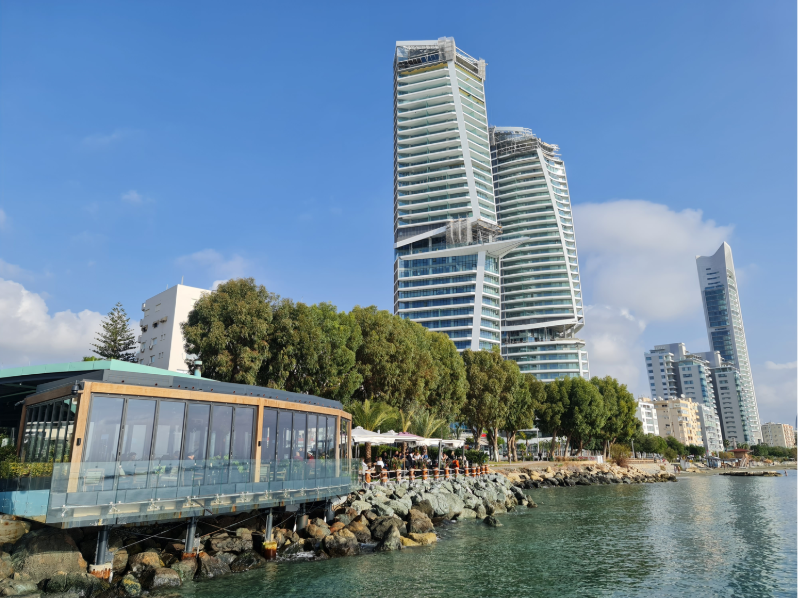
High-rise property in Limassol. Photo: Stephanos Nicolaou / Wikimedia Commons, CC BY-SA 4.0.
We also confuse price visibility with risk. Property feels calm partly because nobody sends us a price every afternoon. It also comes with a long-term story: owners expect it to appreciate and rarely treat a short-term fall as a signal to sell. Imagine that every homeowner received a notification at 4.30pm: YOUR HOME TODAY: €287,400, DOWN 2.8 per cent. The next day: €279,100, DOWN 2.9 per cent. Underneath sits a large red SELL button.
Would the building have become more dangerous, or would we simply be more aware of what buyers might pay that day?
Shares expose us to noise because they are liquid. Property protects us from panic partly by making action slow and difficult. That can be helpful, but illiquidity carries its own risk. You cannot sell a quarter of a flat to cover a difficult year. You can sell part of a diversified portfolio. Safety is not the absence of a moving price.
A share is ownership
When Cypriots buy apartments, nobody describes the decision as gambling on concrete. The buyer owns an asset expected to produce rent and rise in value. Buy part of a business and the language changes: now it is called playing the market. Yet a share is simply a claim on a working company. The price may be foolish in the short term; the underlying ownership is real.
The crucial distinction is between buying one company and buying many. One share is a judgement about one business. A broad index fund can hold hundreds or thousands of businesses across countries and industries. Instead of trying to identify tomorrow’s winner, the investor owns a small slice of productive companies collectively.
That does not make a fund safe in every year. Markets fall, sometimes sharply, and money needed soon does not belong in volatile assets. Diversification reduces the damage one company or country can cause; it does not remove risk. A global fund therefore deserves a place in the conversation alongside an S&P 500 fund.
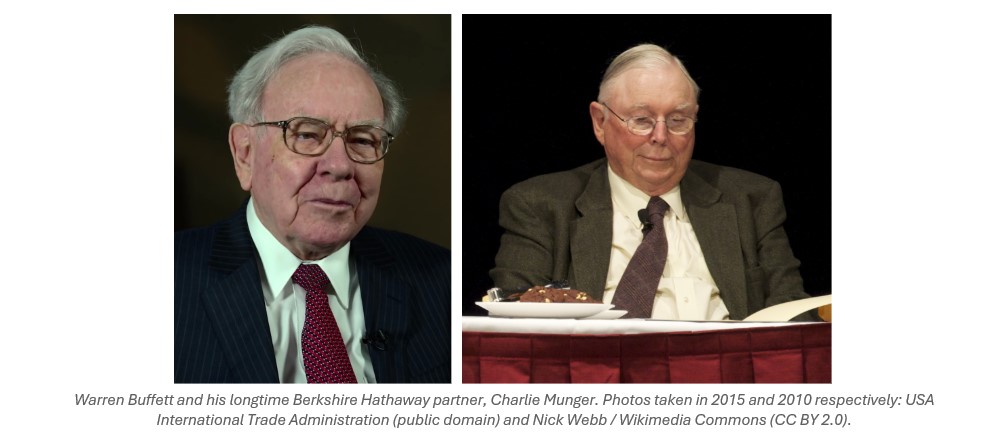
Warren Buffett, perhaps the best-known stock-picker in the world, made the distinction clear in the instructions for the money held in trust for his wife: 90 per cent in a low-cost S&P 500 index fund and 10 per cent in short-term government bonds. His family did not need to become stock-pickers to own businesses.
The comparison we rarely make
Consider €10,000 invested in 2006 and left until 2025. In a model that reinvests income and applies estimated Cypriot taxes and market costs to both sides, the Limassol property investment grew to around €26,000 while a low-cost S&P 500 fund grew to around €73,000. Property led for part of the early period. Over the full nineteen years, the fund finished much further ahead.
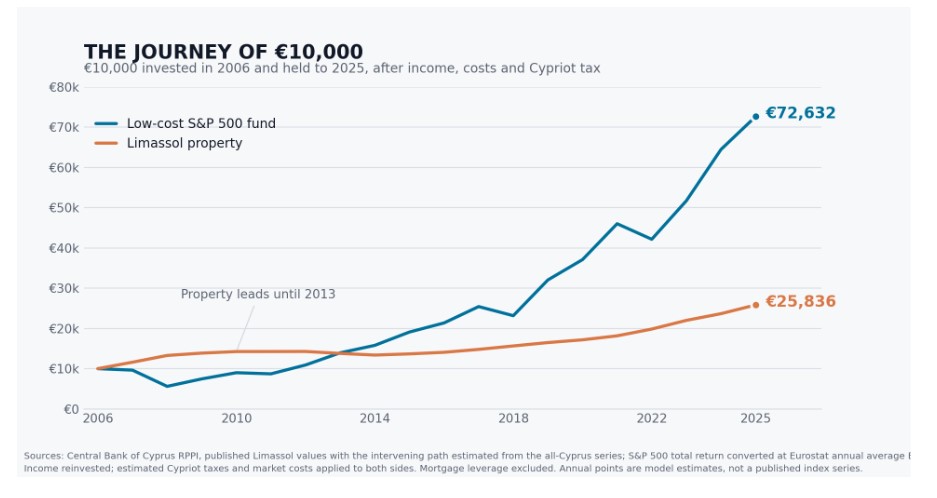
The shape of the two lines also matters. The global financial crisis hit share prices immediately, while property values adjusted more gradually and took longer to recover, particularly after Cyprus’s banking crisis. That is not proof that shares will win over the next nineteen years. Change the dates, use leverage or alter the costs and taxes, and the result changes.
The useful lesson is not €73,000 versus €26,000. It is that most of us would never have run the comparison. We examine a flat closely but often reject a diversified fund without examining it, partly because one is familiar and the other arrives wrapped in words such as equity, ETF and market capitalisation.
We understand oikopedo (building plot), diamerisma (flat), horafi (field) and enikio (rent). Those words feel real. Economically, both conversations begin with the same questions: what do I own, what cash might it produce, what can go wrong and what price am I paying?
Looking beyond the headline return
A useful comparison goes beyond the headline return. It should include liquidity, transaction costs, borrowing, maintenance, tenants and the time required to manage property. For some investors, shares will fit better; for others, property will. The point is to reach the answer by comparison rather than inheritance.
Investing also changes the purpose of saving. Money not needed for immediate expenses or a proper cash reserve can be put to work rather than left earning very little. Most people do not need to analyse individual companies: a low-cost diversified fund, patience and room for error are more realistic starting points.
The lesson Cyprus can teach early
Time matters more than cleverness. Jim Simons’s Medallion Fund earned roughly 39 per cent a year after fees from 1988 to 2018, almost twice Berkshire Hathaway’s annual return of about 19.9 per cent. Yet Warren Buffett sustained his return for nearly twice as long. Simons won the yearly race; Buffett had many more years for returns to build on one another.
That is where financial education should begin. Teenagers do not need lessons in trading; they need to see how money changes choices across a lifetime. At 10 per cent a year, money roughly doubles every seven years; at 7 per cent, roughly every ten. The same mathematics works against a borrower: a €300,000 home may cost far more once decades of interest, fees, repairs and insurance are included.
Personal finance should begin with goals rather than social expectations. Education, travel, a business, a home, independence or the freedom to change direction all give saving and investing a purpose. The practical question is whether each financial decision serves those priorities.
Stories can make those choices real. Schools could examine people in Cyprus and abroad who built businesses, invested patiently, recovered from failure or avoided a fashionable mistake. Morgan Housel’s The Psychology of Money, available in Greek, offers accessible stories about luck, risk, patience and behaviour that could help begin the discussion.
Students should compare a deposit account, mortgage, rental property and diversified fund across return, risk, liquidity, fees, taxes, debt, effort and time. They should also learn that walking away can be sound. Charlie Munger put it plainly: ‘If something is too hard, we move on to something else.’
They also need enough economics to read the news. Interest rates affect mortgages and asset values; inflation changes what savings can buy; energy prices, wars, technology and demographic change affect jobs and businesses. A financially educated school-leaver should be able to connect a headline to household decisions, compare two mortgages, read pension charges and test an investment claim.
Widen the inheritance
What stayed with me in Hong Kong was not which shares my colleagues owned, but how naturally they could discuss ownership without fear or mystique.
Cyprus has spent generations teaching its children something valuable: save, buy something real, hold it and leave the next generation more than you started with. That instinct should be widened, not discarded.
A farmer who keeps good land and thinks in decades already understands long-term investing. A parent who buys a flat for a young child understands delayed gratification. A family that holds an asset through bad years understands patience. We already know the difficult part.
What we have not learned is that ownership can fit inside something smaller than a title deed. The goal is not to persuade every Cypriot to buy stocks, but to ensure that a young person earning a first €100 knows there are more choices than spending it, leaving it in a bank or waiting for a deposit on a flat.
One day, discussing the businesses we own should feel as ordinary around a Cypriot lunch table as discussing what the flat next door sold for.
Not because Cyprus should love property less. Because Cypriots should understand ownership more.
*Fanos Costa grew up in Cyprus and studied Mathematics with Finance at the University of Manchester. He qualified as a chartered accountant with KPMG in Limassol and spent six years with VF Corporation – owner of The North Face, Vans and Timberland – in Switzerland and Hong Kong, latterly as Finance Director for Asia Pacific. For the past six years he has been a chief financial officer for small and medium-sized international businesses in luxury fashion and art, based in London. The author invests in diversified equity funds and individual shares. Nothing in this article is personal investment or tax advice.

Click here to change your cookie preferences