
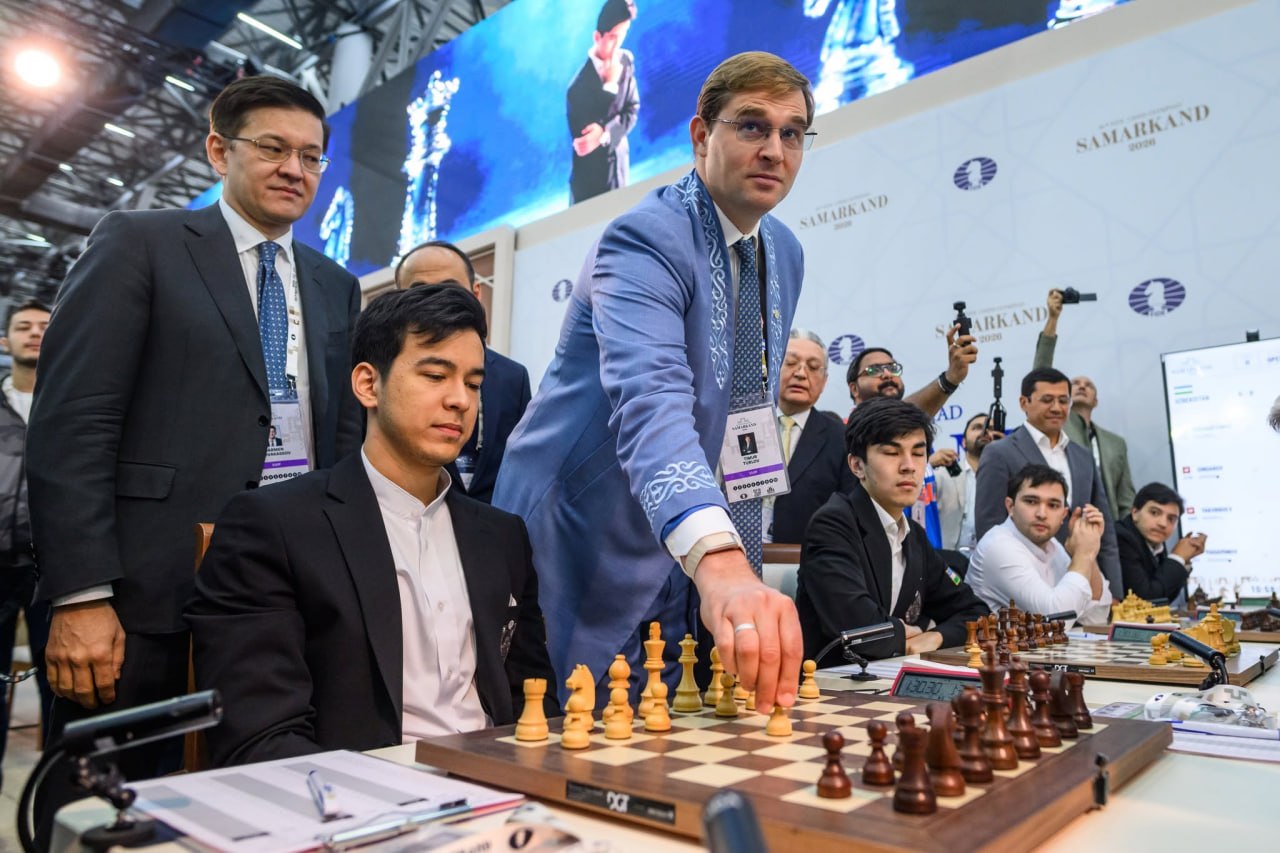
On 26 September, at the Congress of the International Chess Federation (FIDE) in Samarkand, a new president was elected. The post was taken by 38-year-old Timur Turlov, founder and CEO of Freedom Holding. Over the next four years, he is prepared to invest around €30 million in the development of chess. This money will go towards creating a global ecosystem that will cater to both grandmasters and the millions of enthusiasts of this ancient game. What changes lie ahead for the world of chess?
By Andrey Avsitidiysky
ALL FIDE PRESIDENTS
- Alexander Rueb (Netherlands) = 1924-1949
- Folke Rogard (Sweden) = 1949-1970
- Max Euwe (Netherlands) = 1970-1978
- Fridrik Ólafsson (Iceland) = 1978-1982
- Florencio Campomanes (Philippines) = 1982-1995
- Kirsan Ilyumzhinov (Russia) = 1995-2018
- Arkady Dvorkovich (Russia) = 2018-2026
- Timur Turlov (Kazakhstan) = from 2026
Over the 140-year history of the World Chess Championship, 18 chess players have held the title. In the 102 years since FIDE was founded, it has been led by just eight people. The role of the leader in this federation cannot be overstated. The new head of FIDE is a businessman whose fortune is estimated by Forbes magazine at $7.4 billion.
UPCOMING CHANGES (2027–2030)
Finances
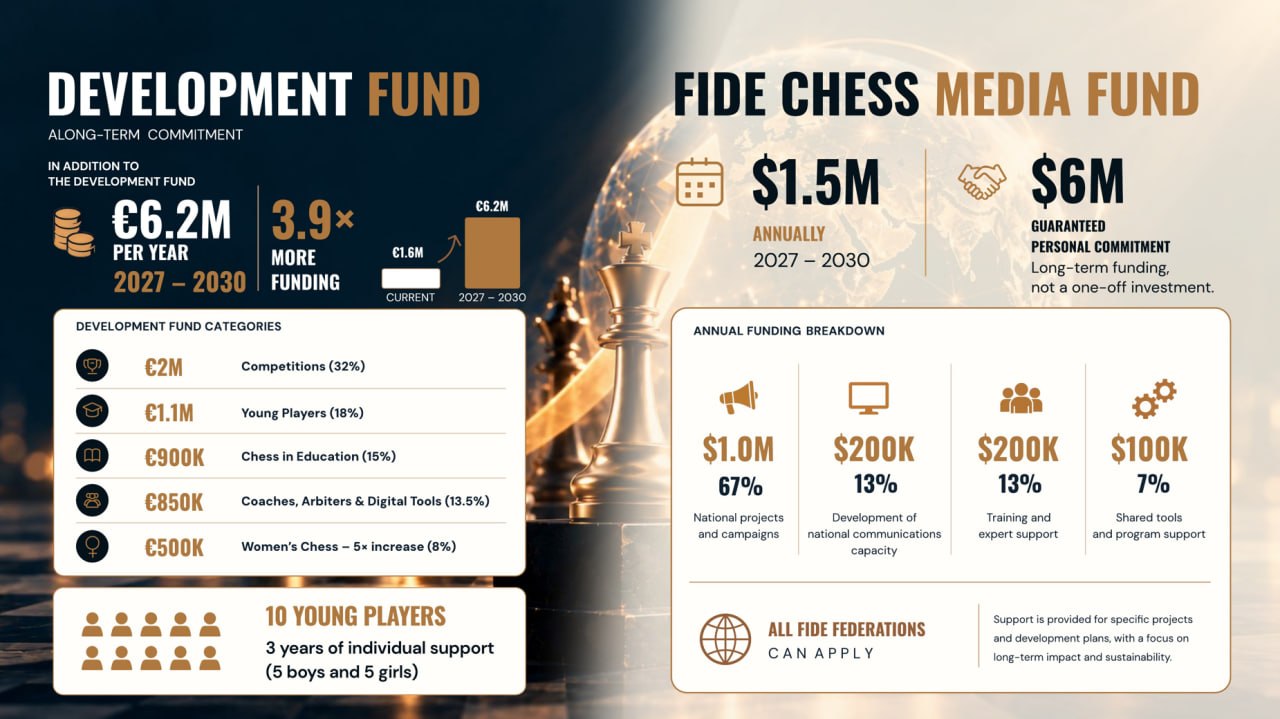
€6.2 million will be allocated annually to the FIDE Development Fund. This is almost four times the current budget. The money will go towards organising tournaments, training arbiters and coaches, educational projects, digitalisation and supporting young talent. Funding for women’s chess will increase fivefold.
$1.5 million a year will be allocated to the FIDE Media Fund. These funds will help national federations promote chess projects to a wider audience. At present, many developing federations lack the resources to employ full-time media relations staff.
Digital transformation
One of the key projects will be a digital ecosystem bringing together players, coaches, tournament organisers and federations. Through a personal account on the FIDE website, featuring their rating and match history, chess players will gain access to online tournaments and educational materials.
Artificial intelligence is expected to be used to analyse games, support the training of players and coaches, administer tournaments and detect cheaters. Federations will be offered modern digital tools to organise tournaments and reduce paperwork.
In April 2026, Freedom Holding acquired ChessBase. Around $5 million will be invested in the development of one of the leading chess software, analytics and game database services, with the aim of unifying disparate products, services and users within an ecosystem modelled on the Freedom SuperApp.
WHAT LIES AHEAD FOR CYPRUS AND OTHER SMALL COUNTRIES?
‘Particular attention will be paid to small countries. Cyprus has been developing chess for several years now in partnership with Freedom, the main partner of the Cyprus Chess Federation since 2023, and the Freedom24 Chess Academy operates in Limassol’, says Bulat Latypov, Chief Communications Officer at Freedom24.
Exactly how the International Chess Federation’s approach will be adapted for Cyprus will become clear as the programme is implemented, but the foundation is already in place: according to Criton Tornaritis, President of the Cyprus Chess Federation, around 2000 people actively play chess on the island, and the number of young talents is growing.
According to Bulat Latypov, FIDE intends to apply the same approach to other small countries: focusing on their needs, sharing experience and providing access to modern tools. Opportunities will be created for children to learn chess, regardless of their country, skill level or financial circumstances.
THE CASE OF KAZAKHSTAN
Since January 2023, when Timur Turlov became president of the Kazakhstan Chess Federation, a system has been established in the country bringing together the authorities, the business sector, schools and the professional chess community. By September 2026, chess programmes had reached around 2500 schools and 133,000 children.
In 2025, Kazakhstani chess players won 162 medals at international competitions, including 64 gold medals. Bibisara Assaubayeva came second at the Women’s Candidates Tournament in Cyprus, whilst the Kazakhstan women’s team won silver medals at the Chess Olympiads in Budapest (2024) and Samarkand (2026).
‘Any ambitious strategy only makes sense when it is backed by the ability to fulfil the commitments made. That is how trust is built. The results of this approach are already visible in Kazakhstan. Our task is to share this experience at an international level’, said the new FIDE president.
GENS UNA SUMUS
The election campaign was tense. Turlov described the 2026 election as the most challenging and competitive in FIDE’s history. Following his victory, he expressed his willingness to put the strong ideas of his rivals, Wadim Rosenstein and Jan Henric Buettner, into practice and to collaborate with them for the good of chess.
‘FIDE brings together 204 federations. Each one will be seen and heard. We will endeavour to draw on all our experience and the culture of negotiation that exists in Kazakhstan to achieve this. We must strengthen FIDE’s prestige, overcome old differences and attract new partners and sponsors’, said Turlov.
FIDE’s next major challenge is to organise the world championship match in a fitting manner. This will be the ‘youngest’ match for the world chess crown. Both the champion and the challenger are 20 years old. The opening ceremony will take place on 22 November at the Palais des Nations in Geneva. Freedom Holding is the general partner of the Salesforce FIDE World Championship Match 2026.
‘I promise to do everything in my power to promote the growth and prosperity of the chess community. We have a long road ahead of us, but we have a strong programme, a competent team and the energy and resources to achieve results’, concluded the new FIDE president.



Click here to change your cookie preferences