
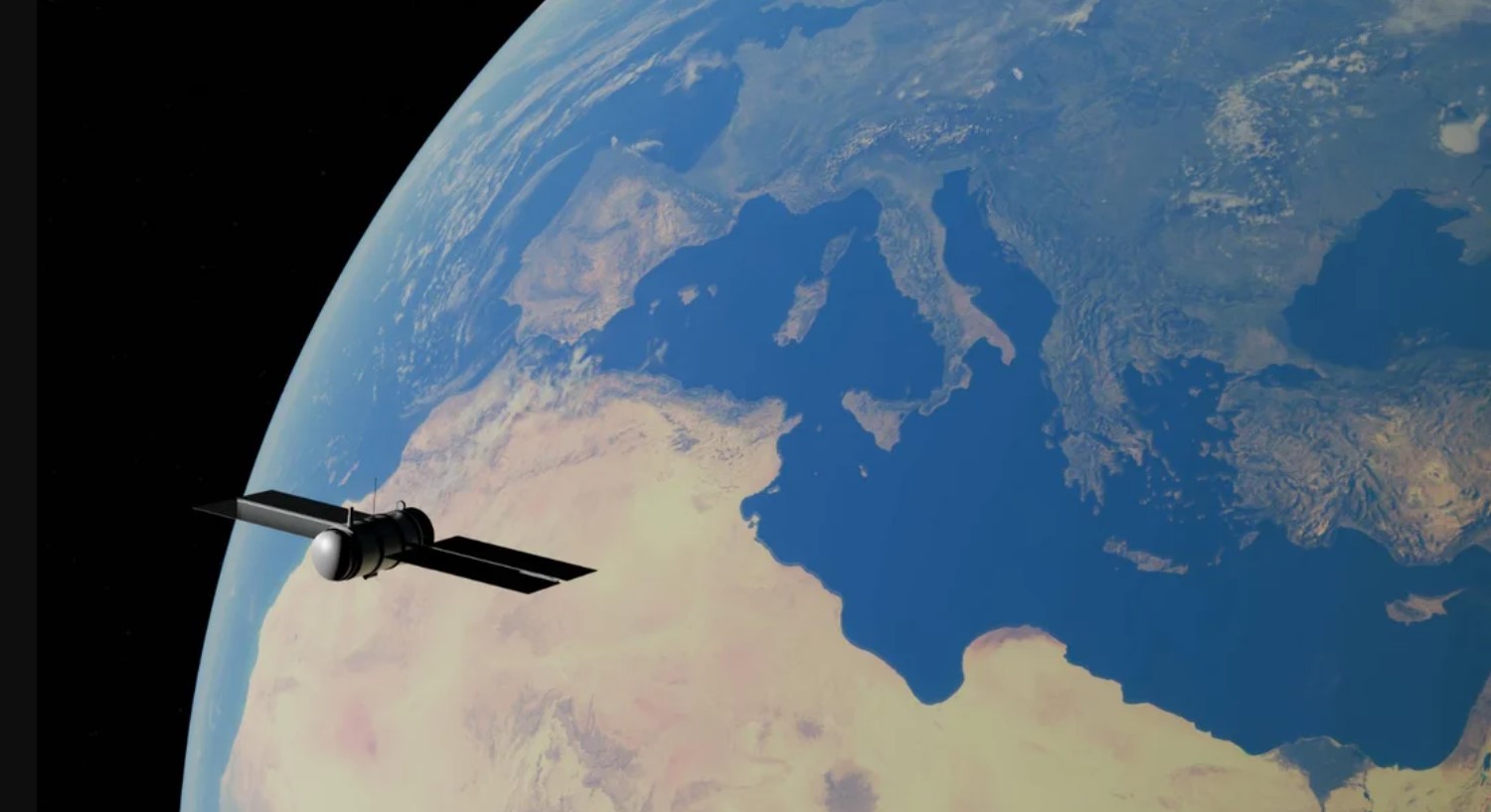
EU-funded researchers are developing tiny devices that could turn infrared sunlight and stray radio waves into extra energy for satellites.
By Jonathan O’Callaghan
Satellites waste energy in space. Some radio waves spill beyond their intended targets, while some of the sunlight reaching a spacecraft falls outside the range that conventional solar panels can effectively capture. Researchers from seven European countries are working together to see if some of that lost energy can be recovered.
The initiative, called POWERSAT and supported by the European Innovation Council, is developing tiny devices that could harvest stray radio waves and infrared sunlight, giving satellites an extra source of energy.
In space, every watt of power and every gram of mass matters. Satellites have limited room for power systems, while adding equipment can increase the weight and cost of a mission. Could recovering energy that would otherwise be lost provide a useful boost?
The POWERSAT team is exploring two ways to do this. One involves capturing radio waves that spill beyond their intended targets. The other aims to harvest infrared light from the Sun that conventional solar panels cannot use.
“There are different untapped regions of the electromagnetic spectrum that could be harvested,” said Dragos Dancila, an associate professor of microwave engineering at Uppsala University, Sweden, whose research focuses on antennas and radio-frequency systems.
Satellites communicate with Earth and with each other using radio waves. But not all of that energy reaches its intended destination. Some spreads beyond the target, rather like a torch beam spilling beyond the wall it is aimed at. This wasted energy, known as spillover, could instead be captured by a special antenna called a rectenna.
Rectennas already exist on Earth, where they can recover stray radio energy in fixed, ground-based settings. The challenge for the POWERSAT researchers is to shrink the technology and make it small and robust enough to survive in orbit, where temperatures can swing dramatically, while also operating on a constantly moving satellite.
“One aim is to take this energy that normally disappears and use it on the satellites,” said Afshin Ziaei, a project coordinator from Thales Research headquarters in France who specialises in radio communications and microwave systems.
The team envisages satellites carrying several centimetre-sized rectennas close to their communications antennas. These capture some of the spillover microwaves, harvest energy, and convert spillover radiation into a small but usable supply of electricity.
Using this technique, the researchers seek to boost the available power of a satellite by up to 10 per cent. That could help extend its working life or provide power for additional instruments without requiring a larger power system.
“It’s always a question of weight,” said Dancila.
The extra power could be particularly useful for low-power electronics such as sensors that monitor the spacecraft.
“You have all these sensors that could be installed, like for monitoring the communications antennas or for monitoring debris that could approach the satellite,” said Dancila.
The rectennas could also enable a low-power form of wireless communication called backscattering communication. By altering and reflecting existing signals, rather like using a mirror to flash sunlight towards someone, small sensors or neighbouring satellites could exchange simple messages while using very little energy.
Radio waves are only one source of energy the researchers hope to recover. The POWERSAT team is also looking at sunlight – specifically, the infrared part of the spectrum that conventional solar panels do not efficiently capture.
The researchers are developing antennas so small that millions could fit on a fingernail. These would sit on the sun-facing side of a spacecraft alongside conventional solar panels, harvesting infrared light and converting it into electricity.
Kristiaan Pelckmans, CEO of Swedish deep tech company FaDO and a partner in POWERSAT, said the approach could achieve efficiencies of up to 80 per cent or more, compared with around 30 per cent for a typical solar panel.
The tiny antennas are not intended to replace conventional solar panels. Instead, they are designed to work alongside them, allowing spacecraft to make use of a wider part of the sunlight reaching them.
“The promise is that it can be much more efficient, meaning more power,” said Pelckmans.
The approach could potentially have applications on Earth too, allowing solar farms to harvest more energy by adding similar devices alongside existing photovoltaic panels.
“Basically, everywhere where they use solar cells, these things could be used,” said Pelckmans.
The researchers are still working to demonstrate that the individual components can deliver on their promise. Developing the tiny antennas has proved challenging, particularly because of the complexity of fabricating diodes that work with the antennas.
“It was fabricated two times until we achieved what we wanted,” said Ziaei.
Towards the end of 2026, the researchers hope to demonstrate solar-energy harvesting, turning microwaves into usable electricity in this way for the first time. They will then test how microwaves can be harvested across four different parts of the spectrum using smaller rectennas.
Even if those demonstrations succeed, there may still be a long wait before the technology reaches orbit. Pelckmans estimates that it could take up to 10 years for the technology to be ready to fly. Space hardware must withstand launch and operate reliably for years in the harsh environment of orbit before it can be trusted on a real mission.
The research is due to run until the end of 2027, with the team planning to demonstrate that its approach works in the laboratory.
Satellites that rely on links between spacecraft for broadband and communications are a potential future application. The same antennas used for these links could potentially double as energy harvesters, providing a modest power boost without requiring a separate power system.
More broadly, recovering energy that would otherwise be lost could help make better use of increasingly sophisticated satellite systems.
The research comes as Europe expands its satellite infrastructure while looking to make space activities more resilient and sustainable. The EU’s IRIS² programme is developing a new satellite network for secure connectivity, while the proposed EU Space Act intends to establish common rules for safer, more resilient and environmentally sustainable space activities.
In this context, technologies that can squeeze more useful energy from each satellite could offer another way to make spacecraft more efficient and potentially extend their useful lives.
For now, however, the goal is to prove that the technology works.
“We are here to show this works,” said Ziaei. “After that, it is in the hands of the industry to bring it to the market.”
This article was originally published in Horizon, the EU Research and Innovation Magazine.



Click here to change your cookie preferences