

The meeting with Norway’s Minister of Fisheries and Ocean Policy, Marianne Sivertsen Næss, took place on the sidelines of the World Maritime Day Parallel Event 2026, bringing together government representatives and international maritime officials to examine how global shipping agreements are put into practice.
The two ministers exchanged views on developments affecting the shipping industry, particularly ongoing negotiations within the European Union and the International Maritime Organisation (IMO).
Their discussions also emphasised the importance of international cooperation while recognising the different circumstances facing individual countries when developing and implementing maritime regulations.
Earlier, Hadjimanolis attended the event’s opening ceremony and participated in a ministerial roundtable alongside representatives from South Korea and Norway, as well as IMO Secretary-General Arsenio Dominguez.
At the centre of the dispute is the International Maritime Organisation’s (IMO) proposed Net-Zero Framework, which would introduce new emissions standards and financial obligations for vessels that fail to meet them.
However, the disagreement has become increasingly complicated, with the US seeking greater recognition of LNG and other transitional fuels while challenging plans to establish an international fund financed through emissions-related payments.
For shipowners, the consequences extend well beyond environmental policy. Companies have already committed substantial capital to vessels designed to operate on LNG, and the treatment of that fuel under the eventual regulations could determine whether those investments remain commercially attractive.
Panayiotou said the intensive dialogue of recent days on the revised pension reform bill confirmed that the State, employers and employees, despite their legitimate differences in approach, shared the same goal.
“Everyone wants a system that secures a decent standard of living for tomorrow’s pensioners and remains sustainable for future generations,” she said.
Alongside the First Pillar, the Social Insurance Fund, Panayiotou pointed to the importance of the Second Pillar, which covers provident funds and occupational pension schemes.
The agreement, announced on Monday, October 26, was signed through the group’s subsidiary, HELLENiQ Energy Cyprus Holdings Ltd, although completion remains subject to approval by the Cyprus commission for the protection of competition.
Financial details of the proposed acquisition have not been disclosed.
The deal would expand the group’s existing operations in Cyprus, where it already has a substantial presence through EKO Cyprus, which operates a network of around 100 petrol stations and supplies fuels, lubricants and liquefied petroleum gas to commercial and industrial customers.
The Kronos field is located in Block 6 of Cyprus’ exclusive economic zone, with Eni owning the rights to the resources in that block alongside Frech energy giant Total.
Given the proximity of the Kronos field and Block 6 to Egypt’s Zohr gas field, which Eni also operates, Eni will be able to use its own infrastructure to take the Cypriot natural gas to the Segas liquefied natural gas (LNG) terminal in the Egyptian port city of Damietta, and export the gas to Europe and, if required, elsewhere from there.
Eni reached its final investment decision for the project in July, and said at the time that it believes there are more than three trillion cubic feet of natural gas in the field.
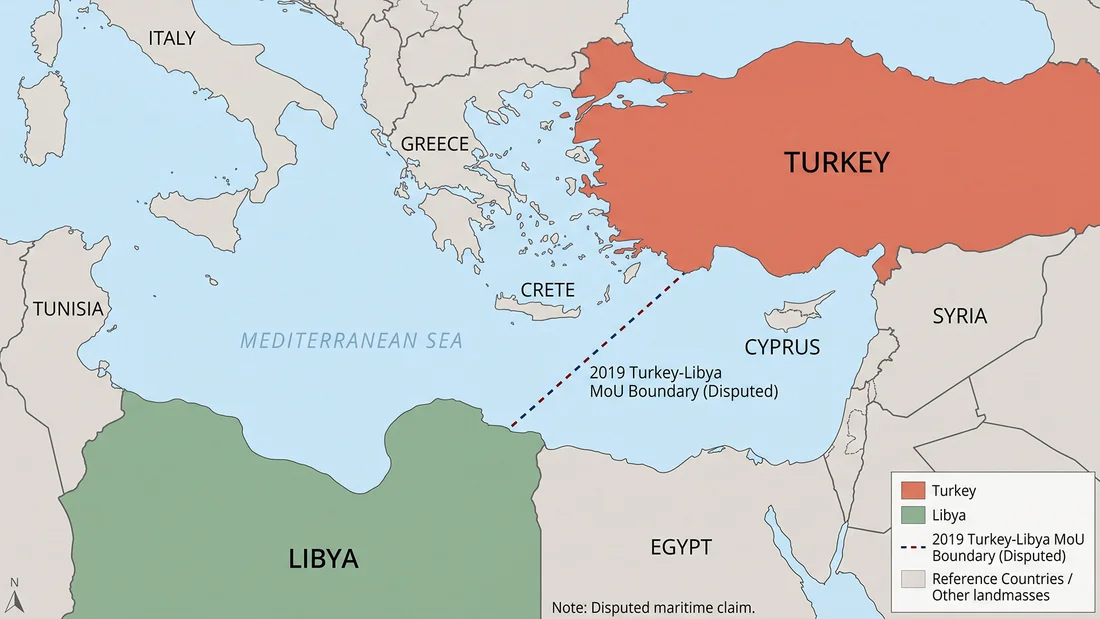
During high-level discussions between Greek Foreign Minister George Gerapetritis and Egyptian Foreign Minister Badr Abdelatty, both sides reaffirmed their shared commitment to international law and the United Nations Convention on the Law of the Sea (UNCLOS), while formally rejecting the move by the Libyan legislature.
The latest diplomatic developments follow a vote by Libya’s House of Representatives to approve and ratify the controversial 2019 maritime memorandum, originally signed between Ankara and Tripoli’s then Government of National Accord (GNA).
The Libyan parliament also repealed earlier resolutions dating back to 2020 that had rejected agreements with Ankara and severed political ties with Turkey. The vote followed a formal briefing by Libya’s Higher National Committee for Land and Maritime Borders, established under Decision No. 40 of 2026.
The development brings fresh attention to the group’s financial links with Cyprus, while Greek authorities have extended their assessment of the suspected tax evasion to 2016 – 2026, considerably earlier than the 2022 starting point initially reported.
According to Greek reporting citing evidence in the investigation, a dividend relating to profits from 2022, 2023 and 2024 was transferred from the Greek operating company to a Cyprus bank account in August. A subsequent transaction of about €1.34m reportedly moved from that account to a joint account held by founder Konstantinos Antaras and his wife.
Of more than 4,500 applications submitted before the September 30 deadline, 1,307 had been approved and 978 homes brought into the Rent Against Instalment scheme, according to Kedipe’s latest update. The state-owned asset manager expects the eventual total to exceed 2,000 homes.
The arrangement is markedly different from a conventional loan restructuring. Kedipes acquires the primary residence, while the participating lender receives 65 per cent of its assessed market value and writes off the remaining mortgage debt to the extent that it is not secured by other collateral. The former owner stays on as a tenant, with the state meeting the rent and the occupant paying €1 a year.
In an official announcement, the regulator said it had identified a website falsely presenting itself as CySEC, alongside further cases of people fraudulently posing as its officers.
The fraudulent website, which is not affiliated with the regulator, is accessible at fake CySEC website.
CySEC urged investors to be particularly cautious when approached by individuals demanding fees or other payments in exchange for the purported recovery of losses incurred through investments in regulated or unregulated entities.
In an announcement on Monday, the bank said the shares were purchased on the Euronext Athens exchange between October 19 and October 23, at an average price of €4.2810 per share.
Specifically, the bank reported that the total cost of the transactions was €8,135,667.62.
The programme was approved at Eurobank’s annual general meeting on April 28, 2026, and subsequently authorised by a resolution of the bank’s board of directors on April 29.
In an announcement published on Monday, the bank said the shares were acquired at an average price of €4.2326 each, with the total consideration amounting to €9,840,889.65.
The programme was approved by shareholders at the bank’s annual general meeting on June 26, 2026, and follows an earlier announcement dated July 31.
Alpha Bank purchased 1,138,088 shares on October 22, spending €4,959,787.50.
The event will showcase ventures developed through the Empowering Women in Agrifood (EWA) Grow 2026 programme and EIT Food Challenge Lab: Ground2Scale+, bringing together entrepreneurs, researchers, investors and industry professionals to explore opportunities across the country’s agrifood and innovation ecosystem.
It is being organised by SocialTech Lab, EIT Food’s country representative in Cyprus, with EIT Food supported by the European Institute of Innovation and Technology (EIT), a body of the European Union.
The participating teams have been developing solutions in areas including agricultural technology, food innovation, sustainability, the circular economy, waste valorisation, regenerative agriculture, fermentation, functional foods, food production and traceability.
The campaign aims to inform citizens about how to identify and report potential misuse of EU funds, while explaining the role and responsibilities of AFCOS Cyprus in safeguarding the bloc’s financial interests.
EU funding supports projects, programmes and initiatives intended to promote Cyprus’ development and improve people’s everyday lives.
The proper use of these resources is a matter of public interest, as fraud or irregularities could divert valuable funding away from initiatives that benefit society.
The one-day event, hosted by Cyprus-based investment firm Zubr Capital, challenged participants to build AI-powered products from scratch or improve existing projects, while gaining practical experience of the demands faced by early-stage businesses.
Participants researched their target audiences, tested key assumptions, established priorities and worked on minimum viable products (MVPs), applying a startup development process within a limited timeframe.
The event, entitled “New Requirements ISO 9001:2026 and ISO 14001:2026”, was held at the Ledra Auditorium at the company’s headquarters in Nicosia.
It was organised as part of ERB Asfalistiki’s long-standing co-operation with the Department of Labour Inspection, under the Ministry of Labour and Social Insurance, and the Cyprus Safety and Health Association.
The presentation focused on the requirements of ISO 9001:2026, which concerns quality management, and ISO 14001:2026, which covers environmental management.
The company said it had already completed the first transfers for Cypriot investors after receiving requests over recent months, and was now extending the process to all affected shareholders.
It has also contacted companies listed on the Cyprus Stock Exchange (CSE) to propose information campaigns aimed at helping shareholders identify and access holdings that may have remained inactive for years.
The initiative focuses on shares held in the Special Account of the CSE’s Central Depository and Registry, where securities remain legally owned by investors but cannot be traded until they are transferred to a broker, bank or other appointed custodian, known as a Participant.
Total revenue rose by €69.10 million, or 2 per cent, to €3.60 billion between April and June, compared with €3.53 billion in the second quarter of 2025.
However, total expenditure increased by €84.00 million, or 2.3 per cent, to €3.74 billion, from €3.66 billion a year earlier.
The figures show that higher income from social contributions and taxes on production and imports, particularly value added tax (VAT), was partly offset by declines in several other revenue categories.
Social contributions increased by €81.10 million, or 6.9 per cent, to €1.26 billion, compared with €1.18 billion in the corresponding quarter of 2025.
The firm said the appointments reflect its continued investment in its people and aim to reinforce its teams to ensure the delivery of high-quality services and comprehensive solutions to clients.
Welcoming the appointments, Andreas Yiasemides, chief executive of PwC Cyprus, said the promotion of the three professionals recognised their expertise, experience and contribution to the firm’s growth.
“Investing in our people is an investment in the future of PwC Cyprus,” Yiasemides said.
“The election of Lambros, Panayiotis and Michalis as partners is a recognition of their expertise, experience and significant contribution to the firm’s growth,” he added.
The increase from €2,475 in the second quarter of 2025 came as average earnings for women grew faster than those for men, while the largest share of employees continued to earn between €1,500 and €2,999 a month.
The figures are averages rather than median earnings, meaning they can be pulled upwards by a relatively small proportion of high earners and do not necessarily reflect what a typical employee takes home.
Cystat’s figures show that 33.6 per cent of employees earned less than €1,500 a month, while just 5.6 per cent earned €6,000 or more.
This means roughly 1 in 3 employees earned below €1,500 a month, while fewer than 1 in 17 were in the highest income bracket.
The largest group, accounting for 41.4 per cent of employees, earned between €1,500 and €2,999 a month.




Click here to change your cookie preferences