
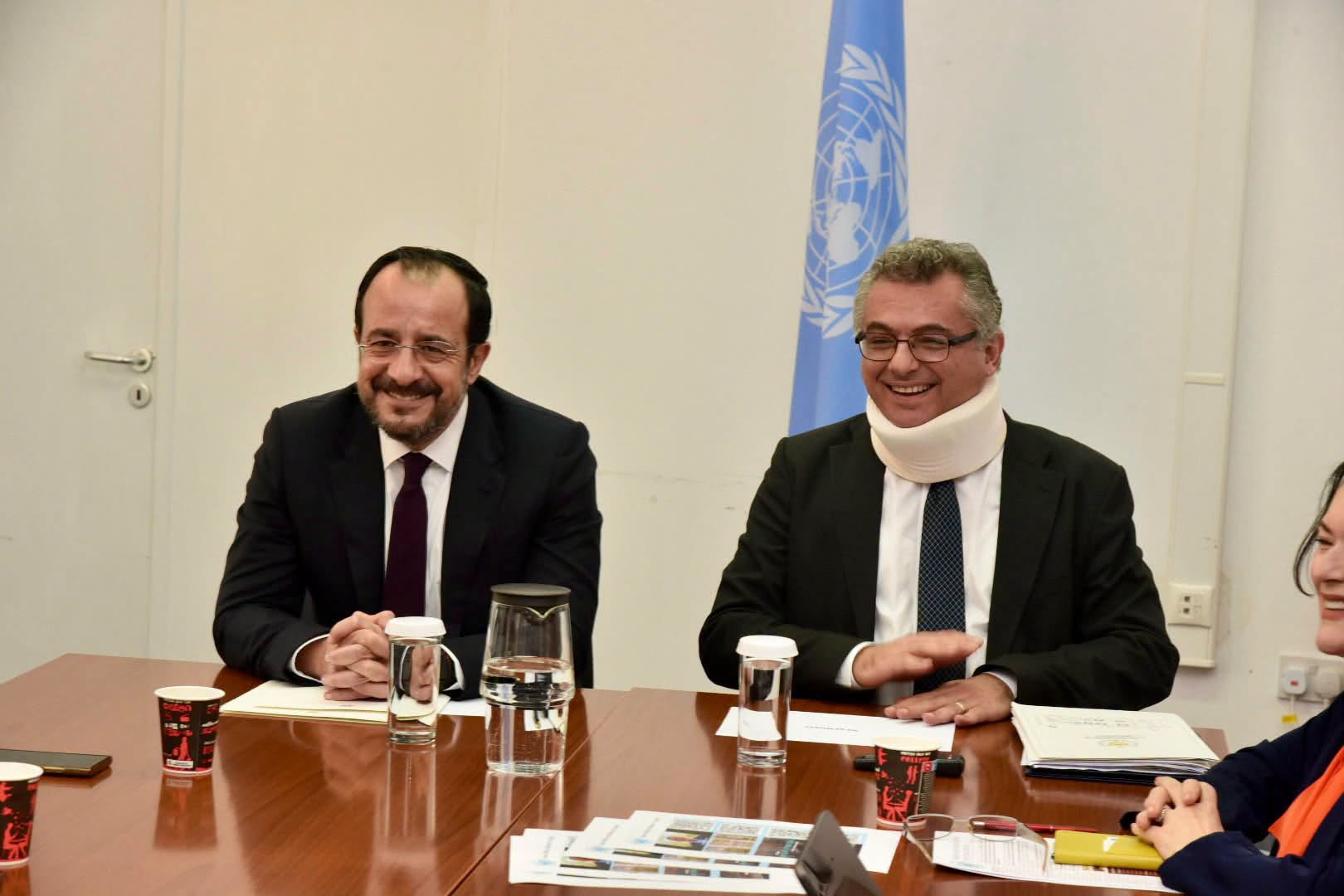
President Nikos Christodoulides on Tuesday said that both he and Turkish Cypriot leader Tufan Erhurman have agreed to make “no further statements” on matters of substance related to the Cyprus problem ahead of the forthcoming arrival on the island of United Nations envoy Maria Angela Holguin on the island.
“It was a very good and constructive discussion, which will continue during Holguin’s presence in Cyprus. For this reason, we have agreed not to make further statements regarding specific issues, and we also agreed that no joint statement would be issued,” he said after meeting Erhurman in the morning.
Both leaders had also met the bicommunal technical committees on cultural heritage and on youth, as well as the civil society steering committee, following their one-on-one meeting.
Of those meetings, Christodoulides said that they were “constructive” and that “various views and suggestions were put forward” by committee members.
He added that those suggestions will be discussed by himself and Erhurman going forward.
Holguin expected to arrive on Thursday
Holguin is expected to arrive on the island on Thursday, and will hold meetings with both Erhurman and Christodoulides, before holding a tripartite meeting with both leaders at the end of her stay.
Prior to Tuesday’s meeting, Christodoulides had stressed that his proposal to open and repopulate the fenced-off area of Varosha under the United Nations’ administration and open the port of Famagusta under the European Union’s control is “mutually beneficial”.
“I believe this is a mutually beneficial proposal. It creates a positive situation for both sides and serves as a practical test of whether we are truly committed to moving forward, specifically by taking bold confidence-building measures which also send a strong message to society as a whole,” he said.
Erhurman had said last week that he had rejected the proposal, lamenting that it fell short of an entry into force of the European Union’s direct trade regulation.
“Is this the entry into force of the direct trade regulation? No, it is not the entry into force of the regulation, but since [the port] would be under EU control, direct trade would begin,” he said.
As such, he said, the proposal was unbalanced.
The direct trade regulation is a pending EU regulation which would allow Turkish Cypriot goods, as certified by the Turkish Cypriot chamber of commerce, to be exported directly into Europe via the Green Line, and given preferential treatment inside the European single market as European goods.
It was proposed in July 2004, three months after the rejection of the Annan plan to reunify Cyprus by the Greek Cypriot side in a referendum, and shortly after the Republic of Cyprus’ accession to the EU.
Menelaou had cited progress on crossing points
Previously, Greek Cypriot chief negotiator Menelaos Menelaou had said that a dispute over the routing of the planned transit road between Athienou and the Nicosia suburb of Aglandjia “has been overcome”.
He said that the outstanding dispute now remains over the question of whether a planned crossing point to connect Louroujina, the southernmost Turkish Cypriot village, with nearby Lymbia, will open at the same time.
The Turkish Cypriot side’s position is that the road between Athienou and Aglandjia constitutes two crossing points, one in Athienou and one in Aglandjia, and that they are part of a package of four alongside plans for a crossing point in the eastern Nicosia suburb of Mia Milia, and one in Louroujina.
However, the Greek Cypriot side treats the road between Athienou and Aglandjia as one crossing point, counterweighted by the Mia Milia crossing point, and is therefore of the view that the Louroujina crossing point should only be opened if a second transit road, through the Turkish Cypriot Kokkina exclave in the Tillyria region, also be opened.

Click here to change your cookie preferences