
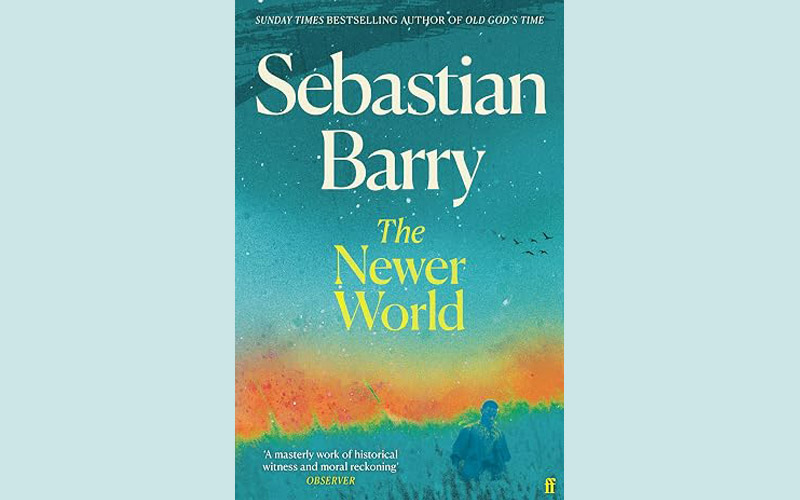
Book review: The Newer World by Sebastian Barry
Sebastian Barry’s latest novel tries to do something that seems paradoxical: to insist upon the miraculous nature of the everyday in a book telling the story of a man whose life is full of extraordinary incident. At the same time, by covering almost half a century in very short book, he seems to suggest both the fleeting nature of time and the idea that any life can be sifted to leave behind the wondrous. In short, perhaps, this is Barry doing what Barry does, using the poetic to punch beyond a book’s weight.
Tennyson Bouguereau and his twin sister, Rosalee, are born into slavery in Paris, Tennessee. Their father having been hung for trying to rob a bank to get the money to buy their mother’s freedom, Tennyson and Rosalee find themselves orphaned as children when their mother is shot for accidentally grazing a white woman’s shin.
The rest of the novel, narrated by Tennyson, covers his life on the farm of the kindly Magan family, first as slave, then as a kind of tenant farmer following the civil war. But in a Tennessee where the confederacy never really lost its grip, simply to live places the Bouguereaus in a constant state of threat, culminating in a violent defence of the farm that marks Tennyson out as the object of a vengeance that never stops looming.
Thanks to the friendship and championing of the town’s progressive lawyer – as well as Tennyson’s God-given musical talent – he is able to move to Nashville to study at a college for the education of freed slaves, the ‘Great Undertaking’. Here he finds two kinds of love, romantic and companionate, the first for a woman, Minnie, and the second for a male friend, George.
Eventually, Tennyson is forced to choose between the two people he loves, following George out of the college and into a military career that sees them work as ‘freedom hunters’, clearing the land of its indigenous people.
In coming back to Rosalee and confronting the impossibility of ever reuniting with her or with Minnie, Barry leaves Tennyson unmoored and uncertain of what is to come, but in no doubt as to the fact that ‘There are miracles available to us’ and that to head out into a future, any future, is ‘all wonders’.
If there is a complaint to be made about The Newer World, it might be that Barry denies us the chance to savour its wonders fully, since the second and third sections of the novel compress time and event to within an inch of dissatisfaction. But given the beauty of its prose and the fact that our narrator tells us that a year ‘has only the thickness of a snowflake’, we should probably just be grateful for the wonders that Barry allows us.
The Newer World by Sebastian Barry is published by Faber



Click here to change your cookie preferences