
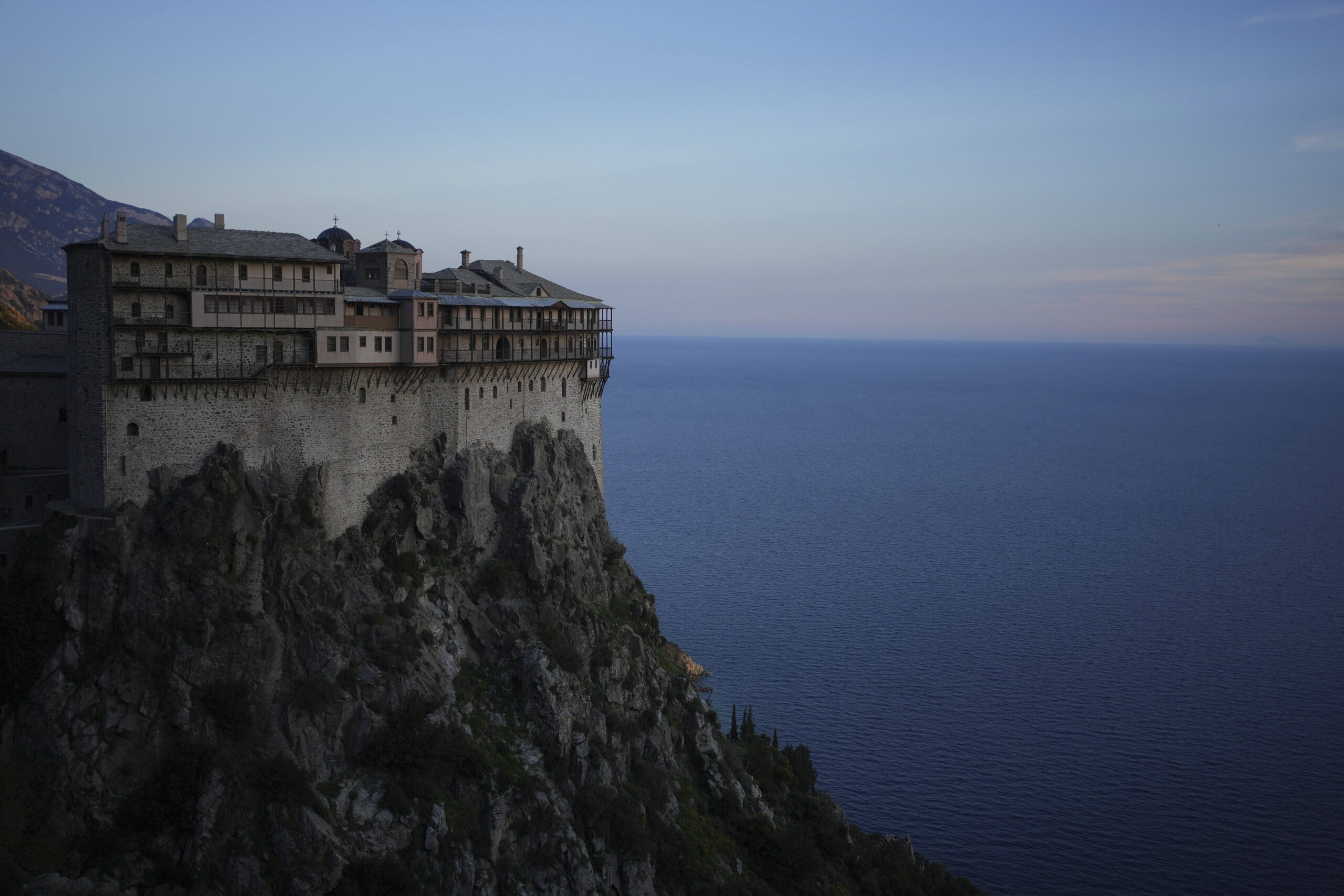
President Nikos Christodoulides began a personal pilgrimage to Mount Athos on Saturday morning and is expected back in Cyprus on Sunday.
He was received by the Holy Community in Karyes, the peninsula’s capital, and then went to the Church of the Protaton.
There he venerated the icon of the Virgin Mary known as “Axion Esti”, a revered relic to Orthodox worshippers.
He then visited the Monastery of Gregoriou, where abbot Elder Christoforos and the monks welcomed him, followed by a visit to the Monastery of Vatopedi in the afternoon.
It is not his first visit, for in March 2024 he made his first trip to Athos as president, after being invited in October 2023 but postponing because of the outbreak of the Gaza crisis.
Monastic life on Athos began in 963, when Saint Athanasios founded the Great Lavra, the oldest and largest of the twenty monasteries still active.
Only men can visit the peninsular and women have been barred for centuries.
The monks negotiated with Sultan Murad II before the Ottomans took control, securing their privileges and property and the right to govern themselves.
The concessions came at a cost, including heavy taxation and, at one point, a sultan’s representative based in Karyes.
Manuscripts studied by researchers show that for roughly the first two centuries no attempt was made to impose Islamic law there.
After a failed uprising in 1821, Ottoman troops occupied the monasteries, which had to support the garrison until 1830.
During the Balkan Wars, in 1912, the Ottomans handed the peninsula to Greece, and it formally came under Greek sovereignty after the First World War.
Athos gained its present constitution in 1924, keeping its own government while forming part of Greece, and Unesco inscribed it as a World Heritage Site in 1988.

Click here to change your cookie preferences