
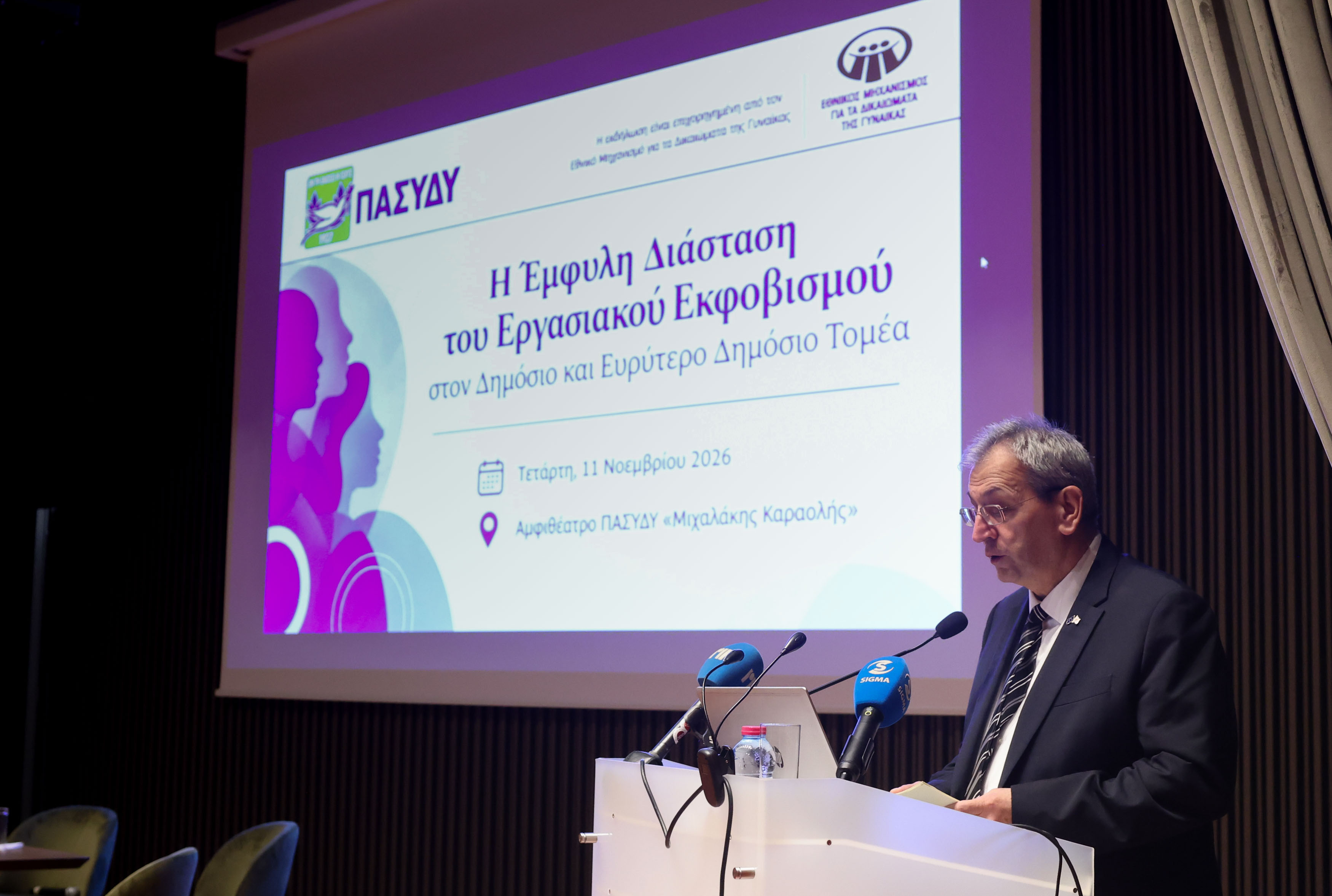
More than six in ten public and broader public sector employees in Cyprus reported experiencing workplace bullying over the past five years, according to a nationwide survey presented on Wednesday.
The findings revealed that 62 per cent of respondents had experienced humiliating, offensive or intimidating behaviour, with belittling, sarcasm and derogatory comments the most common forms of abuse.
The survey, presented at the headquarters of public servants’ union Pasydy, was based on 5,148 valid anonymous questionnaires collected in June 2026.
Among those who experienced bullying, 81 per cent reported belittling, sarcasm or derogatory comments, while 48 per cent said they had been excluded from information or workplace procedures and 46 per cent reported excessive or selective monitoring.
Women reported higher exposure to workplace bullying than men, at 64.8 per cent compared with 56.1 per cent.
Of those affected, 38 per cent said they experienced bullying frequently, very frequently or daily, while 41 per cent reported occasional incidents.
The findings also pointed to a strong hierarchical dimension, with 64 per cent of those affected identifying a superior as the perpetrator, including 49 per cent who named their immediate supervisor.
Another 33.1 per cent reported bullying by colleagues at the same level, while 68 per cent believed workplace hierarchies discouraged employees from challenging or reporting abusive behaviour.
Despite the prevalence of such experiences, 52 per cent of those affected never reported the incidents, 38 per cent made an informal report and only 10 per cent submitted a formal complaint.
The main reasons for remaining silent were the belief that reporting would be pointless (52 per cent), lack of trust in existing mechanisms (47 per cent) and fear of retaliation (36 per cent).
Confidence in institutional safeguards was particularly low. Only 14 per cent of respondents believed mechanisms existed to address workplace bullying, while 49 per cent believed none existed and 37 per cent were unaware of any.
Just 10 per cent considered existing mechanisms effective.
Presenting the findings, Hypatia Equality Promotion Foundation chairwoman Anna Pilavaki highlighted significant gender differences, low reporting rates and limited confidence in available protection mechanisms.
Women more frequently reported anxiety about going to work and sleep problems, while men more often cited low morale and reduced productivity.
Labour Minister Marinos Mousiouttas warned that workplace bullying could have serious consequences even when there were no visible signs of abuse.
“It may leave no marks on the body, but it leaves deep marks on the soul, self-esteem, health and professional development of the person experiencing it,” he said.
“An ironic comment in front of colleagues, scrutiny that always targets the same person. Individually, these may seem insignificant, but when repeated, they turn the workplace into a place of fear.”
Mousiouttas pointed to legislation introduced in recent years to address violence and harassment at work.
He said Cyprus ratified the International Labour Organisation’s Convention 190 on Violence and Harassment in the World of Work in 2024, while specific legislation introduced in 2025 established protections covering both the public and private sectors.
According to the minister, the law requires employers to adopt prevention policies and codes of conduct, inform and train employees, and designate someone to handle complaints.
It also provides protection against retaliation, compensation for victims and criminal penalties for perpetrators, with the Labour Department responsible for monitoring implementation.
Mousiouttas said psychosocial risks were increasingly being incorporated into occupational health and safety policies, while employers adopting equality policies and measures against harassment could receive recognition through a workplace gender equality certification scheme operating under the ministry’s supervision.
However, he acknowledged that legislation alone was insufficient to tackle the problem.
“The survey, however, clearly shows us that the law alone is not enough,” he said.
He identified three priorities: raising awareness of employees’ rights, establishing accessible and independent complaint mechanisms that inspire confidence, and training supervisors to prevent and address bullying.
“A workplace free from bullying is the right of every employee and, at the same time, a prerequisite for a public service that is effective, productive and worthy of citizens’ trust,” he said.
Pasydy general secretary Stratis Matthaiou described the findings as evidence of a problem rooted in workplace relations, administrative culture and the exercise of authority.
He called for independent and accessible complaint mechanisms, effective protection against retaliation, confidential investigations and stronger accountability.
Representing the Gender Equality Commissioner’s Office, Niovi Georgiadi described workplace bullying as a form of psychological violence affecting employees’ dignity, mental wellbeing and professional lives.
University of Cyprus psychology professor Panayiotis Stavrinides warned that workplace bullying should not be confused with isolated disagreements, describing it as repeated behaviour intended to undermine or humiliate an individual.
He also highlighted cyberbullying through digital communication platforms and the potentially serious psychological consequences of persistent workplace harassment.
“Workplace bullying is not simply a problem of interpersonal relationships, but an organisational issue in which management responsibility is decisive,” he said.




Click here to change your cookie preferences