
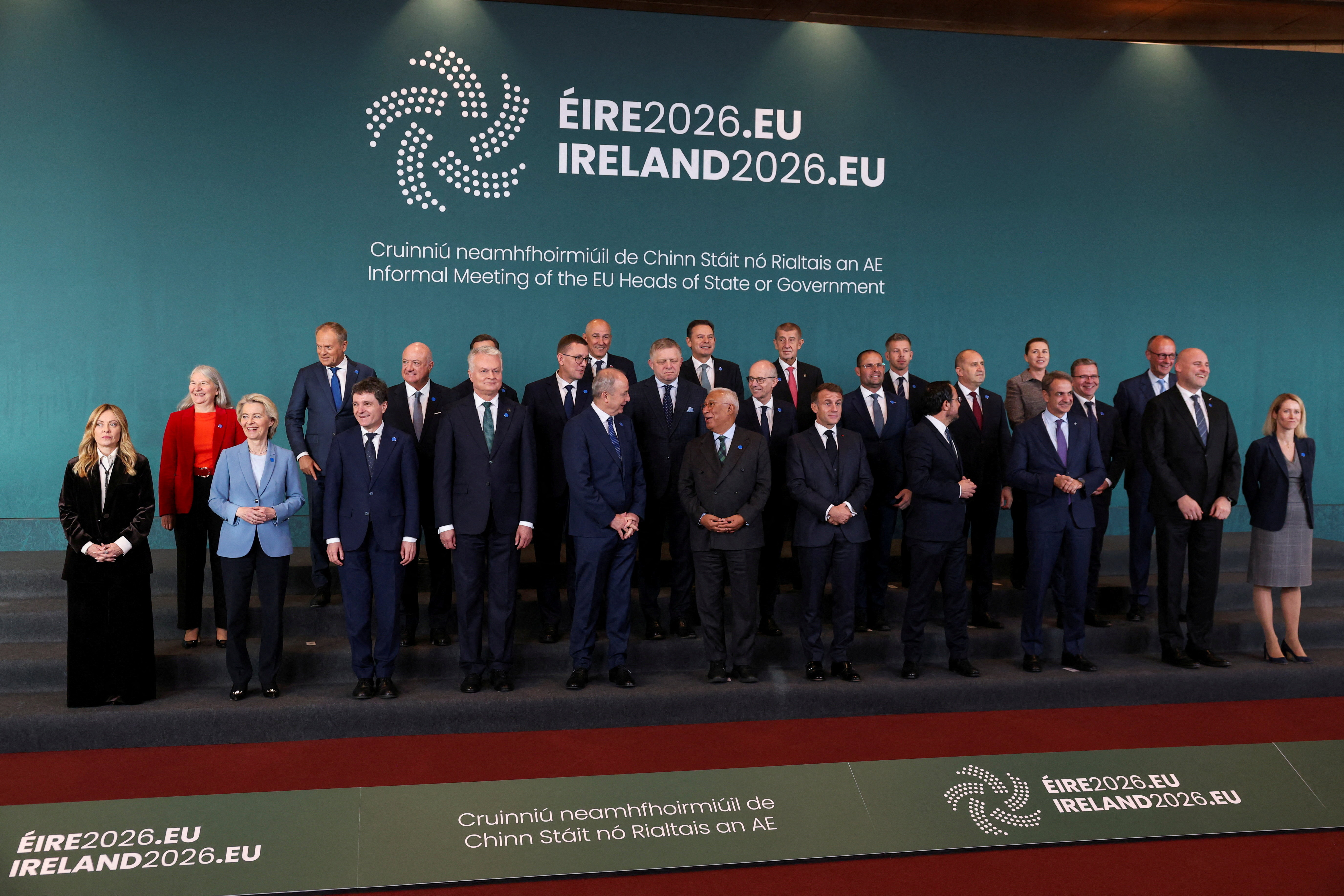
EU leaders have agreed that Europe’s team for Ukraine peace talks will comprise five major military powers – non-member Britain plus France, Germany, Italy and Poland – and EU institutions, European Council President Antonio Costa said on Friday, after months of wavering over who will speak for the continent.
“Europe must speak with one clear voice and united voice in all discussion that shape the future of Ukraine and the security of our continent. And this is ultimately a team effort,” Costa, who chairs EU summits, told a press conference at the end of a leaders’ meeting in Dublin.
The Kremlin said on Friday that Russia would be open to European countries taking part in Ukraine peace talks if it saw they genuinely intended to contribute to peace. Russian officials have also called for a broad agreement on Europe’s security architecture to be reached before specifics of the war are addressed.
German Chancellor Friedrich Merz described the Kremlin’s comments as “the same old game” and said that Europe and the United States had agreed on a clear message.
“There will be no discussions about Ukraine without Ukraine, and no discussions about Europe without Europe. Furthermore, there is no need to talk about European security architecture. We have that already,” Merz told reporters midway through the summit.
Kushner says us has begun talks on Europe’s security
US negotiator Jared Kushner said in Moscow on Thursday that he had begun discussions with European partners on the continent’s security architecture.
Representatives from Britain, France, Germany, Italy and the EU attended Russia-Ukraine talks in Abu Dhabi this week, where both Moscow and Kyiv cited some progress, though there was no sign of a breakthrough on key issues such as territory.
EU officials said the representatives for Europe in future talks were likely to be national security advisers from the five military powers, plus delegates from the European Commission and the European Council, the body for EU governments. Nato is also expected to be represented.
Before its invasion of Ukraine in 2022, Russia demanded the withdrawal of Nato forces from countries that joined the alliance after 1997. Nato rejected the demand.
EU foreign policy chief Kaja Kallas said Russian calls for discussions about Europe’s security architecture threatened to divert attention from the need for a ceasefire. Latvian Prime Minister Andris Kulbergs called such discussions “a trap”.
Polish Prime Minister Donald Tusk said it was important to avoid unnecessary concessions to Russia.
“My view was shared by many others: there can be no revision of Europe’s security architecture – that is what Putin is demanding,” he said.
During a meeting on Thursday, leaders from Poland, the Baltics and Nordic states warned against brainstorming with the US or Russia about Europe’s security architecture, according to a European diplomat and a European official.
Forty European countries, meeting as a broader group in Dublin on Thursday, signed a declaration saying that any matter affecting European security should be decided with the involvement of Europeans.


Click here to change your cookie preferences