
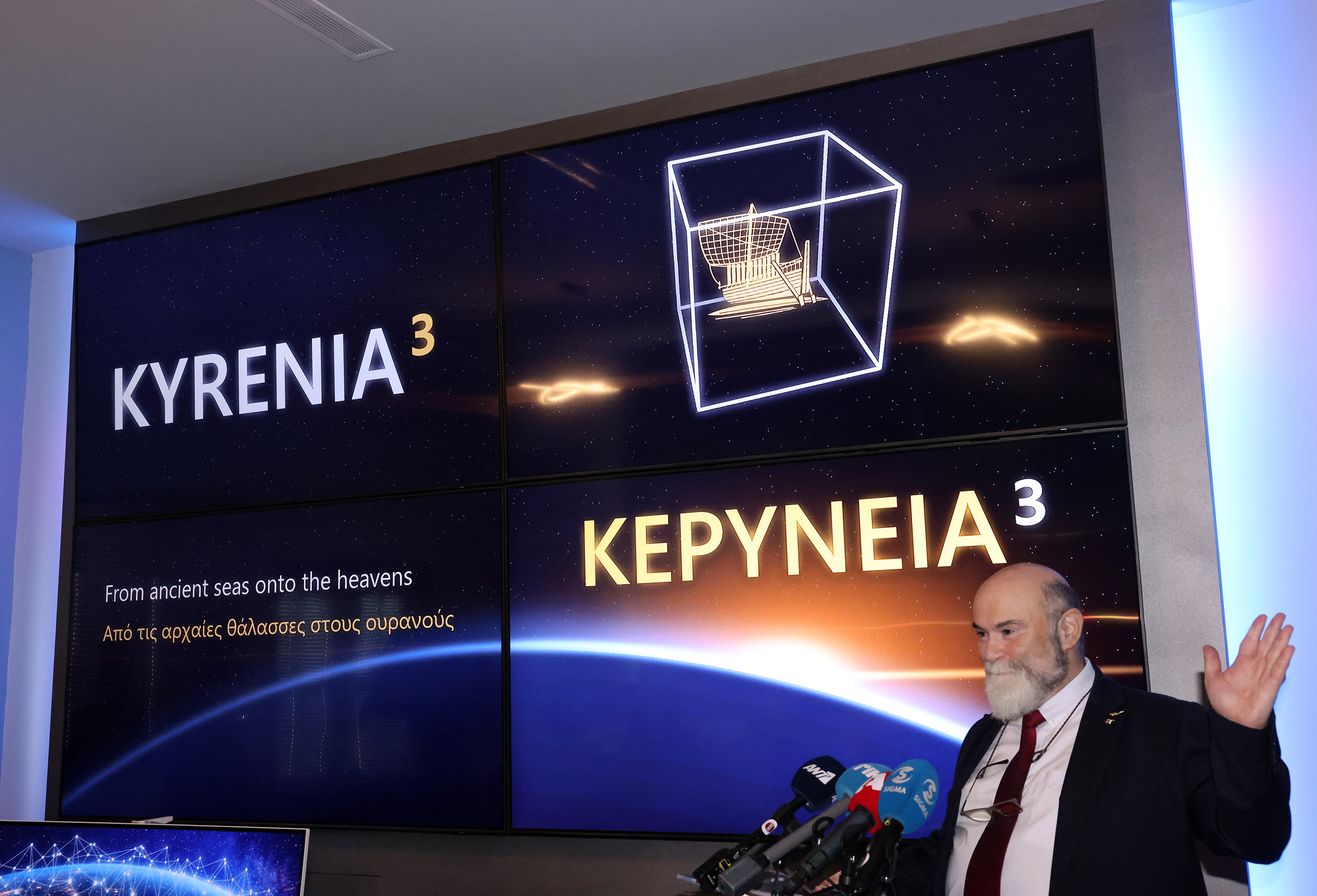
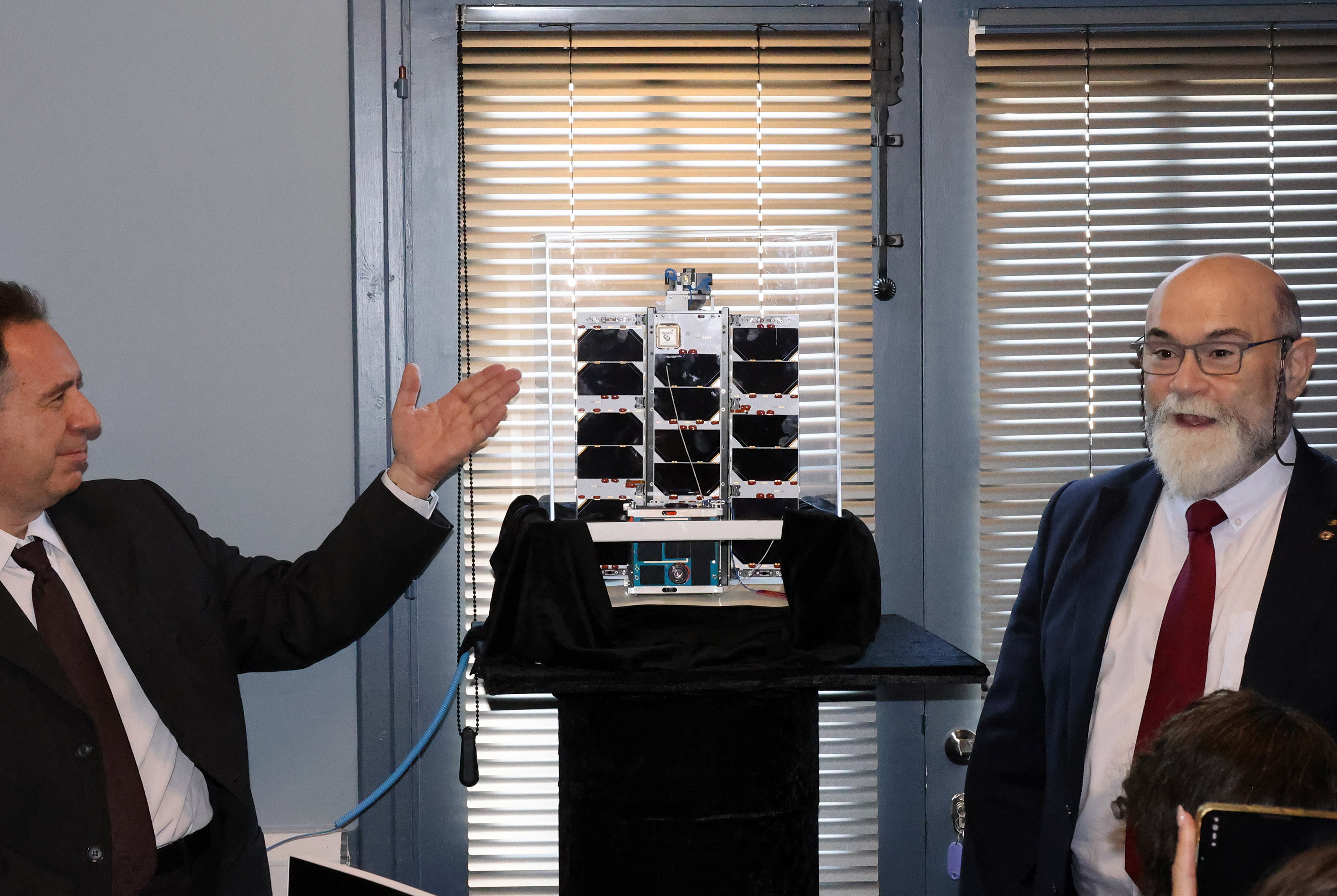
Cyprus unveiled its first locally built satellite, Kyrenia 3, on Monday, marking a significant step in the country’s ambitions to establish itself in the international space industry, as a new space weather operations centre also began operating in Nicosia.
The satellite was presented at the Cyprus Space Exploration Organisation’s (CSEO) facilities, home to the International Space Innovation Centre (C-SpaRC) under the auspices of Chief Scientist Demetris Skourides.
The unveiling marked the culmination of years of work to develop the country’s satellite manufacturing capabilities, supported by an investment of approximately €2.5 million in specialised research infrastructure.
Speaking exclusively to the Cyprus Mail, CSEO president George Danos said the occasion represented the fulfilment of a dream he had pursued for more than a decade.
“I’m deeply moved,” he said.
He recalled telling members of the Cypriot diaspora in New York, around 2018, that his ambition was to build the country’s first microsatellite and name it Kyrenia 3.
Danos said the facilities now established in Nicosia meant Cyprus could move beyond individual research projects and develop a sustained satellite manufacturing capability.
“This infrastructure gives us the ability to produce not just one, not just the three satellites we presented, but to continue producing satellites and other mechanisms for space,” he said.
“This is enormous for our country.”
Cyprus developing technological capabilities
The centre brings together specialised equipment for satellite engineering, manufacturing and testing, including a metal 3D printer, vibration testing equipment and an ISO 7 clean room where microsatellites are assembled.
Skourides told the Cyprus Mail the importance of the project lay in Cyprus developing its own technological capabilities rather than relying solely on satellite data and equipment produced abroad.
While Cyprus already has expertise in Earth observation, the ability to manufacture microsatellites and specialised components represents a significant development.
“You don’t have to be a large country to participate in this ecosystem,” he said.
“It is an ecosystem that will lead to new jobs and new opportunities, including for young scientists.”
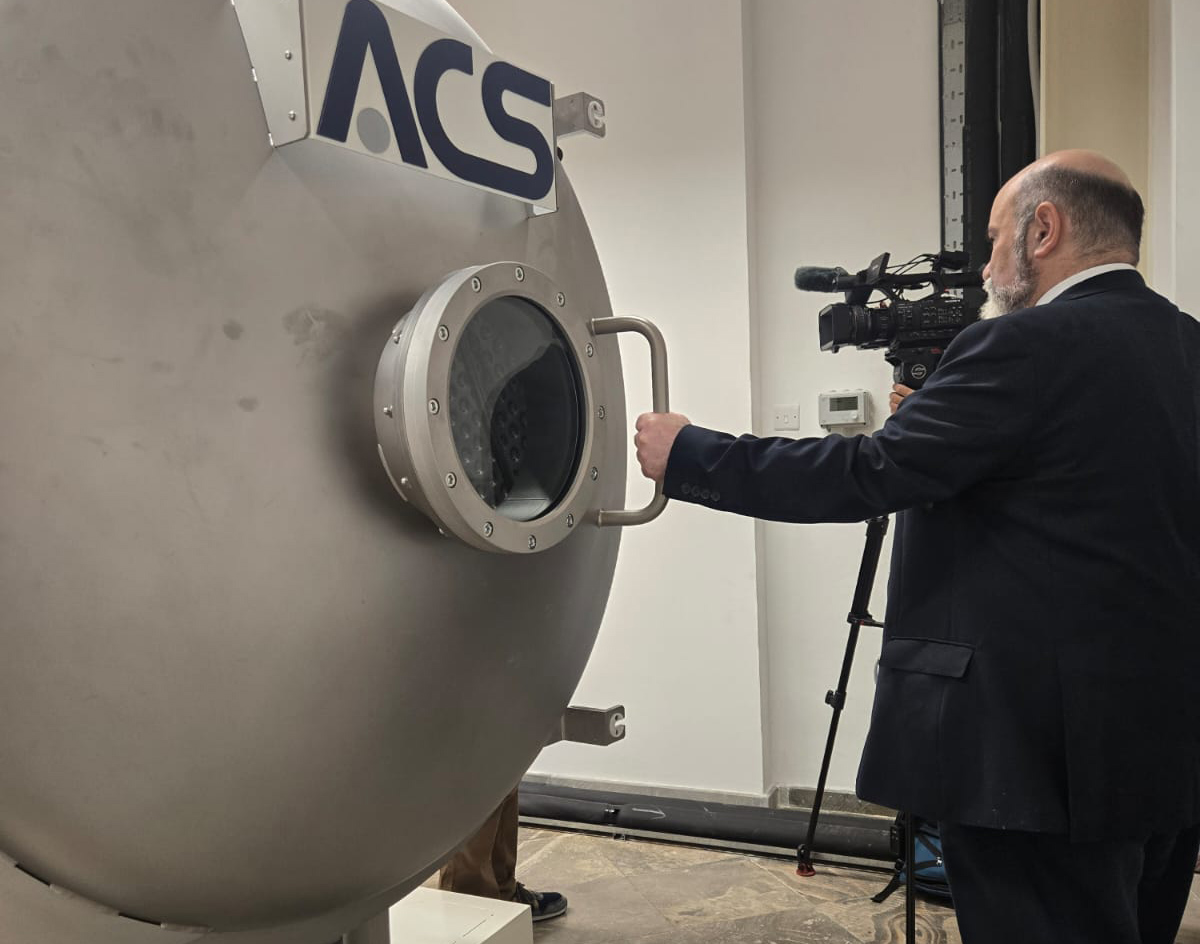
He pointed to the centre’s specialised metal 3D printer as an example of how applied research could be brought closer to industry, allowing businesses and researchers to manufacture certain components locally rather than relying on facilities abroad.
“The difference with this centre is that it brings the research dimension, applied research, closer to industry,” he said.
The next priority, he added, was to make the infrastructure accessible to universities, researchers and businesses, in line with the principles of open science.
Launch dates still to be confirmed
Although Kyrenia 3 has been unveiled, its launch date has yet to be finalised.
Danos told the Cyprus Mail that the organisation was in advanced discussions with international partners over arrangements for launching the three satellites referred to during the presentation.
Securing a launch opportunity can be a lengthy process, he explained, with waiting times potentially reaching 18 months even after a spacecraft has been completed and certified.
Danos also confirmed that research data from the satellites could be shared internationally, while other information would have more specific applications in Cyprus, including the monitoring of forest fires.
New centre to monitor solar storms
Monday also marked the official activation of the space weather operations centre, which uses artificial intelligence and machine learning to analyse solar activity and forecast potentially disruptive events.
Solar activity can affect telecommunications, satellite operations, navigation systems and electricity infrastructure, making accurate forecasting increasingly important.
Danos said the centre’s forecasting capabilities had attracted interest from NASA and other international organisations.
“Today I am using that machine learning, artificial intelligence, to give us forecasts of when the sun might bombard our planet with radiation or particles,” he said.
The centre’s forecasting results had demonstrated internationally competitive capabilities and could be useful well beyond Cyprus, he added.
“The satellites are important for Cyprus,” he said. “But the results of space weather research are important for everyone.”
The system has already generated approximately 110,000 forecasts.
From space research to human health
The centre is also involved in research examining how conditions in space affect the human body, through cooperation with the Cyprus Institute of Neurology and Genetics and NASA’s Translational Research Institute for Space Health.
Danos said researchers had identified changes in the regulation of certain genes under space-related conditions, including microgravity, and investigated whether existing medicines could be repurposed to protect astronauts.
The research could also have applications for human health on Earth, including neurological and cardiovascular conditions.
Bringing space into Cypriot classrooms
Beyond its scientific and commercial ambitions, the project also aims to bring space exploration closer to children.
CSEO’s Director of Workforce Development and Global Partnerships Don Koulaouzos introduced an educational initiative through which students will be encouraged to build satellite receivers and antennas capable of receiving messages from space.
“With low-cost technology, we’re going to inspire the youth of Cyprus to embrace science, technology, engineering and mathematics,” he said.
From the Kyrenia ship to space
The satellite’s name draws on the history of the ancient Kyrenia ship, linking Cyprus’ maritime heritage with its ambitions in space exploration.
“Our role is no longer limited to the sphere of influence of our small but great homeland,” Danos said.
“Our role now extends outwards, to the wider planet.”



Click here to change your cookie preferences