
Iran’s most powerful Shi’ite militia ally in Iraq has been raking in hundreds of millions of dollars from oil stolen from the state, Iraqi officials say, prompting the prime minister to ready his security forces to confront the heavily armed group.
Prime Minister Ali al-Zaidi has launched his toughest challenge yet to the group Kataib Hezbollah by cracking down on an oil smuggling network it has run for years, senior security, army, police and oil officials told Reuters.
They said the smuggling, carried out with accomplices among some security and oil officials, has robbed the government of hundreds of millions of dollars dating back to 2021.
Kataib Hezbollah, branded a terrorist organisation by the US, is one of dozens of heavily armed pro-Iranian groups that have semi-official status in Iraq. It denies the smuggling and calls the crackdown part of a campaign to seize its weapons.
“We are therefore being subjected to the greatest campaign of blackmail aimed at forcing us to relinquish the weapons of dignity that have upheld sovereignty and protected the rights of Iraqis at multiple stages,” the group said in a statement.
Iran, the Middle East’s main Shi’ite Muslim power, has had deep influence in majority Shi’ite Iraq since the United States toppled Sunni Muslim dictator Saddam Hussein in 2003.
The Iranian-backed armed groups have resisted repeated calls by both Zaidi and his ally US President Donald Trump to disarm, and have struck US troops and targets in Saudi Arabia and the United Arab Emirates in solidarity with Tehran since the United States and Israel launched their war against Iran in February.
Jasim al-Bahadli, an Iraqi security analyst specialising in studying armed Shi’ite groups aligned with Iran, said the government anti-smuggling campaign has become a political confrontation with the militia.
“Al-Zaidi is effectively challenging a group with deep security, political and economic influence, and that carries significant risks for both sides,” he said.
“More broadly, it appears to be an attempt to contain the influence of Iran-backed armed groups by targeting economic networks that underpin their power, particularly after Kataib Hezbollah resisted government efforts to bring armed factions more firmly under state control.”
GOVERNMENT INVESTIGATION
So far, nine senior security and oil officials have been dismissed following a high-level government investigation into oil smuggling, focused on Jurf al-Sakhar in Babil province, a Kataib Hezbollah stronghold about 50 km (30 miles) south of Baghdad.
Zaidi has ordered all suspects to be referred to the courts, and dismissed the Babil police chief, the province’s intelligence and security commanders and the director of the state-run Oil Pipelines Company (OPC).
Now he has ordered senior military and security commanders to deploy additional forces around Jurf al-Sakhar and prepare for the entry of government troops into the town, potentially bringing the government into a direct confrontation with fighters.
ARMED TO THE TEETH
The groups have built up arsenals that include assault rifles, machineguns, anti-tank guided missiles, mortars, rockets, armed drones and, according to Iraqi security reports and assessments, some short-range ballistic and cruise missile capabilities supplied by Iran or derived from Iranian systems.
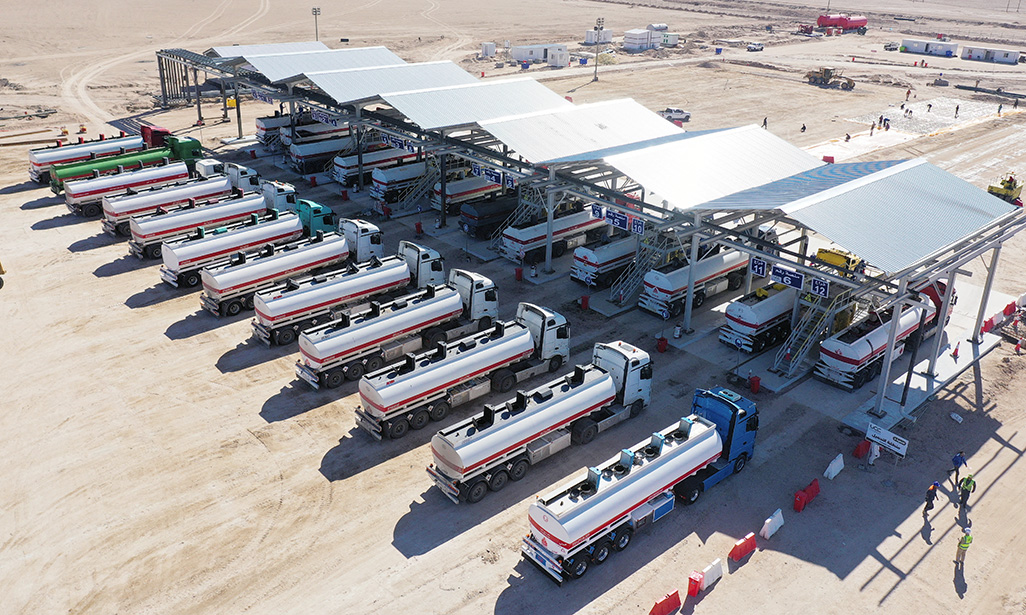
Two security sources who took part in an inspection mission on Saturday to Jurf al-Sakhar said investigators had found evidence that smugglers had punctured a crude oil pipeline and siphoned crude into makeshift storage pits dug in the ground.
The 26-inch pipeline carries at least 200,000 barrels per day of crude, according to an Iraqi Oil Ministry document reviewed by Reuters.
The sources said investigators found concealed pumping equipment inside several hangars used to avoid aerial surveillance while loading tanker trucks with siphoned crude. Investigators also found a small oil refinery concealed in the area, the sources said.
Two Iraqi oil officials with direct knowledge of the investigation said it was too early to quantify losses without knowing how long the tapping points had been operational, but estimated the value of crude potentially siphoned since 2021 could amount to hundreds of millions of dollars.
The crackdown is set against a backdrop of mounting US pressure on Iraq over the role of pro-Iranian groups in the country’s oil sector.
In May, Washington sanctioned Iraq’s deputy oil minister, alleging he had facilitated the diversion of Iraqi oil for the benefit of Iran and its proxy militias. Sanctions were also imposed on militia leaders and networks Washington said were exploiting Iraq’s oil wealth to finance Tehran-aligned groups.
Reuters reported in 2024 that a fuel oil smuggling network had raked in $1 billion for Iran and its proxies.


Click here to change your cookie preferences