
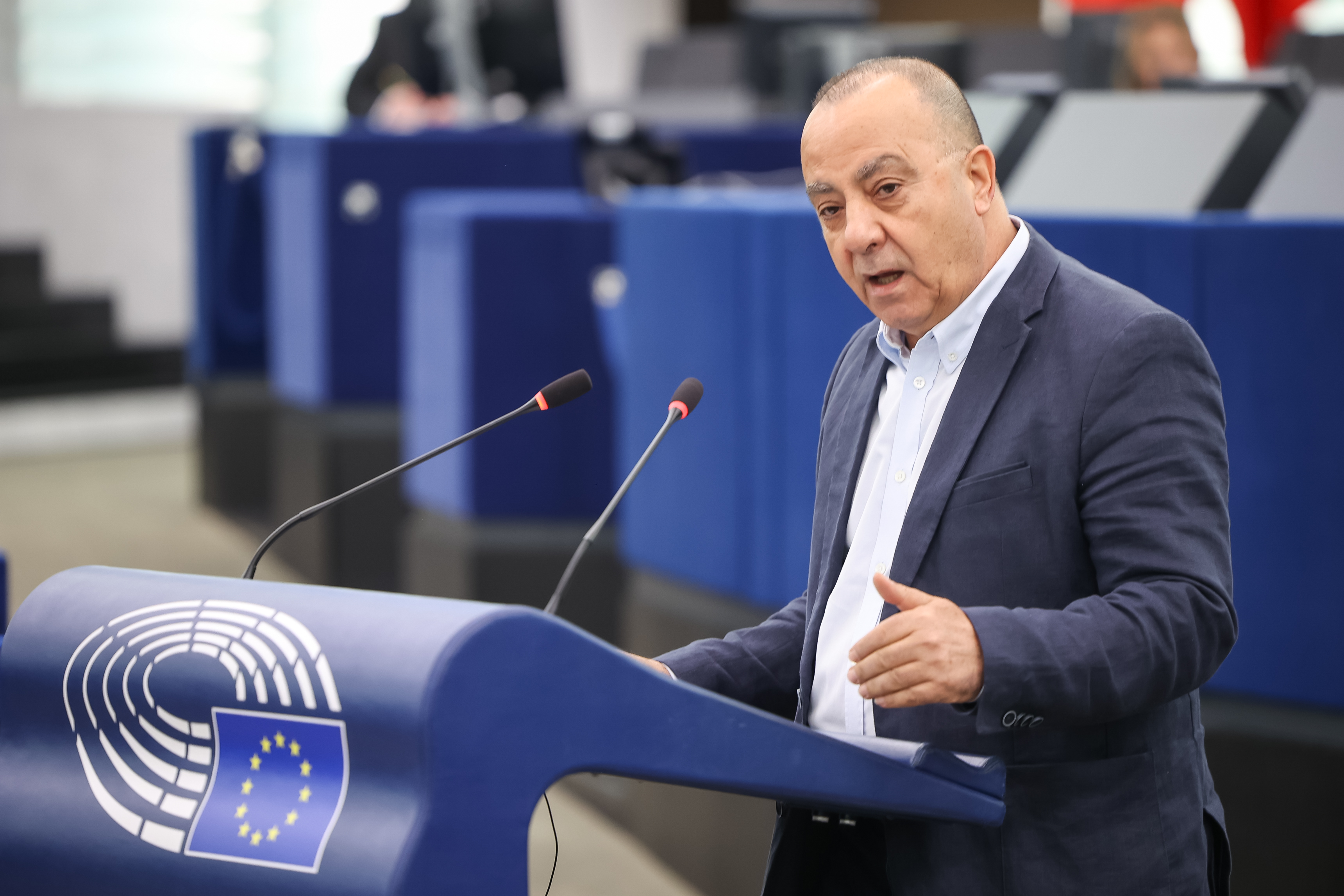
Capitalism and “neoliberal policies” are “bleeding the people dry”, Cypriot member of the European Parliament Giorgos Georgiou told Wednesday’s Strasbourg plenary session, as it debated the rising cost of living across Europe.
He addressed Irish Culture Minister Charlie McConalogue, who was in Strasbourg representing the Council of the European Union, over which Ireland currently presides, and European Social Rights Commissioner Roxana Minzatu, saying that “we, and you, are doing quite well in here, with our job security and our handsome salaries”.
“Out there, however, the squares are filling up with thousands of indignant members of the public who can no longer bear the rising cost of living,” he said, with youth-led protests having been held in both France and Portugal, as well as elsewhere, against the rising cost of living in recent days.
He said that “for some, including the far right”, the blame for those rising costs is placed on “people of different skin colours, immigrants, or communists”, before returning to the matter of EU officials’ salaries, saying that “if you ask AI, it will tell you that [European Commission President Ursula] von der Leyen’s monthly salary exceeds €43,000”.
“Many Europeans do not earn that much in a year,” he added.
‘It is not radical to take to the streets’
He then asked both McConalogue and Minzatu whether they “know when the public’s rage and anger will overturn everything and real improvement”, before answering his question, saying that “it will happen when millions realise that you are lining the pockets of industrialists with money which belongs to future generations”.
“Your brand of capitalism, with its neoliberal policies, is bleeding the people dry, but know this: both today and tomorrow, we will stand on the right side, out there, with the people, so that there may be hope for better days,” he said.
The debate had been called on by the parliament’s The Left group, of which Georgiou is a member, and German MEP Martin Schirdewan was the first to speak, saying that “it is not radical to take to the streets to call for quality education, healthcare, fair wages, and affordable”.
“What is radical are the conditions which force people to fight for a life of dignity. The social emergency within the European Union is what is truly radical. Soaring prices for rent, food, and energy mean poverty and a daily fight for survival for 90 million people,” he said.
‘They will be sitting cold in their own flats’
He added that the commission is “doing nothing to address this social emergency”, and that while “winter is approaching”, around 40 million people across the EU “cannot afford to heat their homes”.
“They will be sitting in the cold in their own flats. Cold makes people sick. Poverty makes people sick. In the European Union, the poor die ten years earlier than the wealthy. This is an absolute scandal,” he said.
Minzatu, meanwhile, acknowledged that “housing prices across the European Union have increased by more than 60 per cent” over the course of the last decade, and said that as such, “citizens are counting on us, as policymakers at European level, national level, local level, to come up with concrete, strong and fast responses to bring about real change”.
She did, however, point to efforts made by the commission to reduce housing costs, including the Affordable Housing Act, proposed in September, which, if passed into law, will allow member states and local authorities to restrict short-term rentals and non-primary residences, should criteria be met.
EU must ‘make sure the results we want trickle down to every household’
Looking ahead, she said that the planned introduction of national and regional partnership plans – money given directly by the EU to member states for infrastructure and agriculture funding – from 2028, will likely include “a key tool to ensure that social affordable housing will be there”.
“The European Union should indeed be able to provide a social shield for its citizens, and we need to mobilise all our efforts urgently so that we can make sure that the results we want trickle down to every household that needs the support. We must fulfil our promise of being a Europe that protects and empowers our citizens in time of need,” she said.



Click here to change your cookie preferences