
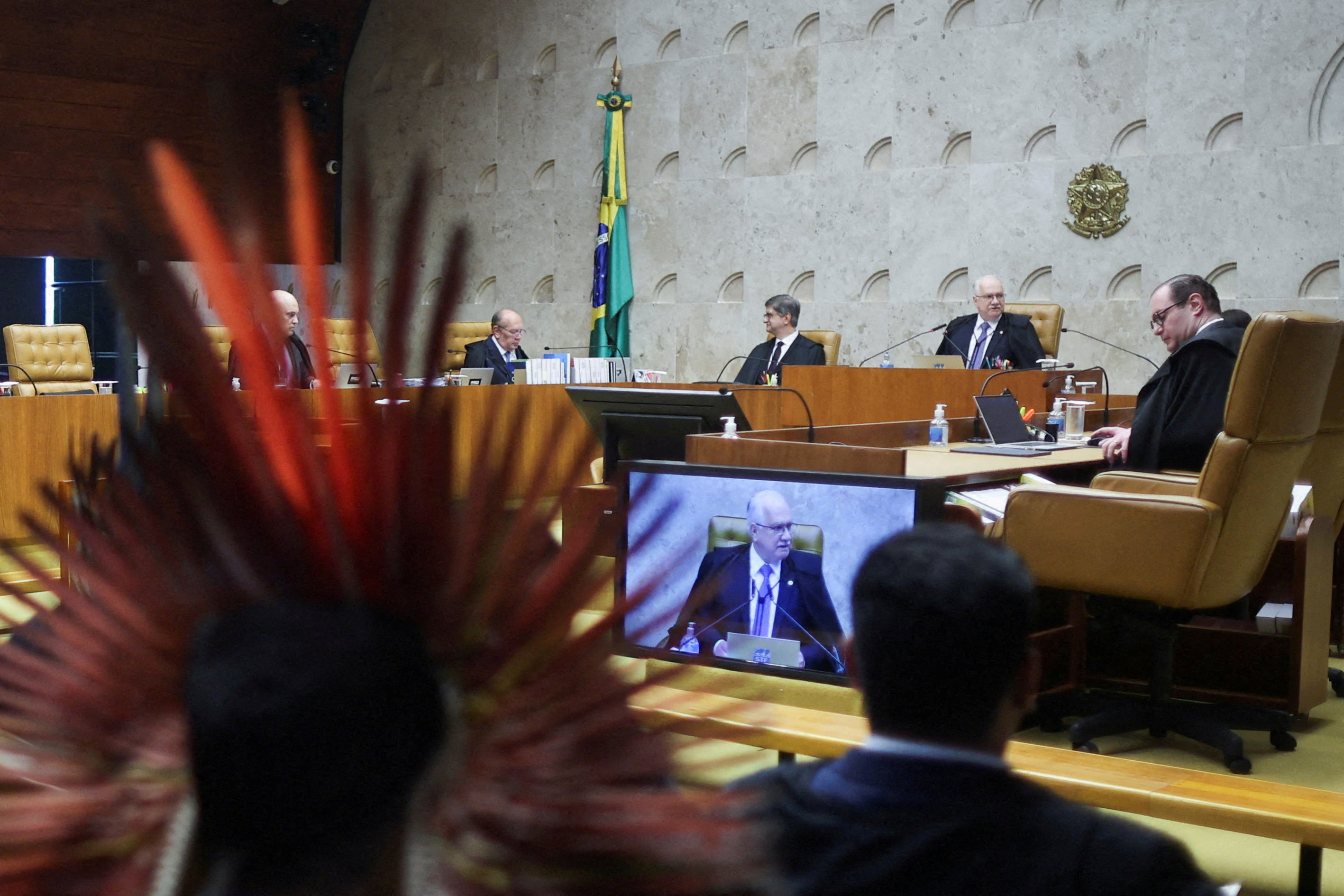
A majority of Brazil’s Supreme Court reaffirmed protections to Indigenous land rights on Wednesday, curbing attempts by Congress to limit the recognition of reservations in a ruling likely to stoke tensions between the top court and lawmakers.
Six of the 10 Supreme Court judges have voted to establish Indigenous land rights as entrenched clauses of Brazil’s constitution that cannot be stripped by lawmakers, said Deborah Duprat, a former federal prosecutor who worked on Indigenous rights issues for decades.
“It’s an important message to Congress,” she added.
Although four Supreme Court justices have not yet rendered their opinions on the issue, their votes are not enough to block the majority decision.
Although Brazil’s 1988 constitution recognized the rights of Indigenous peoples to their ancestral territory, the process of demarcating those lands has dragged on for decades. Indigenous advocates say hundreds of communities still await that formal recognition, with many entangled in violent land disputes.
In recent years, resistance to Indigenous land claims has mounted from a powerful farm lobby backed by the conservative majority in Congress.
Lawmakers passed a law in 2023 to limit protections for Indigenous lands that communities cannot prove they occupied when the constitution took effect. Proponents say that cutoff date protects landowners from claims they were unaware of when they purchased their property.
As the Supreme Court prepared this month to rule on whether that law was constitutional, the Senate voted to amend the constitution in line with the 2023 law.
The lower house of Brazil’s Congress is also expected to pass that constitutional amendment. But some Supreme Court justices already have argued in their votes this week that this section of the constitution cannot be amended because it protects fundamental rights.
“The legislative branch may not, under any pretext, suppress or reduce rights guaranteed to Indigenous peoples, under penalty of violating the foundational principles of the democratic rule of law,” Justice Flavio Dino wrote.




Click here to change your cookie preferences