
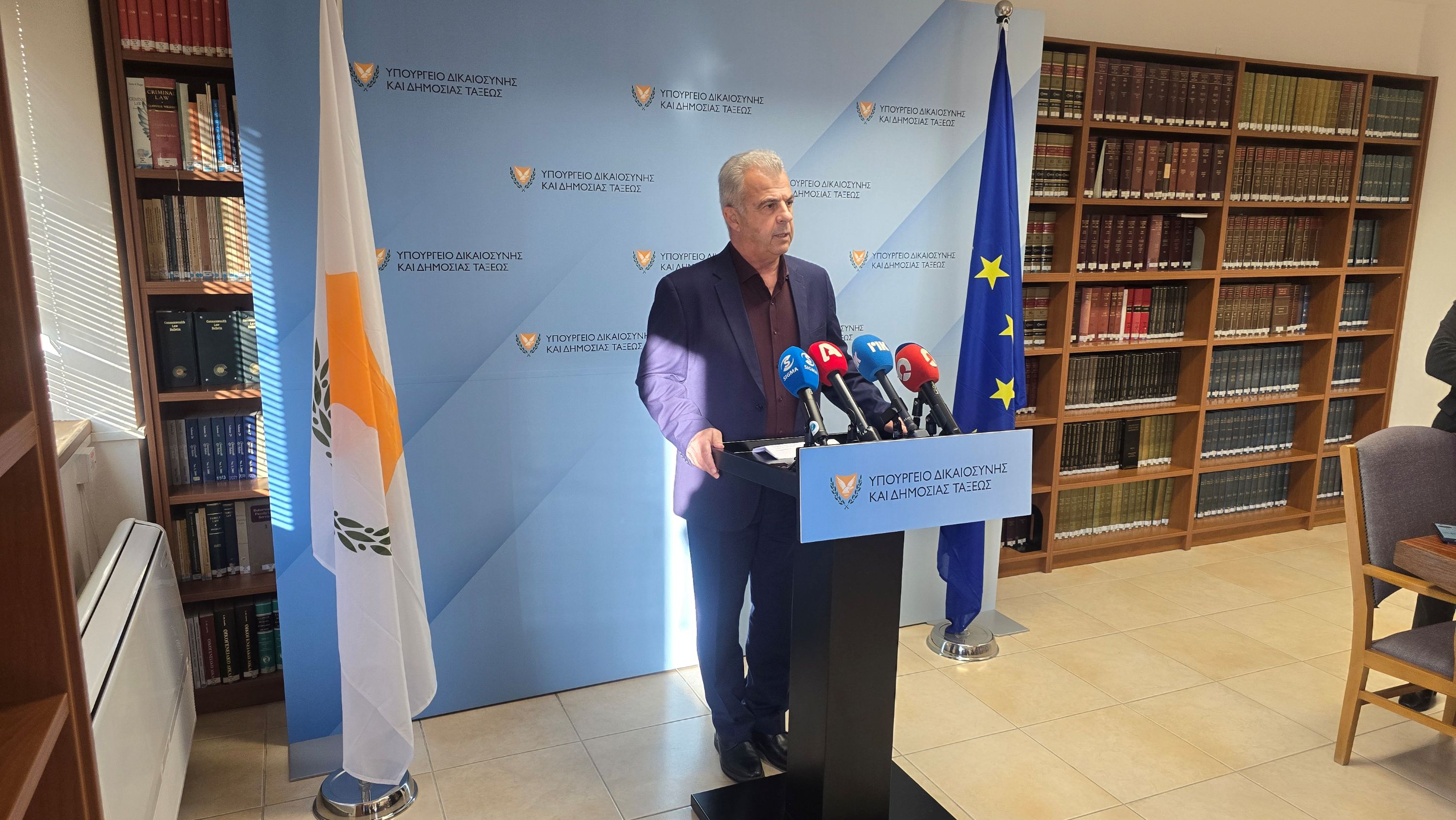
Positions remain hardened over a recently announced police reform aimed at adjusting working hours and holiday regulations for officers of all ranks, with police unions threatening protests following a meeting with Justice Minister Costas Fitiris on Friday.
The head of the police branch of the Isotita trade union, Nikos Loizides, expressed the union’s anger over the plans proposed earlier this week by police chief Themistos Arnaoutis.
“We have legal remedies at our disposal, including the Joint Police Committee, the European police union and the courts. With the approval of my council, we are also prepared to hold protests in unexpected locations and on unanticipated days,” Loizides said after the meeting. “We have sent a request to the other unions to cooperate,” Loizides said after Friday’s meeting.
He emphasised that the union would not hesitate to call protests, not ruling out the possibility that these could take place on January 7, the day of the opening ceremony of Cyprus’ EU Council presidency.
Ahead of Friday’s meeting, Loizides said on Wednesday that he expected clarification on the government’s stance regarding the police chief’s reform, warning of “huge gaps” between the interests of the parties involved.
Expanding on those remarks on Friday, he said the unions’ “outburst” to the reform announcement stemmed from statements made by the police chief suggesting the existence of shady unions, dishonest officers abusing overtime and hidden union agendas when asserting labour rights.
“That is why there was such a strong reaction, and that is what we informed the minister about,” he said.
Loizides added that Arnaoutis’ proposal would deprive officers of 15 days of rest, with police who previously received one day off for every 20 working days now being granted only one day off for every 76 working days.
“The minister said that he cannot interfere with the police chief’s orders. Unfortunately, this does not satisfy us,” he said, adding that it appeared the position of President Nikos Christodoulides aligned with the reform. “It seems the president was informed and approved the decision to reduce police officers’ rest days.”
Justice Minister Costas Fitiris, for his part, called on the unions to soften their tone, urging them “not to exceed the limits and deviate from the regulations approved within the framework of democracy.”
“The chief of police issued an order based on his powers, which must be and is being implemented,” he said. “Discipline also means that even those who disagree must carry out orders given by their superiors without question.”
Fitiris pointed to streamlined complaint procedures, noting that unions could pursue legal action if they wished, while also calling for collective efforts to ensure public safety.
“Under no circumstances should it be allowed that, under pressure, whether from public opposition or the use of the media, demands are met in a way that undermines the hierarchy required in a security force such as the police,” he said, rejecting Loizides’ claims that the reform was a political decision influenced by the president.
“You can characterise it as a decision affecting police operations or labour issues, but it was not a political decision. It is a decision of the police leadership,” Fitiris said, adding that “officers who believe they are affected could file complaints through the appropriate channels.”
Responding to the union’s threats of calling for a work stoppage on the day of the opening ceremony of the EU Council Presidency, Fitiris said that the was “worried and saddened” that these was being considered, but stressed that “the state will not stop functioning,” warning that unions would face consequences if they deviated from state regulations.
“There are alternatives, and I am confident that police officers have a sense of responsibility and will never jeopardise the security of the Republic,” Fitiris said, citing the EU presidency, the rise of organised crime and other challenges.
“I do not believe that there is even one police officer who would violate his oath and act contrary to what society demands,” he concluded.
Police unions said in a joint statement on Tuesday that Arnaoutis’ plans amounted to “a blatant circumvention of labour institutions with unprecedented practices and tactics,” stressing that working hours could not be modified unilaterally and must be the result of dialogue.
Meanwhile, Cyprus Police Association (CPA) president Angelos Nikolaou described Friday’s meeting with the justice minister as productive, saying his association supports suspending Arnaoutis’ proposal.
“We raised the issue of the police chief’s unilateral decision to reduce officers’ days off and modify working hours. The minister did not comment on the substance,” Nikolaou said. “The police are a disciplined body. It was agreed that we would follow the chief’s instructions while appealing to the relevant bodies to examine the possibility of modifying, cancelling or suspending the decision.”
Nikolaou said the association had sent a letter to the Joint Police Committee, which is expected to convene next week to examine the issue further.
He declined to comment on the alleged overtime abuse, saying that “the essence is the labour rights of police officers and we must defend those who work and give their all to their duty.”
“The next steps include the appeal to the JPC and registering the matter in parliament,” he said, adding that legal action could follow if necessary, including meetings with the president.
Asked whether the association would take part in strikes, Nikolaou said appeals would first need to be examined, expressing hope that a work stoppage could be avoided, while noting that the option remained on the table if deemed necessary.



Click here to change your cookie preferences