
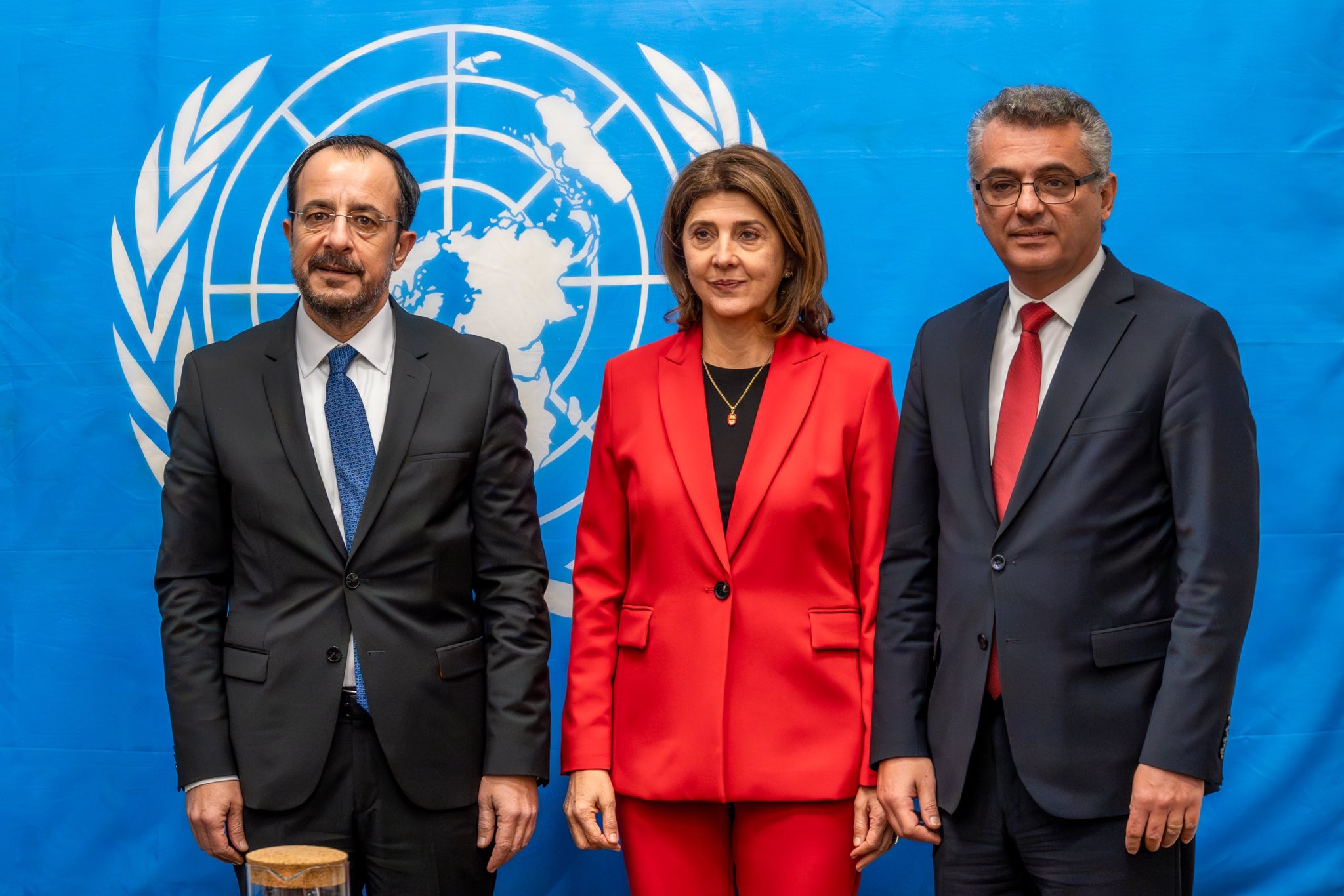
United Nations Secretary-General (UNSG) Antonio Guterres has said that recent informal meetings in an expanded format during 2025, along with contacts between the President Nikos Christodoulides and newly-elected Turkish Cypriot leader Tufan Erhurman, have shown that there is “a new moment of opportunity” to move the Cyprus problem forward.
In his observations accompanying the report on the UN Good Offices mission in Cyprus, Guterres welcomed the commitment of both leaders and the guarantor powers – Greece, Turkey and the United Kingdom – to remain engaged, despite what he described as “the longest period without active negotiations in the history of the Cyprus peace process”.
According to the report, Greece and Turkey made sustained efforts during the reporting period to improve their bilateral relations, a development the Secretary-General said was “particularly significant” in the context of ongoing efforts to revive dialogue.
Guterres attached particular importance to the joint meeting of the two leaders on December 11, 2025, facilitated by his personal envoy, Maria Angela Holguin.
He noted that, for the first time in more than five years, discussions were held on “core” political issues.
During that meeting, the leaders agreed that their objective was “the achievement of a solution to the Cyprus problem with political equality, as described in Security Council resolutions”, a commitment which, he underlined, had not been explicitly stated by the leaders since 2020.
At the same time, the Secretary-General called on both sides to demonstrate “stronger determination” in implementing confidence-building measures that have yet to materialise.
He placed particular emphasis on the opening of new crossing points, noting that these could have a “tangible positive impact on people’s daily lives” and enhance contact, mutual understanding, trade and economic interdependence between the two communities.
Guterres expressed satisfaction with the strengthened role of the bicommunal technical committees, which were tasked with developing and implementing several confidence-building initiatives agreed in March and July 2025.
He said their work had demonstrated their “added value” and contribution to broader peacebuilding efforts, while also praising both sides for efforts to shield the committees from political pressures.
Special reference was made to the bicommunal technical committee on youth, which the Secretary-General said “shows great promise”, responding to the Security Council’s call for the meaningful participation of young people in the peace process.
He reiterated his appeal for the revitalisation of the bicommunal technical committee on education and for joint work on educational materials and programmes, stressing the importance of education in fostering reconciliation and cooperation.
At the same time, Guterres voiced concern over unilateral actions “within and around the buffer zone”, which he said undermine the status quo, the integrity of the buffer zone and the Security Council’s mandate.
He reiterated that the UN’s position on Varosha “remains unchanged”.
Concluding his observations, Guterres described the dialogue between the two leaders as encouraging but still at an early stage, stressing that “further effort is required to strengthen the emerging momentum and to build a genuine climate of trust”.
He pledged to continue engaging with the sides and the guarantor powers, in line with relevant Security Council resolutions.
“I call on both sides to show stronger determination regarding confidence-building initiatives that have not yet been implemented. I encourage the two leaders to reach, without delay, an agreement on the opening of new crossing points, as crossings can have a tangible and positive impact on people’s daily lives and increase contact between the communities, ultimately strengthening mutual understanding, trade and economic interdependence,” Guterres said.
The report, covering the period from June 12 to December 15, 2025, records intensified dialogue and UN engagement with both communities and the guarantor powers.
A key milestone was the informal expanded-format meeting convened by the Secretary-General in New York on July 17, 2025, attended by President Christodoulides and former Turkish Cypriot leader Ersin Tatar, the foreign ministers of Greece and Turkey, and the UK minister of state responsible for Europe and North America.
During that meeting, participants reviewed six confidence-building initiatives agreed in March and reached a shared understanding on four additional initiatives. While some have already been implemented, others require further work and consultation.
This was followed by a trilateral meeting hosted by the Secretary-General with the two leaders in New York on September 27.
The annex to the report includes written submissions by both leaders.
Christodoulides reiterates that the only viable solution is a bizonal, bicommunal federation with political equality, in line with UN resolutions and the convergences achieved at Crans-Montana, while expressing concern over Turkish actions that he says create new faits accomplis.
Erhurman, for his part, outlines a “new methodology” for restarting negotiations, arguing that “this time it must be different”, and presents a package of measures covering issues such as movement, youth, trade and missing persons.

Click here to change your cookie preferences