
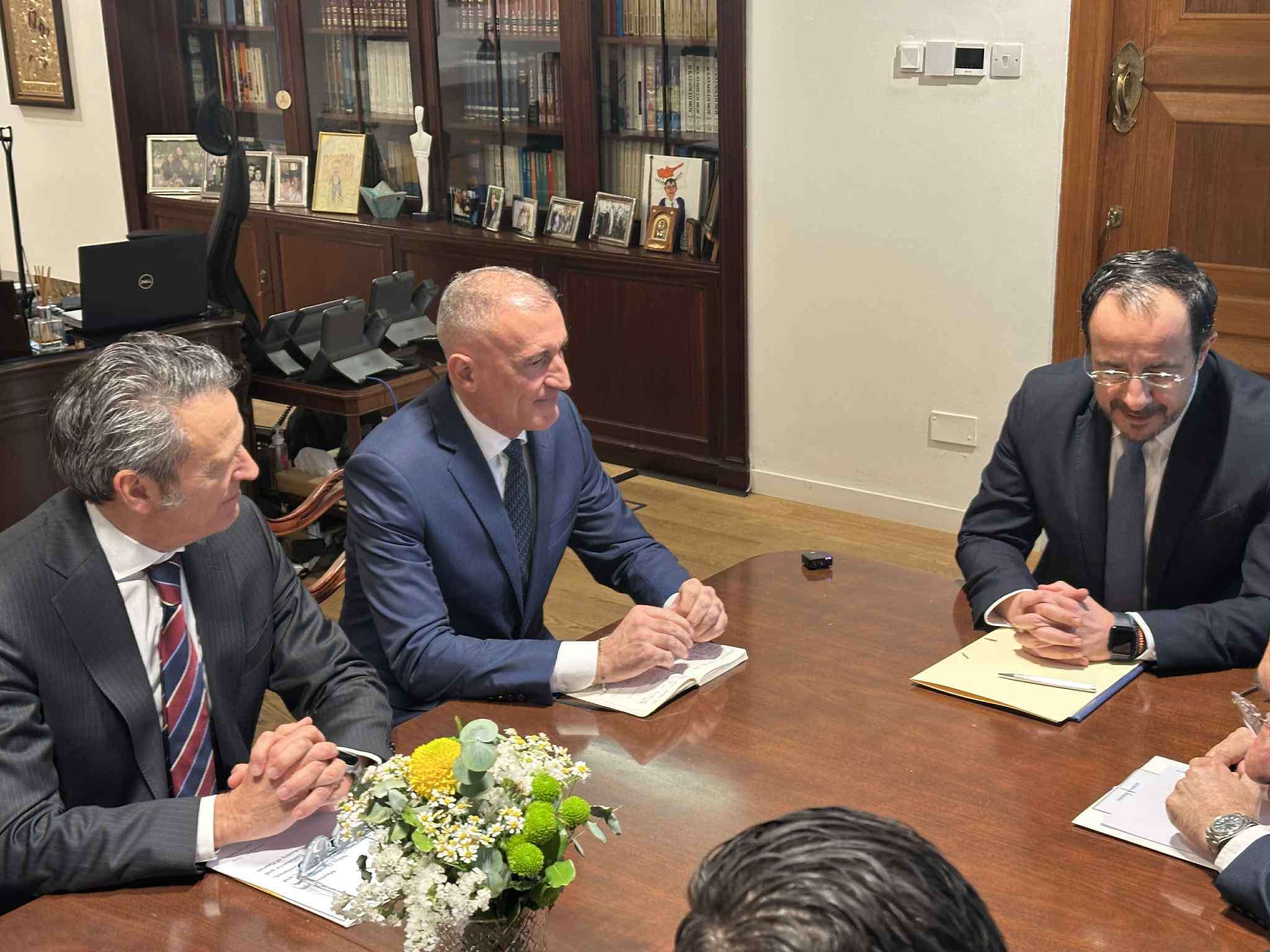
The Kronos gas field in Block 6 of Cyprus’ Exclusive Economic Zone (EEZ) is “in the final stage of development” ahead of a potential final investment decision, President Nikos Christodoulides said on Thursday during a meeting with Eni’s chief operating officer of global natural resources, Guido Brusco.
“It is very important that we are in the final stage of development of Kronos. It is very important for us, for you, for Egypt, for Europe, so I look forward to our discussion to finalise as soon as possible,” he said. After a final investment decision is made, the way will be cleared for gas to begin to be extracted from under the seafloor.
He added that Egyptian President Abdel Fattah al-Sisi had invited him to take part in the Egypt Energy Show in Cairo between March 30 and April 1, and that he had invited European Commission president Ursula von der Leyen to join him.
With this in mind, he said that “we have to complete” work on the Kronos field by March 30, and that the Cypriot side is “ready”.
“We also discussed it with the Egyptian petroleum minister [Karim Badawi]. For us, it will be the first development from plots in our EEZ. It is very important for the country, for our economy, for our people,” he said.
To this end, he said it is “important that there is a will to complete the project and to send the first Cypriot natural gas to Europe”.
Brusco, meanwhile, said Eni is “in the final stage for making an investment decision for Kronos”, and that he had been “in collaboration” with both Christodoulides and Energy Minister Michael Damianos to set “a clear timetable … with the aim of completing the process as soon as possible”.
He added that Eni is “known for its rapid implementation of projects”, but that “it takes two to tango”, and that “some documents still need to be finalised” before the final investment decision is made.
“We are in the very last stage. There are a few things left, which we believe will be closed very soon,” he said.
Asked whether it could still be possible for Cypriot natural gas to be exported as early as next year, he said that “this is a possible time point, of course, as long as we complete our obligations”.
He also said that he had earlier in the day held “very productive discussions” with Energy Minister Michael Damianos and said his company has made an “enormous commitment” to Cyprus.
On this front, Damianos said the Egyptian government now intends to waive a clause of its own domestic law regarding the Kronos field, which states that 20 per cent of gas produced must be channelled into its own domestic market.
If this clause is waived, Eni and its consortium partner French multinational corporation Total will be able to export more of the gas to more profitable European markets, thus making the investment more attractive to them.
“There is this intention, it does not mean that it is a decision,” he said.
Brusco had earlier said that the consortium which holds the rights to Block 6, which comprises Eni and Total, has invested US$1.2 billion in Cyprus.
“The agreement with Cyprus, Egypt, Eni, and Total paves the way for the completion of the project,” he said.
That agreement was part of a series of deals signed by the governments of Cyprus and Egypt last year, and saw the Egyptian government designated as the “host government” for Block 6.
Given the proximity of the Kronos field and Block 6 to Egypt’s Zohr gas field, which Eni also operates, Eni will be able to use its own infrastructure to take the Cypriot natural gas to the Segas liquefied natural gas (LNG) terminal in the Egyptian port city of Damietta.
On this matter, Badawi had said in September last year that his country plans to “accelerate the process to make it possible to transport Cypriot natural gas” to Egypt to be liquefied, and that he expects the gas to “be ready in 2027 for delivery to Europe”.
“We are all collectively committed to delivering the first Cypriot gas through Egypt’s terminals to Europe by 2027. We are all working together, with unity and cooperation, to achieve this,” he said.
He added that the Egyptian government considers the matter to be of “strategic importance” and said the process of extraction of natural gas off the coast of Cyprus, liquefaction in Egypt, and subsequent export to Europe will “make Cyprus a major exporter of natural gas to Europe”.
Seabed surveys to find a sinking point for the pipeline which will take natural gas from Cyprus’ EEZ to Egypt for liquefaction began in June last year, with the initial aim being for natural gas from the Aphrodite gas field to be taken to Damietta.
That came after the governments of Cyprus and Egypt, as well as American multinational corporation Chevron, Israeli energy company NewMed Energy, and the BG Group, which is owned by Royal Dutch Shell, signed an agreement which, according to the Cypriot government, established “the framework for the effective commercialisation” of the gas in the field.



Click here to change your cookie preferences