
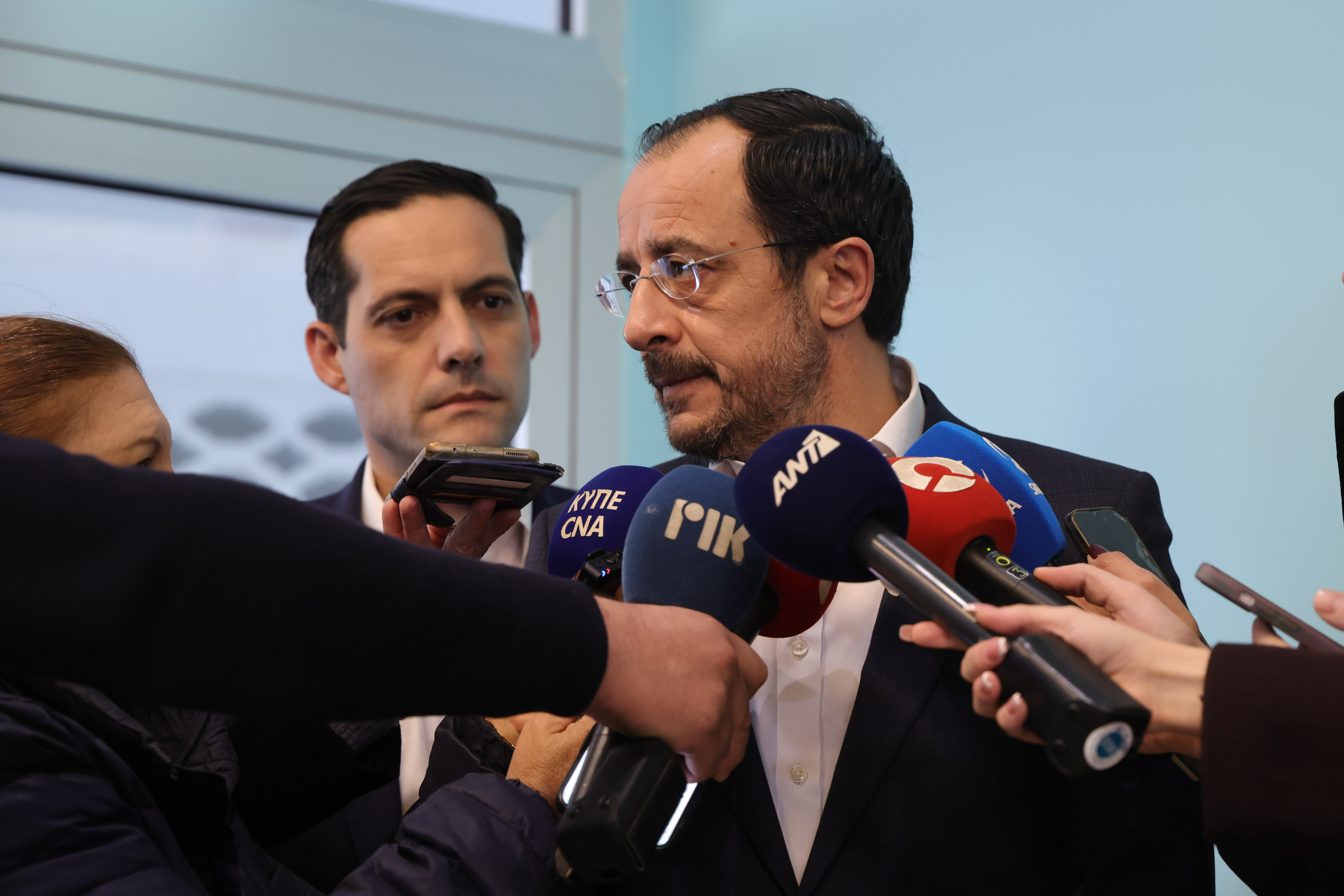
As the government grapples with the fallout from ‘Videogate’ – a clip purportedly showing how in 2023 President Nikos Christodoulides and associates accepted cash from donors to bypass election campaign spending caps– a parallel debate rages on as to who was behind the release and why.
Having vetted the eight-minute-long video, IT experts have ruled out AI manipulation.
An organisation called ‘Fact Check Cyprus’ – which has a page on Facebook – put the clip through an AI test, finding no AI-generated content.
‘Fact Check Cyprus’, with links to the University of Technology, is dedicated to tracking and debunking fake news and hoaxes online.
Dinos Pastos, a cybersecurity and digital forensics expert, told the Cyprus Mail the account posting the explosive video appears to show bot activity.
The fact that the video has appeared nowhere else on the Internet, is another red flag, he said.
Called ‘EmilyTanalyst’, the account is nevertheless a verified account on X – it has the blue check mark. A thumbnail with the colours of the flag of Ukraine appears next to the profile name.
The account itself was first created in 2022, and as of Thursday afternoon, just prior to the video’s release, it had fewer than 400 followers.
We asked Pastos if the content creators can be tracked down.
“Very tricky,” he replied.
The metadata – such as the author’s name, the device type – is removed from videos by X itself before being posted. Plus, an experienced operator would be able to hide the metadata before uploading to the platform.
“Only X has the original video file with the metadata and identifiers. Whether they share it with the Cyprus police, or whether the police have asked for the metadata, I don’t know.”
The police meantime gave out scant detail other than to confirm that they are ‘investigating’.
A police spokesman said only they had received a complaint on the day of the video’s release (Thursday).
The complaint was filed by former minister Giorgos Lakkotrypis, featured prominently in the clip, seemingly being secretly filmed as he nonchalantly speaks about cash donations to the presidential palace via the president’s chief of staff.
Lakkotrypis had yet to give a formal deposition to police, the spokesman added.
But how did a video from an account with low activity get noticed, and how did it spread so fast after its release, coming to dominate the news cycle?
Pastos explained that the post about the video had the keyword ‘Cyprus’ in it. The algorithm picks that up and shares the video among the account’s followers who have an interest in Cyprus-related news.
“It’s how the video got traction, coming to the attention of journalists in Cyprus. From what I hear, one Cyprus-based journalist spotted it within minutes of it being posted, and alerted Lakkotrypis.
A day before the video’s release, the same X account had another post about Cyprus – though it was a positive one.
That post pointed out how Cyprus’ presidency of the European Council presents a good opportunity to find common ground with Turkish Cypriot leader Tufan Erhurman.
This is the first marker of possible ‘Turkish’ involvement, Pastos suggested.
Another clue – which he personally spotted – is the occasional use of ‘ı’ instead of ‘i’.
The ‘ı’ character – without the dot – is typically used on Turkish keyboards.
It appears in the text of the video, such as in the words ‘campaign’, ‘finance’ and ‘via’ – written as ‘campaıgn’, ‘fınance’ and ‘vıa’.
Pastos also noticed the ‘ş’ character – with the characteristic Turkish cedilla under the letter.
The ‘ş’ character pops up in the word ‘Charalambous’.
However, the expert cautions, these Turkish-language characters may have been placed there deliberately for misdirection, rather than by accident or sloppiness.
“Whatever the case, language always leaves a trace,” he remarked.
As to the hypothesis that ‘Russians’ may be involved, it’s unlikely – though again, can’t be ruled out.
The video claims that Christodoulides received cash donations from Russian billionaires Mikhail Fridman and Petr Aven.
Fridman and Aven, co-founders of investment firm LetterOne, were sanctioned by the EU and UK in March 2022 following Russia’s invasion of Ukraine, leading them to resign from the company and freeze their shares.
The company LetterOne itself is not sanctioned.
Fridman and Aven have a connection to the Cyprus-based pharmaceutical company Remedica through investments made by LetterOne’s healthcare unit.
In the clip, Lakkotrypis apparently explains how Fridman and Aven were able to donate to Christodoulides’ campaign via Remedica.
Lakkotrypis tells his off-camera interlocutor: “The pharma company, between you and I, had a bigger issue. The main work I do with them is that their holding company, LetterOne, has two sanctioned individuals. They had Fridman and Aven as two of their shareholders.”
He goes on: “So Fridman and Aven are sanctioned, but they found a way…” and then the audio drops off.
Some observers have pointed out that if ‘the Russians’ were trying to throw dirt at Christodoulides through this video, they wouldn’t draw attention to Russian oligarchs seeking access to the president – it would be counterintuitive, an own goal.
But others do hypothesize a possible ‘Russian’ hand in the video’s release.
They also point to the timing – just a day after Ukrainian president Volodymyr Zelenskiy attended the opening ceremony for Cyprus’ presidency of the EU Council.
Andreas Mavroyiannis, who ran against Christodoulides in the 2023 elections, suggested the affair may be tied to the reaction of Russian actors who allegedly financed Christodoulides with significant amounts and now feel ‘betrayed’.
“The timing is not coincidental,” he said.
Mavroyiannis acknowledged that “there are certainly ulterior motives,” but added he has reasons to believe that “in essence, large-scale illegal funding in exchange for favours did take place.”
Those espousing the ‘Russian payback’ theory recall, for example, how in May 2022 European Commission Vice President Margaritis Schinas warned about the possibility of Russian interference in the 2023 presidential elections.
Schinas made the remarks at a New Democracy Party congress in Athens.
Others remember how on the eve of the 2023 elections, rumours circulated that the Financial Times planned to publish a story alleging that some €10 million in ‘Russian money’ got funneled into Christodoulides’ election campaign coffers.
The newspaper never ran the story, allegedly pulling it at the last moment.
As for the controversial video, the conjecture will rumble on. The clip certainly looks heavily edited and spliced, which for now gives the government and its defenders an ‘out’ – namely that the comments are taken out of context and are thus highly misleading.
On the other hand, neither Lakkotrypis nor Cyfield boss Giorgos Chrysochos – also appearing in the clip – have denied saying these things.



Click here to change your cookie preferences