
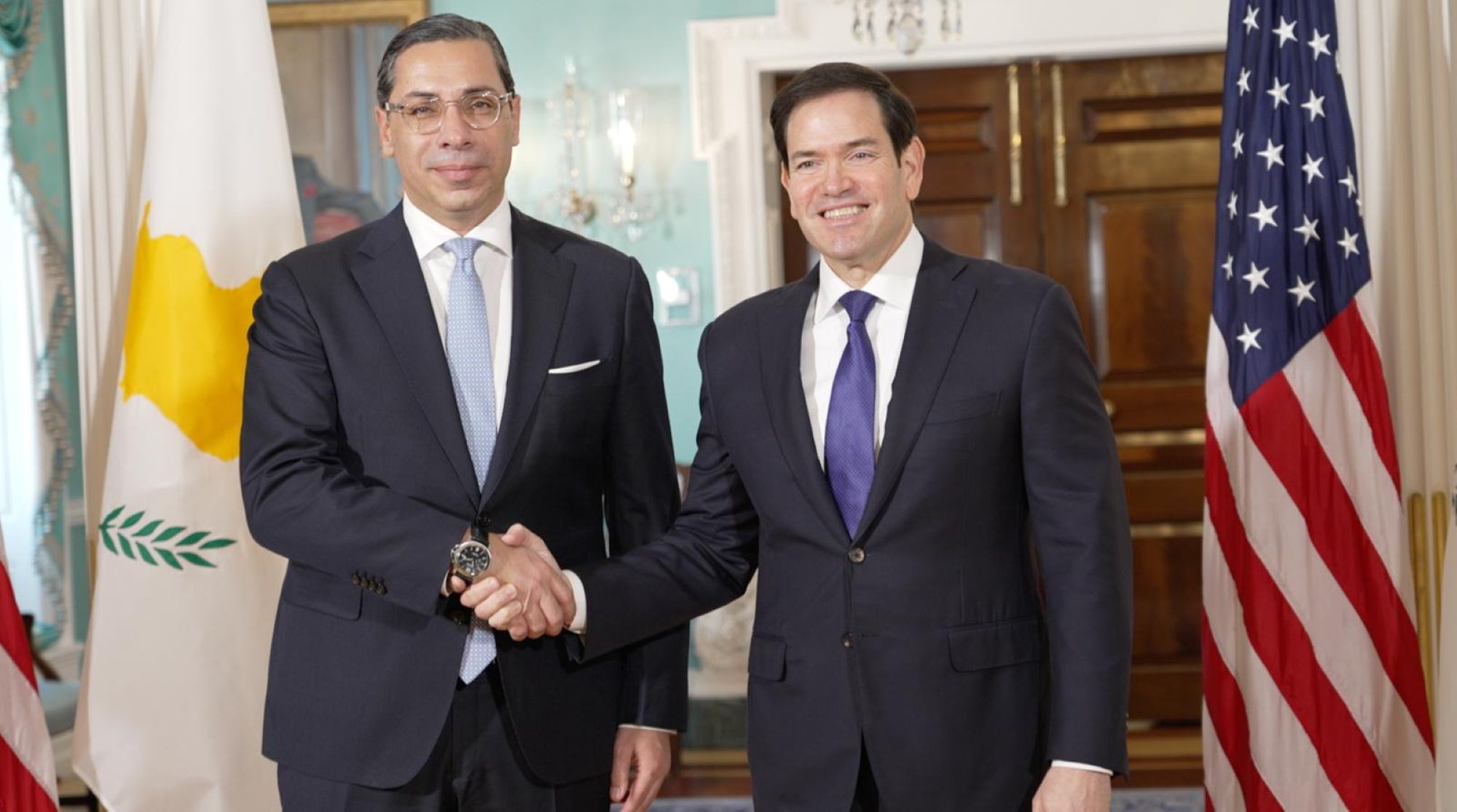
Foreign Minister Constantinos Kombos and United States Secretary of State Marco Rubio on Sunday held a telephone conversation which centred on the matter of Venezuela, as well as other recent global developments.
According to the US’ state department’s deputy spokesman Tommy Pigott, the pair “discussed the United States’ counternarcotics operations in the Caribbean” – the official reasoning given by US government for its overthrow and capture of Venezuelan President Nicolas Maduro and his wife Cilia Flores.
Pigott said the pair had also discussed the ongoing protests in Iran, as well as “shared priorities during the Republic of Cyprus’ Council of the European Union presidency”, which the island holds between January and June.
Cyprus’ foreign ministry, meanwhile, described the discussion as a “forward-looking exchange” and said the pair had discussed the island’s undertaking of the Council of the EU’s rotating presidency, as well as “transatlantic relations” and the “strategic partnership” between Cyprus and the US.
It said the pair also spoken on the matter of “regional developments” in both Syria and Iran, with the Cypriot government last week having reiterated its travel advisory against all travel to Iran in light of the protests.
Additionally, it said they had discussed “efforts for lasting peace in Ukraine” and developments in Venezuela.
Maduro remains in New York, having been flown to the city following his capture in Venezuela, and now faces criminal charges in the US related to drug trafficking.
Meanwhile, US President Donald Trump on Sunday threatened to block energy giant ExxonMobil from accessing Venezuela’s oil reserves after the company’s chief executive officer Darren Woods described the country as “uninvestable” during a meeting at the White House last week.
The US’ actions did garner negative grassroots reaction in Cyprus, though Kombos himself remained measured on the day of Maduro’s capture, calling for “de-escalation, restraint and a resolution that respects international law” at the time.
“We are closely monitoring the developments in Venezuela, in coordination with the EU and other partners. I remain in close contact with the EU high representative for foreign policy Kaja Kallas,” he said.
He added that Cyprus’ “longstanding travel advice to avoid all travel to Venezuela” remains in force.
Earlier, Kallas had stated that the EU is “closely monitoring the situation in Venezuela”, and that she had spoken to about the matter shortly after Maduro’s capture.
“The EU has repeatedly stated that Mr Maduro lacks legitimacy and has defended a peaceful transition. Under all circumstances, the principles of international law and the UN charter must be respected. We call for restraint. The safety of EU citizens in the country is our top priority,” she said.
A protest was then staged outside the US embassy in Nicosia on Monday, with Akel leader Stefanos Stefanou saying that there can be “no excuse” for the US’ actions in Venezuela.
“We categorically state that no alibi and no excuse can justify any illegality. This is why we categorically reject opinions in the press that the American intervention is justified because it was carried out at the expense of a dictator or to prevent the supposed trafficking of drugs into the United States,” Stefanou said.
“It is well known that the US always tries to cover up the illegal interventions and invasions it has carried out all over the world with fabricated news. In every US invasion and intervention, an all-powerful propaganda mechanism always operates.”
Other parties, too, had been less than glowing about the US’ actions, with Volt stressing that “military force cannot be a substitute for diplomacy”.
“Volt condemns any violation of international law, regardless of the countries involved,” it said.


Click here to change your cookie preferences