
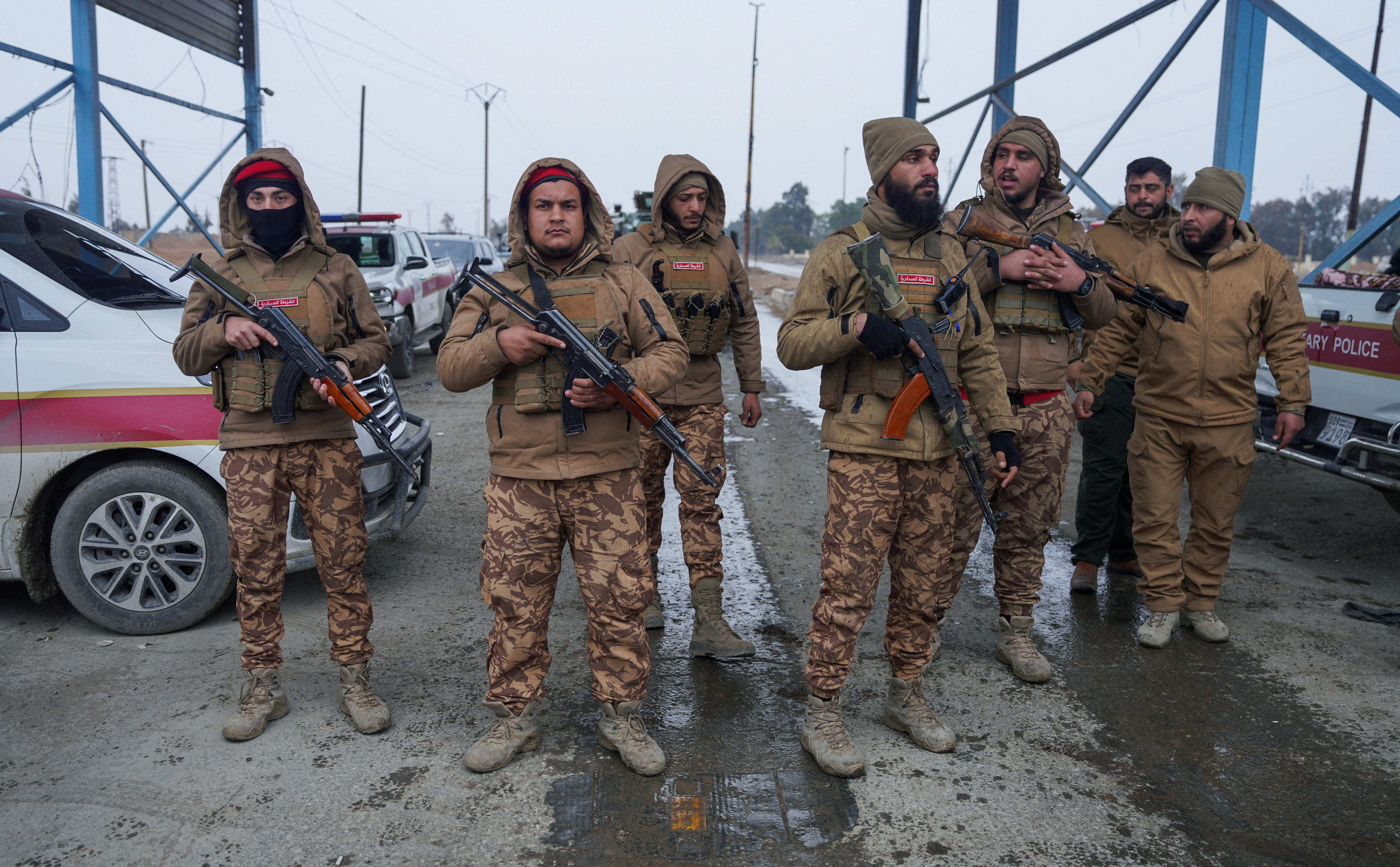
The United Nations said on Thursday it was taking management responsibility for vast camps in Syria housing tens of thousands of women and children associated with Islamic State, after the rapid collapse of Kurdish-led forces who guarded them for years.
Iraq, which has begun taking in detainees transferred from prisons in Syria as the Kurds retreat, said it would begin prosecuting them through its criminal justice system, and called on other countries to help take them in.
More than 10,000 members of Islamic State, and tens of thousands of women and children associated with them, have been held for years in about a dozen prisons and detention camps guarded by the Kurdish-led Syrian Democratic Forces (SDF) in Syria’s northeast.
The SDF has rapidly retreated this week after clashes with Syrian government forces, raising concern about security at prisons and humanitarian conditions at the camps.
The United Nations said the SDF withdrew on Tuesday from al-Hol, which along with another camp, Roj, houses 28,000 civilians, mainly women and children who fled Islamic State’s strongholds as the group’s self-proclaimed caliphate collapsed. They include Syrians, Iraqis and 8,500 nationals of other countries.
Syrian government forces had established a security perimeter around the camp and teams from the U.N. refugee agency UNHCR and the U.N. children’s agency UNICEF reached the camp on Wednesday, officials said.
“UNHCR – which has taken over camp management responsibilities – is actively coordinating with the Syrian government to urgently resume the safe delivery of life-saving humanitarian assistance,” senior U.N. aid official Edem Wosornu told the U.N. Security Council.
U.N. officials had not yet been able to enter because “the situation in the camp remains rather tense and volatile with reports of looting and burning,” U.N. Spokesperson Stephane Dujarric told reporters. He said the Syrian government had expressed a willingness to provide security and support for UNHCR and aid groups.
DETAINEES SENT TO IRAQ
The U.S. military said on Tuesday its forces had transferred 150 detainees from Syria to Iraq at the start of an operation that could eventually see up to 7,000 detainees moved out of Syria.
A U.S. official told Reuters on Tuesday that about 200 low-level IS fighters escaped from Syria’s Shaddadi prison, although Syrian government forces had recaptured many of them.
Iraq’s Deputy U.N. Ambassador Mohammed Sahib Mejid Marzooq told the U.N. Security Council on Thursday that Iraq was accepting detainees to protect regional and international security, but that other countries should be prepared to help.
“This issue should not be left to become a long-term strategic burden on Iraq alone. The insistence of some states on considering their terrorist nationals a threat to their national security and the refusal to repatriate them is unacceptable,” he said.
Islamic State emerged in Iraq and Syria, and at the height of its power from 2014-2017 held swathes of the two countries, ruling over millions of people. Its “caliphate” eventually collapsed after military campaigns by regional governments and a U.S.-led coalition.
An Iraqi military spokesperson confirmed that Iraq had received a first batch of 150 IS detainees, including Iraqis and foreigners, and said the number of future transfers would depend on security and field assessments. The spokesperson described the detainees as senior figures within the group.
RELATIVES OF SOME DETAINEES WORRIED ABOUT THEIR FATE
Iraq’s Supreme Judicial Council said Iraqi courts would take “due legal measures” against detainees once they are handed over and placed in specialised correctional facilities.
“All suspects, regardless of their nationalities or positions within the terrorist organisation, are subject exclusively to the authority of the Iraqi judiciary,” the statement said.
Iraqi officials say IS detainees will be separated, with senior figures including foreign nationals to be held at a high‑security detention facility near Baghdad airport previously used by U.S. forces.
The transfers have raised concern among some relatives of IS detainees in Europe. A European woman whose relative joined the group and was detained in Syria said her family was alarmed by reports that prisoners were being moved to Iraq, noting that Iraq has the death penalty.
Speaking on condition of anonymity, she said the family initially hoped changes in control in Syria might bring information on her relative’s fate.
“At least we thought we might finally learn where he is, whether he is alive or sick,” she said. “But when we saw that the prisoners were being taken to Iraq, that frightened us.”
Two Iraqi legal sources said the IS detainees sent from Syria include a mix of nationalities, with Iraqis making up the largest group, alongside Arab fighters from other countries and nationals of Britain, Belgium, France, Germany and Sweden.


Click here to change your cookie preferences