
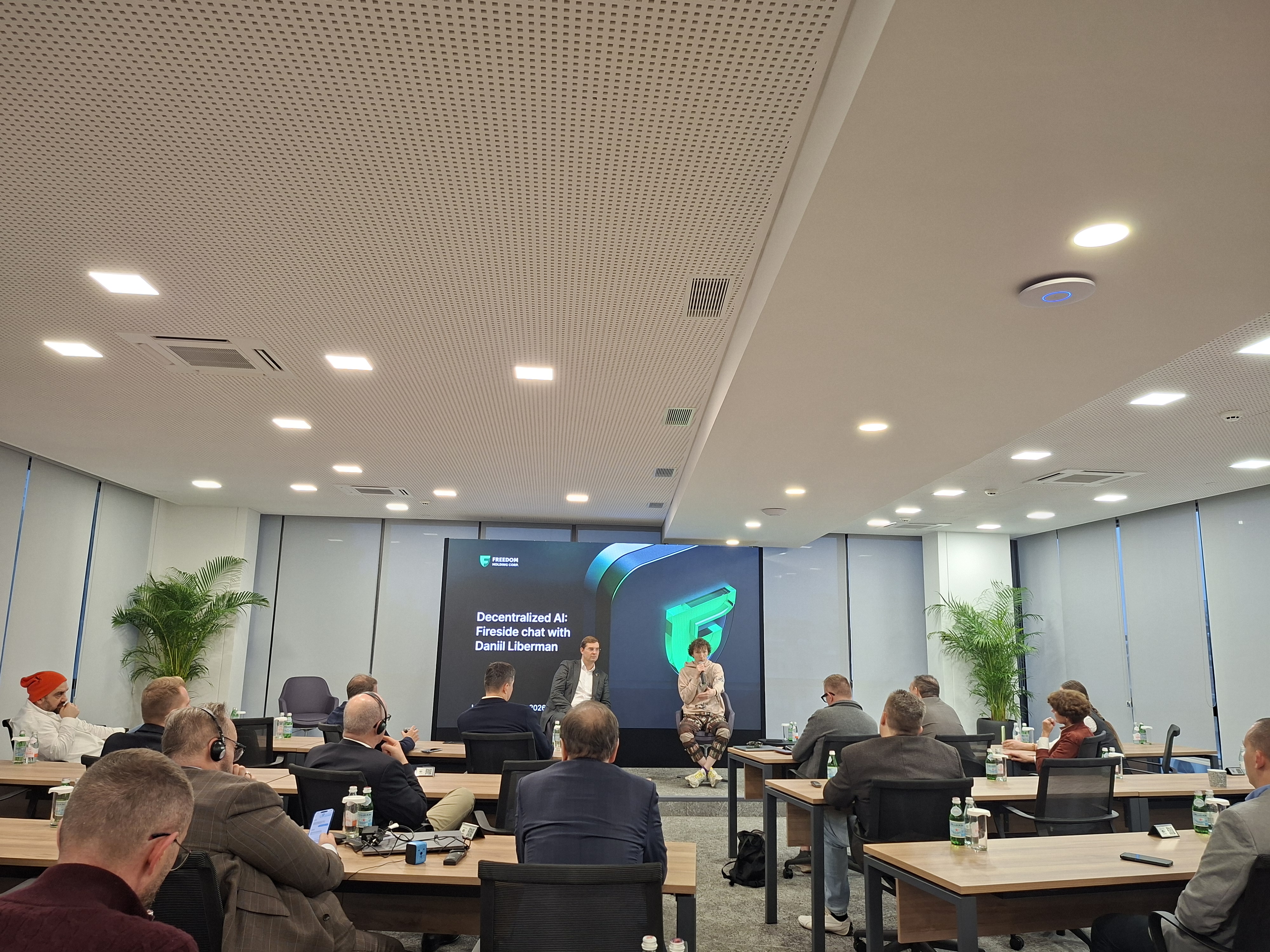
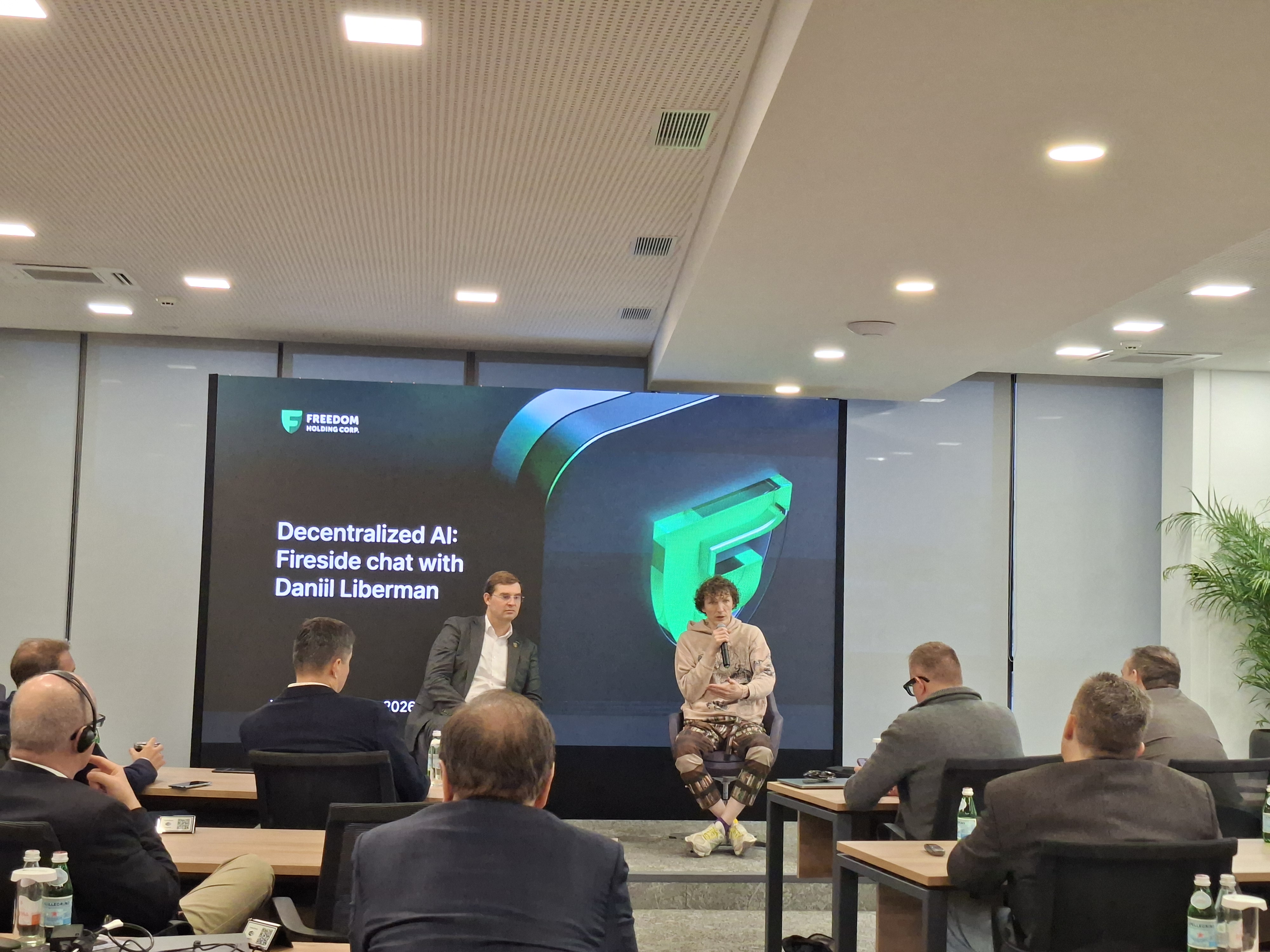
Freedom24 this week hosted a fireside chat at their Limassol offices featuring Daniil Liberman alongside Freedom Holding CEO Timur Turlov, bringing global debates around artificial intelligence, computing power and decentralisation directly to the island.
The event placed Cyprus at the centre of a conversation that has become increasingly influential worldwide, as governments, technology firms and investors grapple with who controls the infrastructure that powers modern AI.
Freedom24’s decision to host the discussion locally underscored its ambition to position Cyprus within global technology and innovation debates.
Liberman drew on a personal background rooted in science and technology, referring to growing up in a family environment shaped by research, early computing and scientific inquiry.
He reflected on early projects that combined advanced computing concepts with biology and genetics, describing formative experiences that shaped his long-term interest in complex systems.
Liberman spoke about involvement in media and technology initiatives in Russia during the Medvedev presidency, explaining that some of these projects were later shut down under tighter political controls.
He described relocating to the United States, where his work expanded into the entertainment industry, including projects in Hollywood that merged software development with film production.
He said software developed by his team could turn a screenplay into a finished digital product within a week, he said.
Liberman mentioned collaborations and interactions with well-known figures and creative teams, including references to Robert Downey Jr and creators associated with The Simpsons, while avoiding specifics that could misrepresent those relationships.
He explained that his career later took him to Silicon Valley, where he became involved in founding and scaling multiple technology businesses.
One of those companies was later absorbed by Snapchat, highlighting his experience operating at the intersection of startups and major technology platforms.
Liberman also referenced work with companies in Eastern Europe, including Ukraine, while keeping the focus on broader regional innovation rather than individual commercial claims.
He described a gradual shift from software and platforms toward large language models and artificial intelligence infrastructure, he said.
A central theme of the discussion was the growing dominance of Nvidia in AI computing, with Liberman stating that around 90 per cent of advanced AI chips are currently purchased by American companies, he said.
He framed access to computing power as a geopolitical issue, noting that US and Chinese firms increasingly dominate the global AI landscape.
Liberman referred to public statements by US politicians, including JD Vance, as evidence of rising political pressure on Europe to clarify its stance on AI development and regulation.
He discussed Chinese AI projects such as DeepSeek, cautioning that headline figures about low development costs may not reflect the full scale of underlying investment.
He said claims of ultra-low budgets often overlook years of spending, equipment purchases and repeated technical attempts, he said.
The discussion moved to the structure of the global cloud computing market, which Liberman described as increasingly concentrated among a small number of dominant providers.
He compared this concentration to earlier phases of operating system development, drawing parallels with open-source models such as Linux.
Liberman criticised certain applications of decentralised finance, particularly Bitcoin mining, arguing that huge amounts of electricity are consumed for what he described as mathematically meaningless calculations, he said.
However, he contextualised this by comparing Bitcoin’s energy use to that of a city with roughly one million people, while acknowledging major improvements in computational efficiency over time.
The conversation culminated in a discussion of Liberman’s current venture, Gonka, which focuses on decentralised AI computing infrastructure.
Liberman is co-founder of Gonka alongside his brother David, following earlier work at Product Science in the United States.
Gonka aims to create a community-governed network where participants contribute and exchange computing power, seeking to reduce dependence on large cloud providers.
According to Forbes article published in 2025, the Libermans have argued that AI compute has become the real bottleneck in innovation, with Nvidia controlling roughly 94 per cent of the global GPU market.
They described decentralised compute as a potential path toward making AI more affordable and accessible, they said.
The Forbes report also highlighted that Gonka was designed to avoid governance mechanisms that could concentrate power, such as delegation, in an effort to prevent recentralisation.
Liberman’s appearance in Cyprus brought these global debates into a local setting, offering rare direct access to perspectives typically discussed at major technology hubs.
For Freedom24, hosting the fireside chat reinforced its role as a bridge between Cyprus and global technology discourse, positioning the island as a place where emerging financial and technological ideas can be openly debated.
The event highlighted how questions around AI, compute access and digital sovereignty are no longer abstract topics but issues shaping economies, regulation and investment decisions worldwide.





Click here to change your cookie preferences