
Focus on foreign policy, strengthening of armed forces and a robust economy
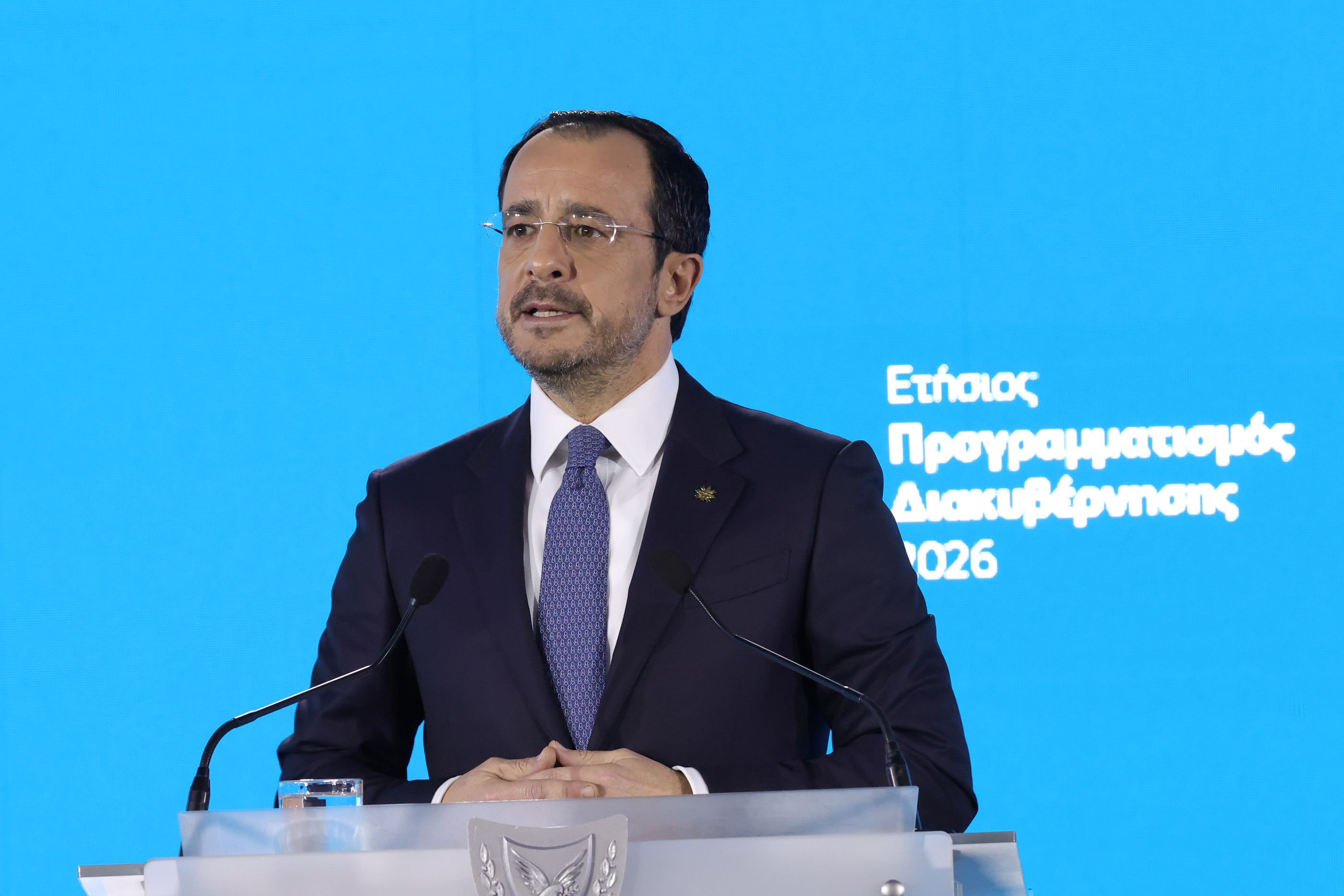
The government envisions making Cyprus resilient and robust both domestically and overseas, President Nikos Christodoulides said Thursday in his annual ‘state of the union’ address.
In the speech, broadcast on television and online, Christodoulides took stock of the three years of his administration, and outlined 55 planned actions for 2026.
Christodoulides assumed office on February 28, 2023.
“Since the first day of assuming office, we have been moving with clear goals,” he stated in his opening gambit.
“We have set ourselves difficult and ambitious goals in order to solve long-standing problems and change mindsets – making your daily lives better, creating hope and prospects for everyone, while at the same time laying the groundwork for a modern Cyprus that we all deserve.”
The president summarised the ‘pillars’ of his administration: an outward looking foreign policy with a clear European-Western orientation, along with the strengthening of the armed forces; a robust and resilient economy; the ongoing modernisation of the state; enhancing transparency, accountability and cracking down on corruption; and policies to bring prosperity and improve people’s day-to-day lives.
In the coming year, Christodoulides said, emphasis would be placed on boosting ties with “countries of special interest” – such as India and Central Asia nations.
He made special mention of the “historic visit” to Cyprus of Indian Prime Minister, Narendra Modi, noting that he would be reciprocating with a visit to India in May.
Expanding foreign relations is ultimately aimed at “our number priority – liberation, the ending of the [Turkish] occupation and the reunification of our country”.
The president stated he is “fully ready” to resume Cyprus negotiations from where they left off at Crans-Montana in 2017.
On security, efforts to beef up the military’s deterrence would continue. This year, in collaboration with the EU and the United States, the government will invite bids for upgrades to the Evangelos Florakis naval base and for modernising the Andreas Papandreou airbase in Paphos.
2026 would also see efforts continue for Cyprus’ full accession to the Schengen area.
In terms of energy security, the government anticipates signing an agreement with Israel regarding the development of the Aphrodite gas field.
In his speech, Christodoulides announced the coming creation of a ‘Supply Chain’ that would function in tandem with airports and harbours. Fuel supply and storage facilities would be built at the Larnaca and Paphos airports, making the island a “regional transit hub”.
“It is an initiative that will render our country a strategic partner in the India-Middle East Economic Corridor and augment our status as a European point of entry for the Asian and African markets.”
On the domestic front, the president said, the objective is to forge a robust economy, modernise the state and tackle challenges such as irregular migration – all actions geared at “enhancing the sense of security for the public”.
He added: “We are faithfully implementing our governance programme, our social contract with all of you, changing Cyprus through a clear ideological framework: social liberalism, a people-centred approach that combines progress with social solidarity…”
On irregular migration, the president contended that Cyprus is “no longer an attractive destination”.
Arrivals have declined by 85 per cent, while returns of irregular migrants went up by 77 per cent.
Regarding dealing with the water shortage, Christodoulides said that over the past two years the government has invested more than €200 million. This year three more mobile desalination units would be installed, generating an additional 50,000 cubic metres of water a day.
On crime, the president announced the coming establishment of an organised crime division. And within the month, parliament is expected to pass a law for body cameras for police officers.
Switching to the economy, Christodoulides highlighted the upgrades of Cyprus’ sovereign debt by international credit rating agencies. Meanwhile by the end of the year public debt is forecast to drop to 50.9 per cent of GDP, one of the lowest ratios in the EU, while growth will reach four per cent.
One of the actions planned for this year is the operation of the first ‘AI Factory’ providing access to supercomputing facilities. Cyprus is also working on developing its own supercomputer in cooperation with an American tech company.
On healthcare, this year the government will spend €145 million on upgrading state hospitals across all districts. This includes expansions and renovations to Accident & Emergency units, and the establishment of a new neurological clinic in Nicosia. In addition, construction work would begin on a new hospital in Polis.
The president also announced the creation of a Food Safety Board.
Major road infrastructure works would include the construction of a highway from linking Evrychou to Astromeritis, and another linking Nicosia to Palekhori.
Click here to change your cookie preferences