
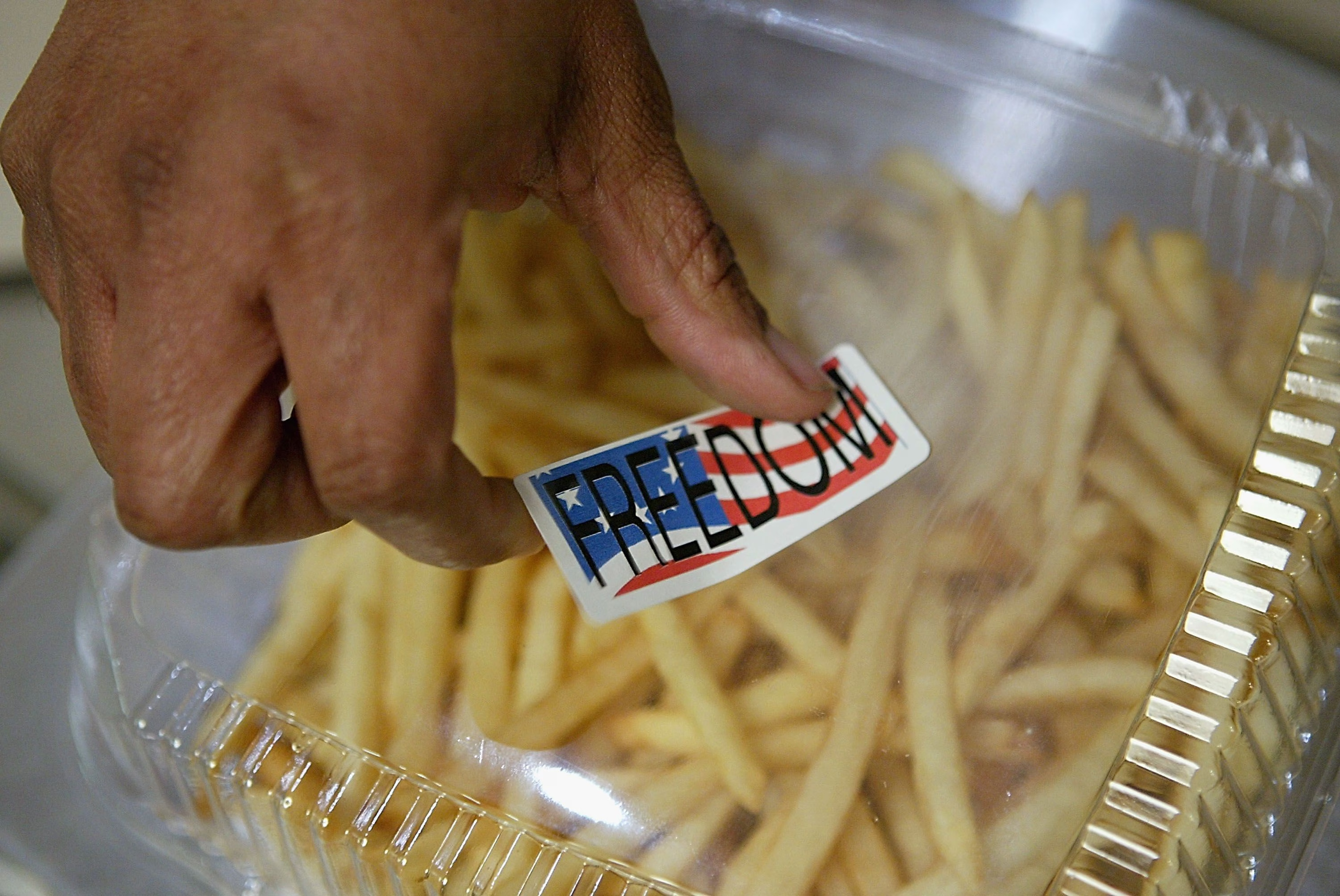
As American as it gets, or at least as American as it briefly tried to get, freedom fries were what happened when a pile of deep-fried potatoes wandered into international politics.
Most people know chips, or in American vernacular French fries, as something greasy, comforting and simple. They are about as politically neutral as food usually gets, yet in the early 2000s, they became nothing short of a deep-fried political statement.
It all started in February 2003, in Beaufort, North Carolina, at a restaurant called Cubbie’s. Its owner, Neal Rowland, decided to rename French fries as freedom fries.
He was inspired by similar linguistic gymnastics during the First World War, when sauerkraut became liberty cabbage and frankfurters turned into hot dogs. History, it seems, has a habit of asking food to carry emotional baggage.
The context was the tense atmosphere after the September 11 attacks and President George W Bush’s declaration of a “war on terror”, and a proposal to invade Iraq based on false claims about weapons of mass destruction.
During UN Security Council deliberations, French Foreign Minister Dominique de Villepin made it clear that France would block any resolution mandating the invasion, and although Russia and China also opposed the war, France was cast as the main obstacle, reviving old anti French sentiment in the US.
Rowland was not subtle about his feelings. In an interview he said that since the French were “backing down” from the war, French fries and French everything needed to be banned.
What began as a local protest soon reached Capitol Hill. On March 11, Republican Representatives Bob Ney and Walter B Jones ordered House cafeterias to swap French fries, toast and bread for their “freedom” equivalents. Ney described this as a small but symbolic rebuke of France’s refusal to stand with its US allies. The change even followed American forces into dining halls in Iraq.
Meanwhile, the French response was calm and faintly amused. Embassy spokeswoman Nathalie Loiseau called it a non-issue and reminded everyone that fries originated in Belgium anyway.
Public reaction was mixed but largely sceptical. A Gallup poll in 2005 found that 66 per cent thought the renaming was silly, while 33 per cent saw it as patriotic. Only 15 per cent actually used the term freedom fries, and 80 per cent stuck with French fries.
Some restaurants adopted the new name, others mocked it. The Saturn Cafe in Santa Cruz for example renamed its offering “Impeach George W Bush fries”, while the makers of French mustard hurried to clarify that their name came from a family, not a nation.
On August 2, 2006, the House menus quietly slipped back to calling them French fries, with new committee chairman, Vern Ehlers, brushing it off by saying it was no big deal.
But perhaps the neatest full stop came from Walter B. Jones, one of the men who helped launch the idea in the first place, who later admitted that he wished it had never happened.


Click here to change your cookie preferences