
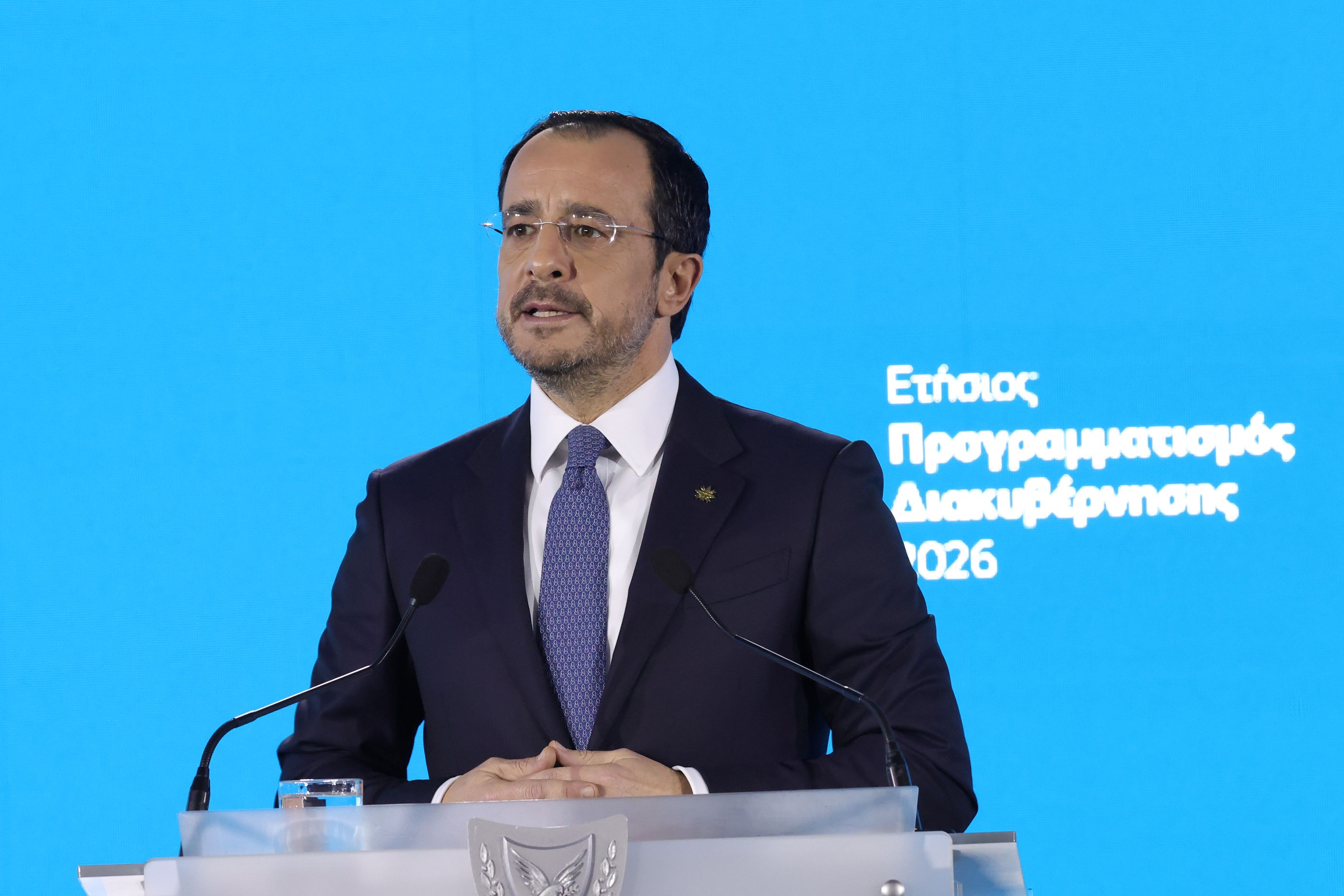
The first of President Nikos Christodoulides’ five priorities in 2026, according to Thursday’s televised address was “outward-looking foreign policy, strong defence and security”. Presumably, these are under the same heading because a strong defence, theoretically, increases influences in foreign affairs.
Great emphasis was placed on foreign policy, as the president’s unrelenting efforts to present Cyprus as a country with some relevance in world affairs has had some traction with a section of the electorate. Gimmicks, like the submission of proposals for the Gaza peace plan, appear to have been taken seriously by voters as have the oft-repeated, dubious claim that the Republic is a pillar of regional stability and security.
“The international standing of the Cyprus Republic is being upgraded thanks to our multi-dimensional foreign policy with a clear Western-European orientation without any prevarication,” the president said on Thursday. In 2026 the government would carry on investing in “the outward-looking foreign policy of the Republic and making the most of the institutional opportunity of the presidency of the Council of the European Union, boosting our footprint in Brussels and further deepening our relations with countries of the region.”
He also persisted with the narrative that having the presidency of the EU council would allow Cyprus to shape the future of the union. It was “a presidency, which apart from the handling of critical issues for the future of the union, aims to strengthen its strategic autonomy – a Europe that is truly autonomous, open to the world.” He did not explain how Cyprus, the third smallest country of the EU and one of the least influential, will strengthen the strategic autonomy of Europe in the next five months.
This constant talking up of the country’s power, which is sold as the big achievement of the Christodoulides presidency, also featured in the opinion poll carried out by the state broadcaster. The findings of the poll were presented on Thursday to coincide with president’s ‘state of the union’ address. Under the title ‘International strength of the country’ we were informed that now 26 per cent of respondents said it had become stronger, compared to only 10 per cent in May 2024. The number of people who believed there was no change fell from 61 per cent in 2024 to 43 per cent today.
There are many ‘actions’ planned for 2026 to boost our power: “tightening of relations with states of central Asia and India, signing of agreement with Israel for development of the Aphrodite gas field, invitation of tenders for the upgrade of the Evangelos Florakis naval base, modernisation of the Andreas Papandreou air base, utilisation of the Safe programme, utilisation of American arms programmes, upgrade of training of human resources of national guard…”
This lack of perspective, worn as a badge of honour by the president, and the constant overplaying of the country’s influence in the world, we hope is intended for domestic consumption – a crude way of cultivating national pride and diverting attention away from the daily problems people are facing.
If this is just part of the government’s communication strategy, aimed at portraying the government in a positive light and winning public support, it is legitimate. There is however a danger that the president actually believes that he has made our tiny country more powerful and sets unrealistic targets that could backfire. Such a lack of perspective and unjustified overestimation of the country’s strength was the most catastrophic error committed by the politically naïve Archbishop Makarios, who was so deluded he actually believed he could play power games and win. We are still suffering the consequences.
None of his successors committed this mistake, having full awareness of Cyprus’ size and strength. We hope that President Christodoulides will not break with this tradition, despite the rhetoric.

Click here to change your cookie preferences