
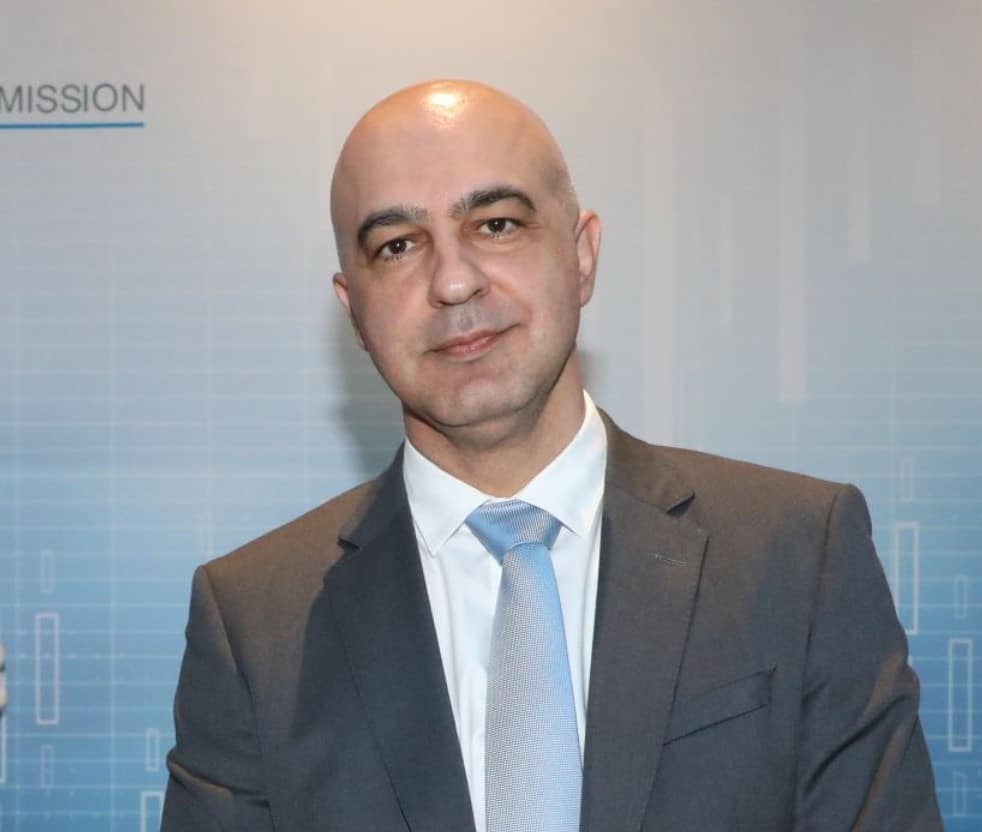
Cyprus will assume the EU Council Presidency “at a defining moment for Europe”, Cyprus Securities and Exchange Commission (CySEC) chairman George Theocharides said in Brussels, arguing that deeper capital markets are central to Europe’s strategic autonomy and long-term competitiveness.
Speaking at the Bloomberg EU Policy Series event, held in the context of the upcoming presidency, he said the motto “An autonomous Union, open to the world” reflects current geopolitical and technological pressures, adding that Europe “must be competitive enough to lead, autonomous enough to protect its interests and innovative enough to shape the future”.
He described the financial sector as the “engine” of that transformation.
Turning to policy priorities, he referred to the Savings and Investment Union and the Commission’s market integration and supervision package, pointing to a structural weakness dating back to the first Capital Markets Union debate in 2014-2015, the persistent fragmentation of European capital markets.
He explained that legal, supervisory and operational barriers, and sometimes cultural ones, still complicate cross-border investment across the bloc, raising the cost of capital, limiting innovative firms and pushing businesses to seek financing outside the EU. At the same time, savers face limited options and uneven protection depending on where they live.
Against that backdrop, he said the Commission’s proposals aim to create a more efficient, competitive and resilient financial ecosystem.
On strategic autonomy, he noted that capital-market depth is essential, as a deeper and more liquid European market reduces dependence on external funding sources and bank lending, strengthening financial sovereignty without isolating Europe internationally.
He also referred to Europe’s private savings, estimated at €14 trillion, describing them as the Union’s largest untapped resource.
A significant share remains in low-yield deposits which, under inflation and demographic pressure, does not provide a sustainable model for wealth creation or pensions.
The Savings and Investment Union, combined with pension, insolvency and market-access reforms, would allow part of these funds to move into productive investment and help close financing gaps linked to the green, digital and defence transitions, he added.
However, he cautioned that autonomy should not become protectionism, stressing the need for reliable equivalence regimes and predictable legislation.
Referring to Cyprus, he said the country can act as a bridge between Europe, the Middle East and Africa, supporting a regulatory framework that is strict where necessary but open where possible.
He added that implementation requires not only legislation but also supervisory convergence so rules are applied consistently across member states.
Looking ahead to the presidency, he highlighted digital finance and innovation among priority areas. Frameworks such as MiCA are designed not only to regulate new assets but to provide clarity and position the EU as a trusted innovation hub, he said.
DORA strengthens resilience against systemic cyber threats, while the anti-money-laundering package and the creation of AMLA establish a new European architecture covering, among others, crypto-asset transactions.
On sustainable finance, he called for effective implementation of SFDR and CSRD to prevent “greenwashing” without excessive complexity, particularly for SMEs.
He also referred to the retail-investment strategy, arguing private investors should participate with confidence through understandable products, meaningful disclosures and reliable enforcement.
Regulatory simplification, he added, does not mean deregulation but “smarter regulation” and proportionate supervision, alongside reduced administrative burdens for smaller firms.
He further stressed financial education and investor protection, warning about the influence of financial influencers and online fraud.
In closing, Theocharides said that “Cyprus is ready to cooperate with member states, institutions, regulators, markets and citizens to build a Europe that is more competitive, autonomous, innovative and open to the world.”




Click here to change your cookie preferences